Perjungti į spausdinamus版作品
 Skaityti daugiau







































 Dėl meno kūrinių ar reprodukcijų, kurių bet kuri pusė yra didesnė nei 105 cm (apie 41 inch), rėmas bus siunčiamas kaip išskaidytas surinkimo rinkinys. Šis metodas užtikrina saugų pristatymą ir apsaugo nuo transportavimo metu galimos žalos.


Jerome Myers: A Visionary of Urban Realism
Jerome Myers (1867-1940) stands as a pivotal figure in American art history, particularly within the Ashcan School movement. Born in Petersburg, Virginia, his life’s journey—marked by itinerant experiences shaped by his father's absences—fueled an artistic sensibility deeply attuned to the struggles and resilience of marginalized communities. This formative upbringing instilled within him a profound empathy for the everyday realities of ordinary people, a perspective that would permeate his prolific output.
Myers’s artistic trajectory began with diverse pursuits – acting and scene painting honed his skills in visual storytelling and dramatic composition—providing invaluable groundwork for his formal training at Cooper Union followed by eight years at the Art Students League under George de Forest Brush. However, it was New York City itself that truly captivated him; specifically, the Lower East Side’s vibrant immigrant neighborhoods became the crucible of his artistic vision.
The Ashcan School and Its Aesthetic
Myers's commitment to portraying urban life with unflinching honesty aligns perfectly with the ethos of the Ashcan School. Rejecting idealized landscapes and academic conventions, these artists sought to capture the gritty textures and emotional complexities of American cities—particularly during the Progressive Era. Myers’s canvases eschewed romantic embellishment in favor of direct observation and meticulous detail, prioritizing capturing the palpable atmosphere of his surroundings.
Fruit Vendor: A Portrait of Resilience
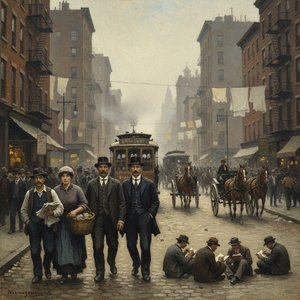
“Fruit Vendor,” painted circa 1920, exemplifies this stylistic approach. The monochrome palette—characteristic of Ashcan School artists—emphasizes form and texture, mirroring the starkness of urban life. Myers’s masterful technique utilizes broad brushstrokes to convey movement and dynamism, capturing the bustling energy of a busy marketplace.
The composition centers on a woman standing beside a fruit cart laden with apples – a deliberate choice reflecting Myers's fascination with immigrant communities and their daily struggles. Surrounding her are figures engaged in conversation and commerce, creating a tableau that speaks volumes about social interaction and economic hardship. The inclusion of a horse adds to the scene’s visual richness and reinforces its connection to the rural past juxtaposed against the burgeoning urban landscape.
Symbolism and Emotional Impact
Beyond mere depiction, “Fruit Vendor” carries symbolic weight. Myers's unwavering gaze at the human condition—particularly the dignity of labor and perseverance—resonates with humanist ideals prevalent during his time. The painting’s subdued tones evoke a sense of melancholy yet simultaneously convey hope – mirroring the spirit of resilience found within those navigating challenging circumstances.
Myers’s enduring legacy lies in his ability to transform observation into art, capturing not just what he saw but also what he felt. “Fruit Vendor,” like countless other works documenting the realities of American life, remains a testament to his artistic vision and its profound impact on the Ashcan School movement.
Klausimai ir atsakymai
Kodėl „Fruit Vendor“ autoriškos teisės statusas yra toks, koks yra?
Autorinės teisės statusas kūriniui „Fruit Vendor“ – yra viešosios erdvės dalis – jo autorinė teisė pasibaigusi – nustatomas remiantis to, kad menininkas mirė 1940 m.
Ar „Fruit Vendor“ pasižymi stipriais šviesos ir tamsos kontrastais?
„Fruit Vendor“ – Jerome Myers pasižymi Raminantis šviesių ir tamsių sričių kontrastu.
Kur rekomenduojama eksponuoti „Fruit Vendor“ Portretinė formata formatą?
Savo Portretinė formata forma „Fruit Vendor“ reprodukcija siūloma Popieriaus svetainė kambariui.
 Peržiūrėti realaus dydžio版
 Pasidalinti
 Dalintis
 Išsamiau
 Vadovas

 Atsisiųsti
 Panašūs eksponatai
 Rentgeno spindulių nuotrauka
 Automatinė diorama
 Q&A
Q&A Statistika