Peržiūrėti realaus dydžio版
 Siųsti
 Dalintis
 Išsamiau
 Vadovas

 Atsisiųsti
 Panašūs eksponatai
 Rentgeno spindulių nuotrauka
 Diaporama
 Statistika
Dead Roe
 Oil On Canvas
- WallArt
- Rococo Painting
 1721
1721 193.0 x 260.0 cm
 Wallace Collection
 Rodyti daugiau
Rankų darbo aliejinės reprodukcijos
Rankiniu būdu tapytas aliejus ant droblio jūsų pageidaujamame dydį ir rėmuose – mūsų menininkų darbas pagal užsakymą. ( Perjungti į spausdinimą Perejti prie skaitmeninių vaizdų)




P118B €10

P118H €10

P118W €10

P438Z €10

P508JH €12

P508YH €12

P805H €10

P805Z €10

P919BZ €10

P919G €10

P919XJ €10

P959ZH €10

P968JZ €12

W106C €8

W218G €10

W218JH €8

W218Y €10

W307PJ €10

W316G €10

W316PJ €8

W316Y €10

W398PJ €8

W4111J €10

W500HY €15

W500JH €15

W692G €12

W849H €8

W940BG €15

W953PJ €8




Pasirinkite iš mūsų nustatytų dydžių, atitinkančių originalaus meno kūrinio proporcijas.

Įveskite jums reikiamą plotį ir aukštį, kad paveikslas atitiktų jūsų rėmą ar sieną. Kadangi šis darbas yra rankinio darbo, siekiant išgauti kitokio formos dydį, paveikslas gali būti šiek tiek didesnis (nuo kraštų bus palikta daugiau erdvės) arba mažesnis – pasirinkite jums patogiausią variantą. Prieš pradedant tapyti, atsiųsime jums skaitmeninį maketą patvirtinimui. Šioje puslapio nuotraukoje matomas vaizdas nėra galutinis rezultatas – jį parodys tik sukurtas maketas.
Gavus užsakymą, OriginalUniqueArt.com komanda susisieks su klientu el. paštu dėl instrukcijų ir pateiks maketo pavyzdį
Pristatymas visame pasaulyje () per 3–4 savaites, o ne įprastai – per 5 savaites. (21 spalis). Kokybė lieka nepakeičiama.

Nemokamas greitasis pristatymas visame pasaulyje

Aukštos kokybės lininis drobė

Pilnas siuntimo draudimas

Muitinės mokesčių grąžinimo garantija

Tikro spalvų atitikimo garantija

100 dienų grąžinimo politika (tik esant įtaigoms)

100% pinigų grąžinimo garantija

Nuolaida dideliems užsakymams
 Stiklo variantas prieinamas tik pasirinkus dydį iki 110 cm

Dead Roe
Reprodukcijos technika
Reprodukcijos dydis
-


Visų pasirinktų variantų kaina
€ 262
Jean-Baptiste Oudry’s “Dead Roe”: A Study in Baroque Elegance and Hunterly Reflection
Jean-Baptiste Oudry's "Dead Roe," completed in 1721, is more than a simple hunting scene; it’s a meticulously crafted tableau of observation, restraint, and the poignant beauty found within mortality. Housed within the Wallace Collection in London, this oil on canvas painting offers a rare glimpse into the Rococo sensibilities of a master artist who skillfully blended naturalism with aristocratic patronage. Oudry, born in Paris in 1686, inherited an artistic lineage from his father, Jacques Oudry, a renowned painter and art dealer, establishing a foundation of observation and technical skill that would define his own career.
The composition immediately draws the eye to the central figure: a roe deer, lying prone on its side. The animal’s posture—head resting upon a weathered rock—conveys a sense of quiet resignation, almost serene in death. Oudry's rendering is remarkably detailed; one can discern the subtle textures of the fur, the delicate veins beneath the skin, and the precise curve of each bone. This commitment to realism was characteristic of Oudry’s work, particularly his depictions of animals, reflecting a deep understanding of anatomy and a keen eye for capturing their inherent grace. The muted palette—primarily browns, grays, and ochres—further enhances the scene's somber mood, emphasizing the deer’s lifelessness while simultaneously highlighting the surrounding landscape.
The Context of the Hunt: Aristocracy and Observation
“Dead Roe” exists within a specific historical context – the era of the French aristocracy and their elaborate hunts. These pursuits were not merely sporting events; they represented status, skill, and connection to the natural world. Oudry’s commission reflects this patronage system, providing him with the opportunity to showcase his artistic abilities while catering to the tastes of wealthy clients. The painting is a testament to the meticulous observation required by these hunts – the artist had to accurately depict not only the animal but also the setting, the equipment, and the participants. Oudry’s skill in capturing this detail elevates “Dead Roe” beyond a simple hunting scene; it becomes a carefully constructed narrative of a specific social ritual.
Interestingly, the presence of the black dog, lying attentively beside the fallen deer, adds another layer to the composition. This animal, often associated with the hunt, isn’t depicted as actively involved in the kill but rather as a silent observer, perhaps reflecting on the cycle of life and death. The two birds perched above, seemingly undisturbed by the scene below, contribute to an overall sense of detachment—a subtle commentary on the fleeting nature of beauty and the inevitability of decay.
Symbolism and Emotional Resonance
Beyond its realistic depiction, “Dead Roe” is rich in symbolic meaning. The deer itself can be interpreted as a representation of vulnerability and mortality, while the hunter’s absence underscores the transient nature of human control over the natural world. Oudry masterfully uses light and shadow to create depth and drama, drawing attention to key elements within the composition—the deer's lifeless form, the texture of the rock, and the details of the surrounding landscape. The painting evokes a sense of melancholy and contemplation, prompting viewers to consider themes of loss, beauty, and the interconnectedness of life and death.
The work’s enduring appeal lies in its ability to capture not just a moment in time but also a complex emotional state. It's a reminder that even within scenes of apparent grandeur and aristocratic leisure, there exists a profound awareness of mortality—a quiet reflection on the delicate balance between life and death, hunter and hunted.
A Legacy of Naturalism: Oudry’s Influence
Jean-Baptiste Oudry’s “Dead Roe” stands as a pivotal work in his oeuvre and a significant example of Rococo art. His meticulous attention to detail, combined with his ability to capture the essence of both animal and human subjects, established him as one of the most celebrated artists of his time. The painting's influence can be seen in subsequent generations of artists who sought to emulate Oudry’s naturalistic style and his masterful use of light and shadow. Reproductions of “Dead Roe” continue to resonate with art lovers today, offering a window into a bygone era and a testament to the enduring power of artistic observation.
问答 (or more naturally for a website heading): Klausimai ir atsakymai
Kokią nuotaiką „Dead Roe“, autorius – Žanas Batist Oudri suteikia interjerui?
Savo Calm nuotaika „Dead Roe“ siūloma Living Room erdvei.
Kas sukūrė „Dead Roe“ ir kokiu stiliumi tai atlikta?
„Dead Roe“ kūrybinį darbu pasižymi Žanas Batist Oudri, taikantis Rococo Painting stilių. Autorius ir stilius nurodo šio kūrinio tradiciją.
Kokio vietos išdėstymo formatas „Dead Roe“, autorius – Žanas Batist Oudri tinka?
Formatas (Landscape) ir rekomenduojama erdvė (Living Room) yra du nurodyti išdėstymo faktai kūriniui „Dead Roe“, autorius – Žanas Batist Oudri.
Autoriaus biografija
Jean-Baptiste Oudry: Gyvenimas mene
Pradiniai metai ir mokslas
- Gimė: 1686 m. kovo 17 d. Paryzuje, Prancūzijoje.
- Oudry kilme iš meninės šeimos; jo tėvas, Jacques Oudry, buvo tapys, o kūrinys – meno prekybininkas. Jo motina, Nicole Papillon, buvo susijusi su grave senuoju Jean-Baptiste-Michel Papillon.
- Savo mokslą jis pradėjo Académie de Saint-Luc mokykloje, studijuodamas pas Nicolas de Largillière nuo 1707 iki 1712 m. Šis svarbus laikotarpis suformavo jo ankstyvuosius portretavimo ir stebėjimo įgūdžius.
- Jis sparčiai pažengė, tapdamas padėjėjo profesoriumi Académie de Saint-Luc 1714 m., o iki 1717 m. tapo pilnu profesoriumi.
Meninis vystymasis ir stilius
- Pradėjęs nuo portretų, Oudry palaipsniui išplėtė savo kūrybinį repertuarą, įtraukdamas stillius – ypač vaisių ir gyvūnų – taip pat religinius temus.
- Jo stilius evoliucionavo link rokoko, kuriam būdingas elegancija, naturalizmas bei žaismingas aristokratijos gyvenimo ir laisvalaikio vaizdymas.
- Rūpestis smulkiausiomis detalėmis bei gebėjimas tikringai atvaizduoti gyvūnų tekstūras ir charakteristikas tapo jo kūrybos žyminimo ženklu.
- Jis demonstravo meistriškumą tiek tapyboje, tiek dizaine, sklandžiai pereindamas nuo drobtės kūrimo prie gobelenų sukurimo.
Didieji pasiekimai ir iškilę darbai
- Kaimo pramogos (Les Amusements Champêtres): Gobelenų serija, sukurta karališkajai Beauvais manufaktūrai, pristatanti idiliškas kaimo gyvenimo ir medžioklės escenas.
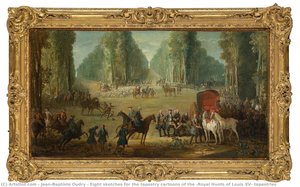
- Ludvikas XV medžioja briedą Saint-Germain miške (1730 m.): Šis paveikslas užtvirtino Oudry reputaciją kaip oficialiojo karališkojo avim medžioklės tapytojo. Jis puikiai atvaizduoja tiek medžioklės prachtą, tiek natūralią aplinką.
- Ludvikas XV karališkieji avinimai (Chasses Royales Gobelins): Gobelins manufaktūrai skirtų gobelenų projektų serija, dar labiau įtvirtinusi Oudry žinomumą kaip gobelenų dizainerio.
- Iš daugeliui karaliaus Ludvikas XV užsakytų mirusių avinių portretų, demonstruojančių jo meistriškumą gyvūnų anatomijoje ir stillių kompozicijose.
Įtaka ir palikimas
- Įtakos: Nicolas de Largillière playing letingą vaidmenį Oudry ankstyvojo meninio vystymosi, suteikdamas pagrindinius mokymus portretavimo ir technikos srityse.
- Oudry kūriniai paveikė vėlesnius gyvūnų tapininkų ir gobelenų dizainerių pokolius. Jo naturalistinis stilius ir dėmesys detalėms nustatė naują standartą vaivydėlių vaizdymui.
- Jis reikšmingai prisidėjo prie Prancūzijos dvaro dekoratyvinio meno, kurdamas pr响uskius gobelenus, kurie papuošė karališkus rezidus.
Istorinė reikšmė
- Oudry kūriniai suteikia vertingų įžvalgų apie XVIII amžiaus aristokratijos gyvenimą ir medžioklės svarbą Prancūzijos bajorams kaip pramogai.
- Jo gobelenai laikomi Prancūziško dekoratyvinio meno šedevrais, demonstruojančiais to laikotarpio techninį meistriškumą ir meninę kūrybiškumą.
- Jis buvo paskirtas prestižinguose pareiguose Académie Royale de Peinture et de Sculpture, kas įrodė jo pripaulinimą kaip savo laikų išmintingo meno meistro.
- Mirė: 1755 m. balandžio 30 d., palikdamas po savęs neįtikėtinų paveikslų ir gobelenų palikimą, kuris vertinamas ir šiandien.

Žanas Batist Oudri
1686 - 1755 , Prancūzija
Trumpa informacija apie kūrėją
- Birth Date: 1686 m. kovo 17 d.
- Birth Place: Parisas, Prancūzija
- Death Date: 1755 m. balandžio 30 d.
- Influenced By: Nicolas de Largillière
- Movement: Rokoko
- Name: Jean-Baptiste Oudry
- Nationality: Prancūzų
- Notable Works:
- The Pastoral Amusements
- Louis XV hunting a deer in the forest of Saint-Germain
Susiję straipsniai

Baroque vs. Rococo: A Definitive Guide to the Drama of Grandeur and the Elegance of Grace
Explore the profound differences between Baroque drama and Rococo elegance. Our expert guide delves into art history, chiaroscuro, and the evolution of European masterpieces for collectors and enthusiasts seeking deep historical context.

Rožinio Amžius: 10 Šedevrų Apibrėžiančių Rokoko Stilių
Atraskite 10 rokokoko šedevrų, apibrėžiančių prabangą ir grožį! Sužinokite apie žymius dailininkus, spalvotus motyvus bei istorijas. Puikios meno reprodukcijos jūsų namams – OriginalUniqueArt.com.
From Grandeur to Grace: Exploring the Evolution of Baroque & Rococo Art
Explore the captivating evolution from Baroque's drama to Rococo's grace! Discover key artists, characteristics & lasting influence of these art movements with expert insights at OriginalUniqueArt.
Jean-Baptiste Pater: Rococo Charm & Ephemeral Beauty of 18th-Century France
Explore the captivating world of Jean-Baptiste Pater, a master of Rococo painting. Discover his elegant *fête galante* scenes and shimmering portraits – a glimpse into 18th-century French aristocracy. Learn about his legacy & find high-quality reproductions.
Drama & Delight: A Journey Through the Grandeur of Baroque and Rococo Art
Embark on a cultural journey through the dramatic grandeur of Baroque and the delicate grace of Rococo art. Discover the history, techniques, and timeless beauty of these magnificent eras with our expert-led exploration of European masterpieces.