Ecsalių versija
 Viskas apie Carnival







































 Dėl meno kūrinių ar reprodukcijų, kurių bet kuri pusė yra didesnė nei 105 cm (apie 41 inch), rėmas bus siunčiamas kaip išskaidytas surinkimo rinkinys. Šis metodas užtikrina saugų pristatymą ir apsaugo nuo transportavimo metu galimos žalos.


The Composition of Chaos
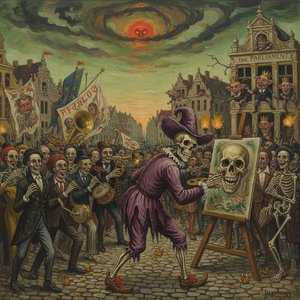
The canvas presents a dense arrangement of figures that occupy a shallow, crowded space. Within this composition, distorted faces and mask-like features emerge from a sea of movement. The palette relies on heavy applications of yellow, red, and white, which are set against dark outlines and deep shadows. Thick, jagged lines define the edges of the characters, creating a sense of physical friction between the overlapping forms. Ribbon-like shapes swirl through the frame, contributing to a flattened perspective where depth is difficult to discern.
The texture of the oil paint is tactile, with visible brushstrokes that remain prominent across the surface. These strokes follow organic, often irregular paths, reinforcing the movement of the crowd. Light falls unevenly across the scene, casting strange shadows upon the faces of the individuals. This lighting creates a theatrical effect, highlighting certain features while leaving others in murky obscurity. The figures themselves appear as a collection of grotesque and exaggerated shapes, their features rendered with a heavy, expressionistic hand.
Themes of Disguise and Social Unrest
The subject matter centers on a gathering of masked individuals, suggesting the atmosphere of a masquerade or a carnival. This choice of imagery draws from the artist's early life in Ostend, Belgium, where his parents operated a souvenir shop filled with shells and carnival masks. These objects provided a visual vocabulary for exploring themes of hidden identity and the fragility of outward appearances. The presence of these masks introduces an element of psychological tension, as the faces of the crowd are obscured by artificial layers.
The painting functions as a window into a nightmarish vision of social decay. Through the use of distorted anatomy and unsettling color contrasts, the work communicates a sense of profound unrest. The crowded nature of the composition mirrors the frantic energy of a festival, yet the underlying tone remains one of disorientation. By utilizing the medium of oil on canvas to create these heavy, textured forms, the artist captures a moment of intense, raw emotion that avoids traditional notions of beauty in favor of a more unsettling reality.
Klausimai ir atsakymai
Ar šis kūrinys Carnival yra sukeitintas rankiniu būdu ar atspausdintas?
Ranko darbas: profesionalus pavežėjas rankiniu būdu nukopijuoja Carnival aliejuje ant lino drobės.
Kokią dydį turėčiau pasirinkti darbui Carnival?
Originalo matmenys yra 66.7 x 83.2cm. Dydviai svyra nuo 28.2 x 35.4 cm (€423) iki 196.4 x 246.1 cm (€1822); šioje pusėje pateiktoje lentelėje nurodyti pagrindiniai etapai ir jų kainos.
Kiek trunka pristatymas?
Pristatymas užtruks nuo 4 iki 5 savaičių, naudojant nemokamą ekspresinį siuntimą visame pasaulyje; šioje pusėje taip pat galite rinktis skubios gamybos variantą. Jūs galite grąžinti prekę per 100 dienų ir gauti visą sumokėtą sumą atgal, nepriklausomai nuo bet kokių sąlygų.
Kur yra originalas kūrinio Carnival?
Originalas yra Harvard Art Museums kolekcijoje, Kembrižas.
Kokia technika buvo naudojama kūriniui Carnival autoriu James Ensor?
Oil On Canvas
 Peržiūrėti realaus dydžio版

 Pasidalinti
 Dalintis
 Išsamiau
 Informacinė l lapelė


 Atsisiųsti
 Panašūs eksponatai
 Rentgeno spindulių nuotrauka
 Automatinė diorama
 问答

 Statistika