

 Peržiūrėti realaus dydžio版
 Siųsti
 Dalintis
 Išsamiau
 Vadovas

 Atsisiųsti
 Panašūs eksponatai
 Rentgeno spindulių nuotrauka
 Diaporama
 Statistika
Spring Flood
 Oil On Canvas
- WallArt
- Impressionism
 1897
1897- 19th Century
 64.0 x 57.0 cm
 Tretyakovska galerija
 Rodyti daugiau
Giclée / Meno spausdinimas
Muziejų lygio „giclée“ arba drobos spausdinimas: greita gamyba ir lankstios apdailos parinktys. ( Pirkti rankomis tapytą reprodukciją Perejti prie skaitmeninių vaizdų)




































Pasirinkite iš mūsų nustatytų dydžių, atitinkančių originalaus meno kūrinio proporcijas.

Įveskite jums reikiamą plotį ir aukštį, kad atvaizdas derėtų prie jūsų rėmo ar sienos. Spausdiną galima tik sumažinti, bet nepadidinti virš originalaus paveikslėlio dydžio, todėl keičiant proporcijas, dalis vaizdo prarandama. Prieš spausdinimą atsiųsime jums skaitmeninį maketą patvirtinimui. Šioje puslapio nuotraukoje matomas pjūvis nėra tikslus – jį rodo tik maketas.
Pristatymas visame pasaulyje () per 2 weeks, o ne įprastas 4/5 savaičių laikotarpis. (26 spalis)

Nemokamas greitasis pristatymas visame pasaulyje

Aukštos kokybės lininis drobė

Pilnas siuntimo draudimas

Muitinės mokesčių grąžinimo garantija

Tikro spalvų atitikimo garantija

100 dienų grąžinimo politika (tik esant įtaigoms)

100% pinigų grąžinimo garantija

Nuolaida dideliems užsakymams
 Stiklo variantas prieinamas tik pasirinkus dydį iki 110 cm

Spring Flood
Giclée / Meno spausdinimas
Reprodukcijos dydis
-


Visų pasirinktų variantų kaina
€ 70
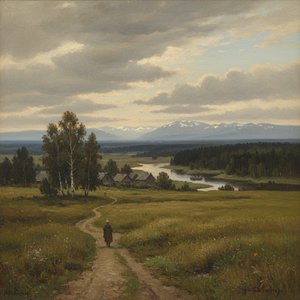
Spring Flood by Isaak Ilyich Levitan: A Serene Reflection of Nature
Isaak Ilyich Levitan's "Spring Flood," painted in 1897, is a captivating landscape that embodies the artist’s signature style – a poignant and evocative portrayal of the Russian countryside. This oil on canvas masterpiece, measuring 64 x 57 cm, resides within the esteemed collection of the Tretyakov Gallery in Moscow, Russia, serving as a testament to Levitan's profound connection with nature and his ability to translate its essence onto canvas.
Artistic Style and Technique
"Spring Flood" exemplifies Levitan’s mastery of mood landscape painting. Unlike earlier landscape artists who focused on topographical accuracy, Levitan sought to capture the emotional atmosphere and spiritual resonance of a scene. The artwork is rendered in an Impressionistic style, characterized by loose brushstrokes and a focus on capturing fleeting moments of light and color. The technique involves layering paint to build up texture and create atmospheric effects. Notice how the artist uses muted yellows, browns, and blues to evoke a sense of serenity and quietude. The delicate play of light on the water creates a sense of movement and energy, while the reflections in the water add depth and complexity to the composition. The flattened perspective is typical of Impressionism, emphasizing the surface qualities of the paint.
Subject Matter and Composition
The painting depicts a tranquil riverbank scene during what appears to be late autumn or early spring. The dominant feature is the reflection of trees and shoreline in the water, creating a symmetrical effect that draws the viewer into the heart of the landscape. A small boat rests gently on the shore, adding a subtle human element to the otherwise natural setting. The composition is carefully balanced, with the horizon line positioned slightly above the midpoint to emphasize the vastness of the sky and the surrounding environment. The inclusion of two people in the scene adds a touch of human connection to the peaceful landscape.
Historical Context and Symbolism
Levitan painted "Spring Flood" during a period of significant artistic change in Russia, as artists began to move away from traditional academic styles towards more modern approaches. The painting reflects this shift, embracing Impressionistic techniques while retaining a distinctly Russian sensibility. The flood itself can be interpreted symbolically – representing renewal and the cyclical nature of life. The muted color palette and tranquil atmosphere evoke a sense of melancholy and introspection, characteristic of Levitan’s work. It is believed that Levitan was deeply affected by personal loss during this time, which may have contributed to the painting's poignant emotional tone.
Emotional Impact and Legacy
"Spring Flood" continues to resonate with viewers today due to its ability to evoke a profound sense of peace and contemplation. The artwork’s beauty lies not only in its technical skill but also in its capacity to transport the viewer to a tranquil natural setting, inviting them to reflect on the beauty and fragility of life. As a masterpiece of Russian art, "Spring Flood" stands as a testament to Levitan's enduring legacy as one of Russia's most beloved landscape painters.
问答 (or more naturally for a website heading): Klausimai ir atsakymai
Ar „Spring Flood“, autorius – Izaakas Iljičas Levitas priklauso labiausiai siekiamų Impressionism kūrybos veikalų?
Impressionism kryptėje kūrinys „Spring Flood“ pasižymi Recognized populiarumumo lygio.
Kokiam istoriniam laikotarpiui priklauso „Spring Flood“, autorius – Izaakas Iljičas Levitas?
„Spring Flood“ priklauso 19th Century erai.
Kurių spalvų dominuoja darbe „Spring Flood“, autorius – Izaakas Iljičas Levitas?
Kūrybos darbe „Spring Flood“, autorius – Izaakas Iljičas Levitas naudojama Neutrals paletė, kurioje dominuoja Celadon (#bbc5c3) spalva.
Autoriaus biografija
A Symphony of the Russian Soul: The Life and Art of Isaak Ilyich Levitan
Isaak Ilyich Levitan, a name synonymous with the evocative power of Russian landscape painting, was more than just a chronicler of nature; he was a poet of the land, a translator of its moods into visual form. Born in 1860 in Kibarty (present-day Lithuania) to a Jewish family who later settled in Moscow, Levitan’s life was marked by both profound hardship and an unwavering dedication to his art. The early loss of his mother and father instilled within him a sensitivity that would permeate his canvases with a melancholic beauty. This sense of longing, coupled with the restrictions imposed upon Jewish communities in Tsarist Russia, fueled a desire to find solace and expression in the natural world. He entered the Moscow School of Painting, Sculpture and Architecture in 1873, where he came under the tutelage of Alexei Savrasov, whose influence would prove pivotal in shaping Levitan’s artistic vision. It was Savrasov who nurtured his student's innate ability to capture not merely the appearance of nature, but its very essence—its atmosphere, its emotional resonance.Early Life and Influences
I860 August 18 (by the Old Style, 30): Born into the family of a railroad employee Ilya Abramovich Levitan in Kibarty (today Kibartai village in Lithuania). Levitan’s formative years were marked by tragedy—the untimely deaths of his parents profoundly impacted his worldview and instilled within him an acute awareness of mortality. Despite these challenges, he demonstrated remarkable resilience and determination, pursuing his artistic ambitions with unwavering passion. Savrasov recognized Levitan's exceptional talent early on, fostering his burgeoning interest in landscape painting and introducing him to the principles of Realism—a movement that prioritized truthful representation over idealized beauty. This mentorship proved instrumental in shaping Levitan’s artistic style and guiding him toward a path of profound emotional depth. The influence of Vasily Polenov, another prominent artist of the Peredvizhniki group (the Wanderers), further broadened Levitan's horizons, exposing him to diverse artistic perspectives and inspiring him to explore new techniques.The Emergence of Mood Landscape
Levitan swiftly distinguished himself as an artist capable of conveying profound emotion through landscape. He wasn’t interested in topographical accuracy for its own sake; rather, he sought to imbue his paintings with a sense of *mood*, a feeling that resonated deep within the viewer's soul. This approach earned him the title of pioneer of the “mood landscape,” a genre that moved beyond simple representation to explore the spiritual connection between humanity and nature. His palette was often subdued, favoring naturalistic colors and poetic elements over vibrant displays. He masterfully employed light and shadow, creating atmospheric effects that evoked feelings of tranquility, solitude, or even quiet despair. Works like *Autumn Day. Sokolniki* (1879), painted when he was just nineteen years old, already demonstrated this remarkable ability to capture the subtle nuances of the Russian countryside. The painting’s muted tones and delicate rendering of light create a sense of wistful nostalgia, hinting at the transience of beauty and the inevitability of change. This distinctive style—characterized by its expressive use of color and texture—became Levitan's hallmark and cemented his place as one of Russia’s most celebrated landscape painters.Notable Works and Artistic Development
Levitan’s oeuvre encompasses a vast array of canvases depicting scenes from Russian rural life, imbued with an unparalleled sensitivity to the emotional landscape. Among his most iconic paintings are *The Vladimirka Road* (1892), *Eternal Rest* (1894), *Stormy Day* (1895), and *Vesper Chimes* (1896)—each a testament to his evolving artistic style and deepening understanding of the human condition. These works exemplify Levitan’s mastery of atmospheric perspective, capturing the ethereal beauty of twilight landscapes with breathtaking precision. He skillfully utilized brushstrokes—often loose and expressive—to convey movement and emotion, transforming static images into dynamic representations of inner experience. Collaborations with fellow artists like Konstantin Korovin and Mikhail Nesterov enriched his artistic vision, fostering a spirit of creative exchange and mutual inspiration. His designs for scenery for Savva Mamontov’s private Russian Opera showcased his versatility and willingness to explore different artistic mediums—a reflection of his multifaceted personality and unwavering commitment to artistic excellence.Legacy and Recognition
Levitan's influence extended far beyond his immediate contemporaries, shaping the trajectory of Russian landscape painting for decades to come. He instilled within his canvases a profound appreciation for the spiritual dimension of nature—a perspective that resonated deeply with audiences across generations. His work served as a powerful antidote to the prevailing aesthetic conventions of his time, advocating instead for an honest and empathetic portrayal of human experience. In 1897, Levitan was elected to the Imperial Academy of Arts—a prestigious honor recognizing his growing stature within the Russian art world—and subsequently became head of the landscape studio at Moscow School of Painting, Sculpture and Architecture. His dedication to nurturing young talent ensured that his artistic legacy would endure for years to come. Isaak Ilyich Levitan died peacefully in 1900 at the age of forty, leaving behind a body of work that continues to captivate viewers worldwide—a timeless testament to the enduring power of art to illuminate the human spirit and celebrate the beauty of the natural world. His remains were interred in Novodevichy Cemetery alongside Anton Chekhov—a poignant symbol of artistic kinship and a lasting tribute to his profound contribution to Russian culture.
Izaakas Iljičas Levitas
1860 - 1900 , Rusija
Trumpa informacija apie kūrėją
- Artistic Movement Or Style: Mood Landscape
- Artists Or Movements Influenced By This Artist: ['Rusijos krašulininkiai']
- Artists Who Influenced This Artist:
- Aleksėj Savrasov
- Vasylij Polenov
- Date Of Birth: August 30, 1860
- Date Of Death: July 22, 1900
- Full Name: Isaak Ilyich Levitan
- Nationality: Rusijoje
- Notable Artworks:
- Aukštis dieną. Sokolniki
- Vladimirka kelias
- Amžiny poilsis
- Place Of Birth: Kibarty, Lithuania
Susiję straipsniai

Evocations of Place: A Historical Journey Through Landscape Art
Explore the rich history of landscape art with OriginalUniqueArt. Discover renowned artists, movements like Impressionism & Romanticism, and expert guidance for collecting timeless pieces. Find your perfect serene escape today!

Džono Konsteblio Šedevrai: 25 Išskirtiniai Darbai Jūsų Interjerui | OriginalUniqueArt
Atraskite 25 įspūdingiausius Džono Konsteblio paveikslus! Romantizmo meistro gamtos vaizdai, Dedham Vale peizažai ir meno istorijos šedevrai. Meno reprodukcijos jūsų interjerui – OriginalUniqueArt.com

Aleksey Savrasov: The Poetic Realism That Defined Russian Landscape Painting
Explore the poetic realism of Aleksey Savrasov, founder of Russian lyrical landscape painting. Discover his masterpieces like 'The Rooks Have Returned' and learn about his lasting influence on 19th-century art. OriginalUniqueArt offers high-quality reproductions.

10 Romantinių Peizažų Simbolių: Tapybos Majestatės Viršūnės
Atraskite 10 legendinių romantinio peizažo kūrinių! Pasinerkite į Claude Lorrain, Caspar David Friedrich ir J.M.W. Turner genijaus pasaulį. Išmokite apie tapybos meistriškumą bei gamtos grožį. Aukščiausios kokybės meno reprodukcijos – OriginalUniqueArt.com. Tyrinėkite kolekciją!
Fyodor Vasilyev: A Poetic Vision of Russian Landscape – Life, Legacy, and the Transience of Nature
Explore the captivating world of Fyodor Vasilyev, a pioneering Russian landscape painter. Discover his lyrical style, influential works like 'Clouds' & lasting legacy. Learn about his life, artistic journey & impact on Russian art history.
