Perjungti į spausdinamus版作品
 Skaityti daugiau







































 Dėl meno kūrinių ar reprodukcijų, kurių bet kuri pusė yra didesnė nei 105 cm (apie 41 inch), rėmas bus siunčiamas kaip išskaidytas surinkimo rinkinys. Šis metodas užtikrina saugų pristatymą ir apsaugo nuo transportavimo metu galimos žalos.


Identification of the Portrait of Mother
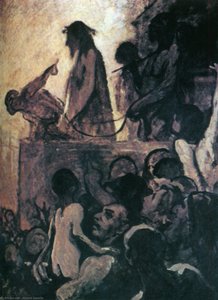
Executed in 1855, Mother by Honoré Daumier presents a portrait of disquiet. This work functions as a genre painting, utilizing a depiction of a mother and child to offer social or political commentary. It captures a specific tension inherent in the domestic sphere during the mid-19th century.
The subject matter focuses on the immediate, pressing needs of the family unit. Through this lens, Honoré Daumier moves beyond simple portraiture to address the broader anxieties of the era. The figures are rendered with a sense of urgency that defines the composition.
Visual Composition and Emotional Atmosphere
Three figures occupy the center of the composition, caught in a moment of palpable distress or urgency. A woman leads the group, her posture suggesting a determined movement forward. She is flanked by two smaller figures, likely children, who follow closely in her wake. This arrangement creates a sense of momentum against a backdrop of heavy, dark hues. The setting suggests either a nighttime scene or a dimly lit interior, where the shadows press in from the edges of the frame.
The color palette is restricted to somber tones, dominated by shades of blue and gray. These muted colors, combined with loose and expressive brushwork, heighten the psychological weight of the scene. The darkness does not merely function as a setting but acts as a reflection of the internal state of the family. Every stroke contributes to a sense of quiet desperation, freezing a fleeting moment of familial concern within a heavy, atmospheric gloom.
Artistic Style and Technical Approach
The work occupies a transitional space between Impressionism and Realism. While the painting is rendered in a Realism style, it avoids the meticulous detail favored by many of its contemporaries. Instead, the artist employs loose brushstrokes to prioritize atmosphere and the transmission of emotion over precise anatomical accuracy.
A subdued palette of muted blues and grays defines the color scheme. This choice, combined with the expressive brushwork, establishes a palpable sense of melancholy. The artist utilizes chiaroscuro—the dramatic interplay of light and shadow—to sculpt the forms of the figures. This technique heightens the psychological intensity of the scene, emphasizing the central figure against the pervasive gloom of the background.
Klausimai ir atsakymai
Ką vaizduoja „Mother“ – Honoré Daumier ir kokią nuota sukelia?
„Mother“ – Honoré Daumier vaizdelioje atspindžiami family portrait, social critique, human suffering, emotional expression, urban landscape, political protest, dramatic lighting, sukurti Dramatic nuotaika. Tematika ir atmosfera kartu apibūdina šį kūrinį.
Kas yra „Mother“?
„Mother“ – Honoré Daumier temos apima family portrait, social critique, human suffering, emotional expression, urban landscape, political protest, dramatic lighting. Kartu jie apibendrina šio kūrinio tematiką.
Ar „Mother“ – Honoré Daumier vaizdą galima laisvai reprodukcijaoti?
„Mother“ – Honoré Daumier yra yra viešosios erdvės dalis – jo autorinė teisė pasibaigusi. Šis statusas nustato, kaip galima reprodukcijaus šio kūrinio vaizdą.
Daugiau informacijos apie šį paveikslą
 Peržiūrėti realaus dydžio版

 Pasidalinti
 Dalintis
 Išsamiau
 Vadovas


 Atsisiųsti
 Panašūs eksponatai
 Rentgeno spindulių nuotrauka
 Automatinė diorama
 问答
 Statistika