- Pradžia

- Skaitmeninis vaizdas
- Gerhardas Richter
- Star Picture
 Preview
 Pirkti atspaudą Užsisakyti kopiją
 Pasidalinti
 Dalintis
 Išsamiau
 Pridėti į mėgstamiausius

 Atsisiųsti
 Panašūs eksponatai
 Rentgeno nuotrauka
 Automatinė diorama
Star Picture
 Oil On Canvas
- WallArt
- Abstract Expressionism
 1969
1969 70.0 x 70.0 cm
 Skaityti daugiau
Įsigykite aukštos skiriamosios raiškos, patobulintą skaitmeninį vaizdą, gerokai pranašesnį už internetinę peržiūrą.
Kiekvieną failą mūsų specialistai kruopščiai paruošia naudojant pažangias technologijas ir profesionalų rankinį retušavimą. Užtikriname, kad kiekvienas vaizdas pasižymėtų išskirtiniu aiškumu, tikslia spalvų atspalviu ir smulkiomis detalėmis.
Baigiamas failas el. paštu pristatomas per 72 valandas; jis optimizuotas nedelsiant naudojimui profesionalioje, redakcinėje ir spausdinimo aplinkoje. Tai ta pati kokybė, kuria pasitiki aukščiausios klasės dizaino studijos, leidyklos ir galerijos.
Skaitmeninis vaizdas
Atsisiųskite didelės raiškos failą asmeniniam naudojimui, spausdinimui ir kūrybiniams projektams.
Kiekvieną skaitinio vaizdo užsakymą papildė
Profesionalus skaitmeninis pristatymas, garantuotas
Pasirinkę OriginalUniqueArt.com, jūs ne tik gaunate paveikslėlį – jūs gaunate profesionaliai patobudintą skaitmeninį kūrinį, sukurtą itin tikniai ir užtikrinantį pasitenkinimą. Štai viską, kas automatiškai pritékia jūsų užsakymui:

Greitas siuntimas el. paštu
Jūsų aukštos raiškos skaitmeninis vaizdo failas bus išsiųstas jums el. paštu per 72 valaudas nuo užsakymo – paruoštas naudojimui be jokių papildomų veiksmų.

Skaitmeninis failas su dirbtiniu intelektu
Jūsų meno kūrinys profesionaliai optimizuojamas naudojant pažangius dirbtinio intelekto įrankius ir rankinį redagavimą, užtikrinant maksimalią detalę, aiškumą ir spalvų tikslumą.

Nemokamas visam laikui pakartotinis siuntimas
Atsitiktinai ištrytikote ar praradote savo failą? Nebijokite – bet kuriuo metu atsiųsime jį jums vėl nemokamai.

Jokio importo mokesčio – niekada
Mėgaukitės savo meno kūriniu akimirka – skaitiniai failai visada yra neapmokestinami, todėl nereikės mokėti muitinės, mokesčių ar pristatymo mokesčių.

Spalvų tikslumo garantija
Naudodami profesionalią įrangą ir spalvų valdymo sistemas, užtikriname, kad jūsų skaitmeninis vaizdas kuo tiksliau atspindėtų originalias spalvas.

60 dienų pasitenkinimo garantija
Jei nebuvate patenkinti savo skaitinio vaizdo, per 60 dienų jį pertaisysime arba grąkinsime 100% sumą – be jokių klausimų.

100% pinigų grąžinimo garantija
Nepat 만족inti? Gaukite visą sumokėtą sumą per 60 dienų nuo skaitmeninio failo gavimo – be jokių papildomų klausimų.

Nuolaidos dideliems užsakymams
Pirkti 3 nuotraukas – pasiūla 10% - Pirkti 5 – pasiūla 15% - Pirkti 10 ir daugiau – pasiūla 20%. Puikiai tinka kūrybiniams projektams, galerijoms bei agentūroms.
Kolekcinio objekto aprašymas
A Universe Contained: Exploring Gerhard Richter’s ‘Star Picture’
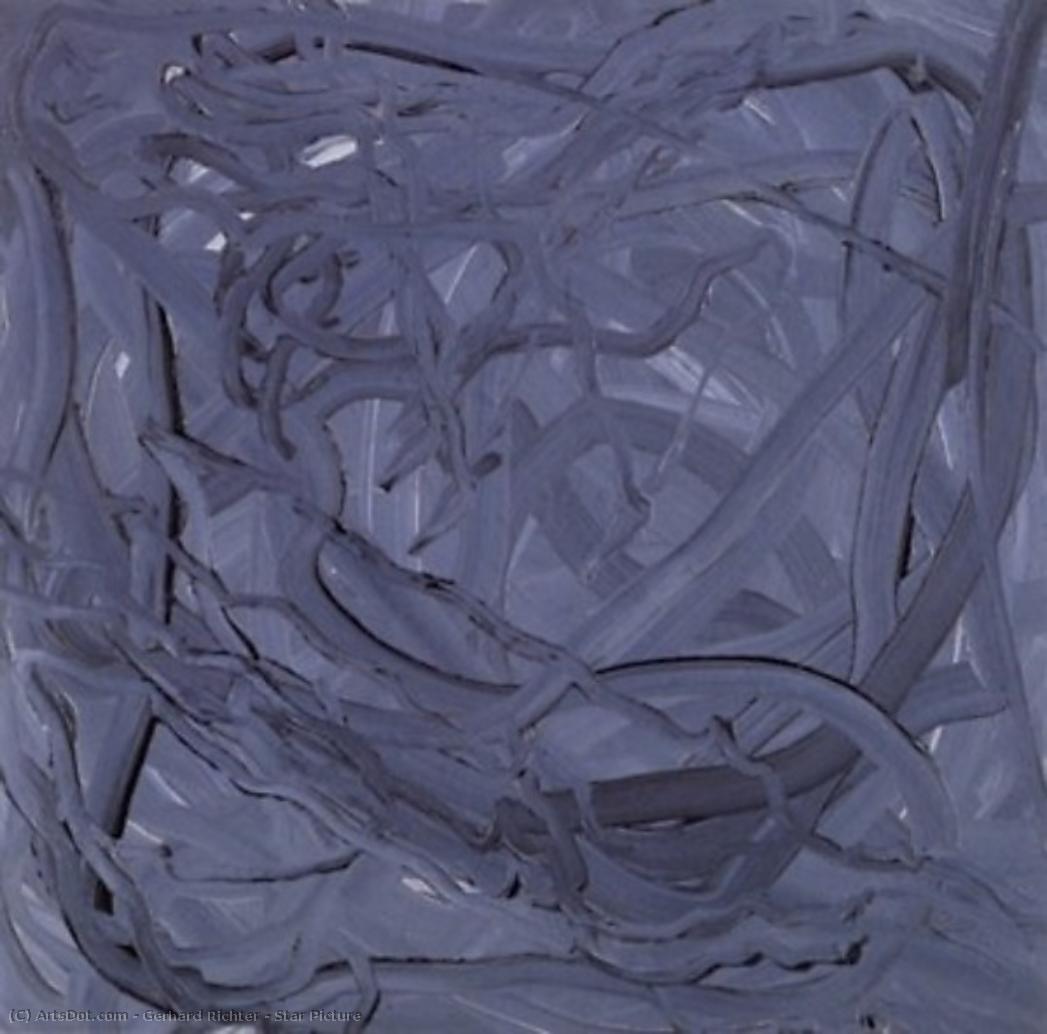
Gerhard Richter's ‘Star Picture,’ created in 1969, is not an invitation to gaze upon the cosmos with romantic wonder, but rather a compelling confrontation with its unknowable vastness. This abstract oil on canvas, measuring 70 x 70 cm, exists as a dense field of blues and greys, a chaotic interplay of lines and forms that resists easy interpretation. It’s a work born from a pivotal moment in history – the year humanity first set foot on the moon – yet it doesn't celebrate triumph or discovery. Instead, ‘Star Picture’ feels like an attempt to grapple with the unsettling implications of expanding our horizons, a visual echo of the anxieties and uncertainties that accompanied such monumental leaps forward.
The Technique of Uncertainty
Richter’s approach in ‘Star Picture’ is deeply rooted in his exploration of perception and representation. He wasn't striving for photorealistic depiction; rather, he employed a technique that deliberately obscures clarity. The painting appears to be built up through layers of paint, mimicking the texture of brushstrokes yet lacking their inherent expressiveness. This creates a tactile quality, an invitation to run your eyes across the surface, but simultaneously denies any comfortable sense of resolution. Diagonal lines dominate the composition, generating a feeling of movement and instability, as if the very fabric of space is in flux. The even lighting further contributes to this ambiguity; there are no dramatic highlights or shadows to guide the eye, only a pervasive, atmospheric haze. It’s a masterful demonstration of how abstraction can convey not emptiness, but an overwhelming sense of information – too much data for the mind to process.
Historical Echoes and Artistic Lineage
To understand ‘Star Picture,’ it's crucial to consider Richter’s biography and the artistic climate of post-war Germany. Born in 1932, he experienced firsthand the trauma of displacement and political upheaval. This history profoundly shaped his artistic vision, leading him to question established norms and explore the limitations of representation. While early influences like Picasso and Arp are discernible in his abstract compositions, Richter quickly forged his own path. The late 1960s saw him experimenting with ‘photo-paintings,’ works based on photographs that he then blurred and distorted. ‘Star Picture’ can be seen as an extension of this exploration – a photograph of the cosmos rendered not as a clear image, but as a fragmented memory or a half-forgotten dream. The ZERO group, with their focus on light and space, also provided a crucial context for Richter's work, though he maintained a critical distance from their utopian ideals.
An Emotional Landscape
‘Star Picture’ is not a comforting artwork. It evokes a sense of unease, even disorientation. The density of the composition, the lack of clear focal points, and the muted color palette all contribute to this feeling. Yet, within this chaos lies a strange beauty – a testament to Richter's ability to transform abstract forms into emotionally resonant experiences. The painting doesn’t offer answers; it poses questions about our place in the universe, the nature of perception, and the limits of human understanding. It is a work that demands contemplation, inviting viewers to project their own anxieties and aspirations onto its enigmatic surface. For those seeking an artwork that transcends mere decoration and instead sparks dialogue and introspection, ‘Star Picture’ offers a profound and enduring resonance.
Autoriaus biografija
A Life Shaped by Division: The Early Years and Artistic Formation of Gerhard Richter
Gerhard Richter’s story is inextricably linked to the fractured history of 20th-century Germany. Born in Dresden in 1932, his childhood unfolded under the shadow of a rising National Socialist regime. This formative period, marked by displacement – his family moved several times during the war years – instilled within him a profound sense of uncertainty and a questioning spirit that would permeate his artistic practice for decades to come. The idyllic landscapes of his early upbringing in Reichenau and Waltersdorf were soon disrupted by conflict, leaving an indelible mark on his psyche. His father, though not a fervent supporter of the Nazi party, navigated the complexities of life under authoritarian rule as a schoolteacher, while his mother fostered a love for literature and music within the family. This duality – a pragmatic acceptance of circumstance alongside a yearning for cultural expression – became a defining characteristic of Richter’s own artistic approach. He began formal training at the Dresden Academy of Fine Arts in 1951, initially immersed in the tradition of socialist realism demanded by the East German state. However, even within this constrained environment, a desire for artistic freedom simmered beneath the surface, fueled by a growing dissatisfaction with ideological constraints and a longing to explore more expansive creative possibilities.Escaping Constraints: Düsseldorf and the Exploration of Style
The year 1961 proved pivotal. Richter, along with his wife Marianne Eufinger, made the daring decision to flee East Germany, seeking refuge in the burgeoning art scene of Düsseldorf. This move marked a radical shift in his artistic trajectory. The West German landscape offered a liberating environment where experimentation and innovation were not only permitted but actively encouraged. In Düsseldorf, he encountered a vibrant community of artists grappling with questions of identity, representation, and the legacy of history. He quickly began to dismantle the rigid stylistic conventions of socialist realism, embarking on a period of intense exploration that would define his early mature work. This era saw him oscillate between seemingly disparate approaches – from photorealism, meticulously recreating photographic images with astonishing precision, to abstract compositions characterized by bold colors and dynamic brushstrokes. His collaboration with Sigmar Polke led to the coining of the term ‘Capitalist Realism,’ a deliberately ambiguous label that reflected their shared skepticism towards established artistic norms and their appropriation of imagery from advertising and mass media. This period wasn’t about finding *a* style, but rather questioning the very notion of stylistic coherence, embracing contradiction as a fundamental principle.Blurring Boundaries: Photorealism, Abstraction, and the Power of Chance
Richter's artistic vocabulary expanded throughout the 1960s and beyond, encompassing a remarkable range of techniques and themes. His photorealistic paintings, often based on family photographs or newspaper images, are not merely copies of reality but rather investigations into the nature of perception and representation. By meticulously rendering these images with an almost clinical detachment, he forces viewers to confront the inherent ambiguity of photographic truth. Simultaneously, Richter delved deeper into abstraction, creating canvases layered with vibrant colors and gestural marks. These abstract works are often created using a unique technique involving squeegees – tools typically used for cleaning windows – which he drags across the surface of the canvas, manipulating the paint in unpredictable ways. This embrace of chance and spontaneity is central to his artistic philosophy, allowing him to relinquish control and invite unexpected outcomes. His ‘Color Charts,’ systematic arrangements of colored squares, further challenge traditional notions of artistic expression, questioning the very definition of painting itself. These works are not about individual aesthetic preferences but rather about exploring the inherent properties of color and its organizational possibilities.Legacy and Influence: A Master of Contemporary Art
Gerhard Richter’s impact on contemporary art is undeniable. His willingness to challenge conventions, his relentless experimentation with technique, and his profound engagement with historical and political themes have established him as one of the most important artists of our time. He has consistently resisted easy categorization, defying attempts to pigeonhole his work into a single stylistic framework. This refusal to be defined, coupled with his technical virtuosity and intellectual rigor, has earned him widespread critical acclaim and commercial success – his paintings regularly fetch record prices at auction. His influence can be seen in the work of countless artists who have followed in his footsteps, drawn to his innovative techniques and his unwavering commitment to artistic exploration. Richter’s legacy is not simply about creating beautiful objects; it's about expanding the possibilities of painting itself. He remains a vital force in contemporary art, continuing to inspire and provoke audiences with his challenging and deeply resonant work.
Gerhardas Richter
1932 - , Vokietija
Trumpai apie šį kūrėją
- Artistic Movement Or Style: Fotorealizmas ir abstrakcija
- Artists Who Influenced This Artist:
- Pablo Picasso
- Jean Arp
- Date Of Birth: Vasario 9 d.
- Full Name: Gerhard Richter
- Nationality: Vokiečių
- Notable Artworks:
- Abstraktas Bild (610-1)
- Gilbert
- S. su vaiką
- Place Of Birth: Dresdenas, Vokietija

