

 Peržiūrėti realaus dydžio版
 Siųsti
 Dalintis
 Išsamiau
 Vadovas

 Atsisiųsti
 Panašūs eksponatai
 Rentgeno spindulių nuotrauka
 Diaporama
 Statistika
The Visit
 Oil On Canvas
- WallArt
- Dutch Golden Age Genre
 78.0 x 74.0 cm
 Staatliches Museum
 Rodyti daugiau
Rankų darbo aliejinės reprodukcijos
Rankiniu būdu tapytas aliejus ant droblio jūsų pageidaujamame dydį ir rėmuose – mūsų menininkų darbas pagal užsakymą. ( Perjungti į spausdinimą Perejti prie skaitmeninių vaizdų)




P118B €10

P118H €10

P118W €10

P438Z €10

P508JH €12

P508YH €12

P805H €10

P805Z €10

P919BZ €10

P919G €10

P919XJ €10

P959ZH €10

P968JZ €12

W106C €8

W218G €10

W218JH €8

W218Y €10

W307PJ €10

W316G €10

W316PJ €8

W316Y €10

W398PJ €8

W4111J €10

W500HY €15

W500JH €15

W692G €12

W849H €8

W940BG €15

W953PJ €8




Pasirinkite iš mūsų nustatytų dydžių, atitinkančių originalaus meno kūrinio proporcijas.

Įveskite jums reikiamą plotį ir aukštį, kad paveikslas atitiktų jūsų rėmą ar sieną. Kadangi šis darbas yra rankinio darbo, siekiant išgauti kitokio formos dydį, paveikslas gali būti šiek tiek didesnis (nuo kraštų bus palikta daugiau erdvės) arba mažesnis – pasirinkite jums patogiausią variantą. Prieš pradedant tapyti, atsiųsime jums skaitmeninį maketą patvirtinimui. Šioje puslapio nuotraukoje matomas vaizdas nėra galutinis rezultatas – jį parodys tik sukurtas maketas.
Gavus užsakymą, OriginalUniqueArt.com komanda susisieks su klientu el. paštu dėl instrukcijų ir pateiks maketo pavyzdį
Pristatymas visame pasaulyje () per 3–4 savaites, o ne įprastai – per 5 savaites. (24 spalis). Kokybė lieka nepakeičiama.

Nemokamas greitasis pristatymas visame pasaulyje

Aukštos kokybės lininis drobė

Pilnas siuntimo draudimas

Muitinės mokesčių grąžinimo garantija

Tikro spalvų atitikimo garantija

100 dienų grąžinimo politika (tik esant įtaigoms)

100% pinigų grąžinimo garantija

Nuolaida dideliems užsakymams
 Stiklo variantas prieinamas tik pasirinkus dydį iki 110 cm

The Visit
Reprodukcijos technika
Reprodukcijos dydis
-


Visų pasirinktų variantų kaina
€ 264
A Window Into Seventeenth-Century Domestic Life: Exploring Gerard Ter Borch’s “The Visit”
Gerard ter Borch, a pivotal figure in Dutch Golden Age art history, stands as a beacon of psychological realism and meticulous observation within the genre of domestic painting. Born in Zwolle in 1617, he embarked on an artistic journey that traversed Europe, absorbing influences from diverse artistic traditions – notably the Baroque – shaping his distinctive style and cementing his legacy as one of the era’s foremost masters. His sister, Gesina ter Borch, also pursued a career in painting, fostering a familial commitment to artistic excellence that would resonate throughout their lives. Ter Borch's oeuvre is characterized by an unparalleled sensitivity to capturing subtle emotions and nuanced interactions within seemingly commonplace settings—a hallmark that distinguishes him from many of his contemporaries.Composition and Technique: Mastering Light and Texture
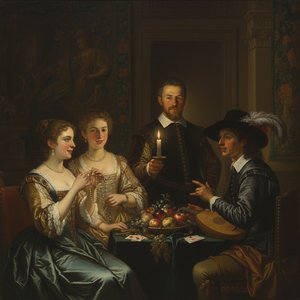
“The Visit,” painted circa 1655, exemplifies ter Borch’s masterful command of technique. Executed in oil on canvas – a medium favored for its ability to achieve remarkable luminosity and textural detail – the artwork presents four figures engaged in conversation within a richly furnished bedroom. The artist skillfully employs chiaroscuro—the dramatic interplay between light and shadow—to sculpt the forms of the women seated on a bench and the men standing nearby, creating an illusionistic depth that draws the viewer into the scene. Ter Borch’s meticulous brushwork captures the delicate weave of fabric, the sheen of polished surfaces, and the subtle nuances of skin tones with astonishing accuracy. This painstaking attention to detail underscores ter Borch's dedication to portraying reality as faithfully as possible—a cornerstone of his artistic philosophy.Symbolism Within Everyday Reality: Decoding Gestures and Expressions
Beyond its technical brilliance, “The Visit” is laden with symbolic significance. The bed draped in a scarlet blanket serves as a visual anchor, representing comfort, intimacy, and perhaps even unspoken desires. The postures and gestures of the figures convey a complex tapestry of emotions—ranging from polite cordiality to veiled apprehension—reflecting the psychological depth that ter Borch sought to achieve. Scholars have interpreted subtle facial expressions and glances as indicators of hidden agendas and unspoken feelings, prompting ongoing debate about the artwork’s intended message. Ter Borch's ability to transform ordinary domestic life into a vehicle for profound emotional exploration distinguishes him from many other artists of his time.Historical Context: Reflecting Dutch Society’s Values
“The Visit” emerged during a period of considerable social and intellectual ferment in Holland—the Dutch Golden Age (approximately 1648-1702). This era witnessed unprecedented economic prosperity, fueled by maritime trade and colonial expansion, fostering a vibrant cultural landscape characterized by artistic innovation and humanist ideals. Genre painting flourished as a response to the prevailing fascination with portraying the realities of everyday life—a deliberate departure from grand mythological narratives favored by earlier Baroque artists. Ter Borch’s work reflects the Dutch obsession with moral virtue and social decorum—values that underpinned the nation's reputation for stability and sophistication.Emotional Resonance: Capturing Transient Moments
Ultimately, “The Visit” transcends its formal qualities to evoke a powerful emotional response in the viewer. The artwork captures a fleeting moment of human connection—a conversation between friends or family members—rendered with breathtaking tenderness and sensitivity. Ter Borch’s masterful depiction of psychological realism invites contemplation about the complexities of human relationships and the enduring power of unspoken emotions. Like many of his contemporaries, ter Borch aimed to elevate genre painting beyond mere visual representation, transforming it into a medium for conveying profound truths about the human condition—a testament to his artistic genius and lasting influence on art history.Location: Staatliches Museum Schwerin
The Staatliches Museum Schwerin houses an impressive collection of artworks from various periods and styles. You can find more information about the museum on Wikipedia: https://en.wikipedia.org/wiki/Staatliches_Mus问答 (or more naturally for a website heading): Klausimai ir atsakymai
Kokia „The Visit“, autorius – Gerardas Ter Borchas švytėjimo (luminance) intensyvumas?
„The Visit“ spalvos pasižymi Dark šviesos intensyvumu.
Ką „The Visit“ turi bendro su kitais Gerardas Ter Borchas kūriniais?
„The Visit“ priklauso Gerardas Ter Borchas Dutch Golden Age Genre kūrybai, kurios įrašytoms temoms priskiriamas domestic intimacy, psychological realism, genre painting style, dutch artistic heritage, symbolic interior space.
Ar galiu pamatyti „The Visit“, autorius – Gerardas Ter Borchas rentgeno nuotrauką?
Darbino „The Visit“, autorius – Gerardas Ter Borchas puslapio Rentgenas veją yra interaktyvus naršyklė, leidžiantis peržiūrėti vienu metu vienąn ਤੋਂ vienas dvylkant optinių vaizdo sluoksnių, įskaitant rentgeno tipo vaizdą.
Susiję straipsniai

Gerard ter Borch: Intimacy & Light in the Dutch Golden Age
Explore the captivating world of Gerard ter Borch, a master of Dutch Golden Age genre painting. Discover his intimate scenes, masterful light, and lasting influence on art history. Learn more at OriginalUniqueArt.

Golden Age Reflections: Dutch Baroque Painting & Cultural Innovation
Explore the Dutch Golden Age of painting! Discover key artists like Vermeer & ter Borch, their innovative techniques, and the rich cultural context behind these Baroque masterpieces. Learn about collecting & appreciating this iconic art period.
Gerard van Honthorst: Illuminating the Dutch Golden Age with Caravaggism & Courtly Grace
Explore the captivating world of Gerard van Honthorst, a Dutch Golden Age master renowned for his dramatic chiaroscuro & courtly portraits. Discover his life, art, and lasting influence on Baroque painting.

Chiaroscuro and Character: A Definitive Guide to Light and Shadow in the Dutch Baroque Era
Explore the dramatic mastery of the Dutch Baroque era. Discover how masters like Rembrandt used chiaroscuro to transform everyday life into timeless art. An expert guide for collectors and enthusiasts seeking to understand the profound interplay of light and shadow.

Dutch Baroque Masters: 10 Paintings That Shaped an Era | OriginalUniqueArt
Journey through the Golden Age with our guide to the Top 10 Dutch Baroque masterpieces! Explore iconic paintings by Rembrandt, Vermeer & Frans Hals. Find museum-quality art reproductions and elevate your home decor at OriginalUniqueArt.com.
