
 Peržiūrėti realybėje
 Pasidalinti
 Dalintis
 Išsamiau

 Atsisiųsti
 Panašūs eksponatai
 Rentgeno nuotrauka
 Automatinė diorama
Joseph the Carpenter


 Skaityti daugiau
Rankų darbo aliejinės reprodukcijos
Rankiniu būdu tapytas aliejus ant droblio jūsų pageidaujamame dydį ir rėmuose – mūsų menininkų darbas pagal užsakymą. ( Perejti prie spausdinimo Perjungti į vaizdą)




P118B $10

P118H $10

P118W $10

P438Z $10

P508JH $12

P508YH $12

P805H $10

P805Z $10

P919BZ $10

P919G $10

P919XJ $10

P959ZH $10

P968JZ $12

W106C $8

W218G $10

W218JH $8

W218Y $10

W307PJ $10

W316G $10

W316PJ $8

W316Y $10

W398PJ $8

W4111J $10

W500HY $15

W500JH $15

W692G $12

W849H $8

W940BG $15

W953PJ $8




Pasirinkite iš mūsų nustatytų dydžių, atitinkančių originalaus meno kūrinio proporcijas.

Galite įvesti savo matmenis, kad jie atitiktų konkretų rėmą ar erdvę. Jei pasirinktas dydis neatitinka originalaus paveikslėlio proporcijų, mes arba apkropsime meno kūrinį, arba papildysime tapybą rankomis dažytい elementais. Prieš pradėdami gamybą, jūsų patvirtinimui atsiųsime skaitmeninį maketą.
Atkreipkite dėmesį, kad ekrane rodomas vaizdas neatspindi tikrojo apkarpymo ar papildymo. Tik maketas tiksliai parodys galutinę kompoziciją.
Nors galima rinktis ir individualius dydžius, rekomenduojame pasirinkti matmenis iš nustatytos sąrašo, kad būtų išlaikytos originalios proporcijos.
Gavus užsakymą, OriginalUniqueArt.com komanda susisieks su klientu el. paštu dėl instrukcijų ir pateiks maketo pavyzdį.
Pristatymas visame pasaulyje () per 3–4 savaites, o ne įprastai – per 5 savaites. (8 rugpjūtis). Kokybė lieka nepakeičiama.

Nemokamas greitasis pristatymas visame pasaulyje

Aukštos kokybės lininis drobė

Pilnas siuntimo draudimas

Muitinės mokesčių grąžinimo garantija

Tikro spalvų atitikimo garantija

60 dienų grąžinimo politika (tik esant gamyklinėms defektams)

100% pinigų grąžinimo garantija

Nuolaida už kelias reprodukcijas
 Stiklo variantas prieinamas tik pasirinkus dydį iki 110 cm

Joseph the Carpenter
Reprodukcijos technika
Reprodukcijos matmenys
-


Galutinė kaina
$ 300
Kūrinio aprašymas
A Quiet Moment of Divine Foreshadowing
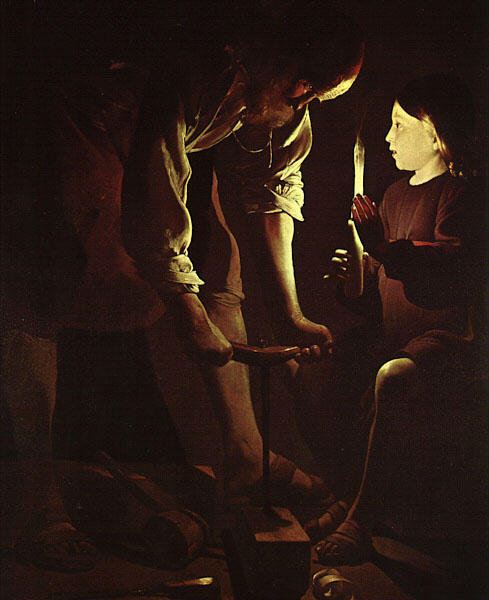
Joseph the Carpenter by Georges de La Tour is a profoundly moving depiction of domestic tranquility imbued with subtle religious symbolism. Created around 1642, this oil painting offers a glimpse into the humble workshop of Saint Joseph, presenting a tender scene of mentorship and foreshadowing. The composition centers on Joseph diligently working as a carpenter, while the young Jesus attentively holds a candle, illuminating his earthly father’s task.Masterful Tenebrism & Baroque Style
De La Tour was a leading figure in French Baroque painting, deeply influenced by Caravaggio's dramatic use of light and shadow – a technique known as *tenebrism*. This is powerfully evident here. The scene unfolds within a darkened space, with a single candle providing the primary source of illumination. This stark contrast isn’t merely stylistic; it directs our gaze to the key elements: Joseph’s focused labor, Jesus's gentle offering, and the tools of the trade.- Style: Baroque, Tenebrism
- Technique: Oil on canvas with meticulous layering (glazes) to achieve luminous effects despite the darkness.
- Composition: Intimate and focused, drawing the viewer into a quiet, personal moment.
Symbolism Woven in Wood & Light
Beyond its surface beauty, the painting is rich with symbolic meaning. The auger Joseph uses to drill wood subtly echoes the shape of the cross – a poignant prefiguration of Christ’s crucifixion. The arrangement of the wood itself, laid across the floor, further reinforces this foreshadowing. Jesus holding the candle isn't simply an act of assistance; it represents him as the “Light of the World,” a central tenet of Christian belief. His raised hand can be interpreted as a gesture of blessing or benediction.- The Auger: Symbolizes Christ’s future sacrifice on the cross.
- Candlelight: Represents Jesus as the “Light of the World.”
- Jesus' Gesture: Signifies blessing, acceptance of his destiny, and divine grace.
Historical Context & Artistic Legacy
Georges de La Tour (1593-1652) lived during a period of religious revival in Lorraine. His work reflects this piety, moving increasingly towards purely religious subjects throughout his career. He was appointed “Painter to the King” in 1638, demonstrating his rising status and influence. Interestingly, La Tour’s work fell into relative obscurity after his death, only being rediscovered in the early 20th century. His masterful use of light and shadow continues to inspire artists today.Emotional Resonance & Interior Appeal
Joseph the Carpenter evokes a sense of quiet contemplation, humility, and familial love. The painting’s subdued palette and intimate scale create an atmosphere of serenity and reverence. Its dramatic lighting and compelling narrative make it a captivating focal point for any space. This artwork would be particularly well-suited to interiors seeking a touch of Old World elegance, spiritual depth, or a sophisticated artistic statement. A high-quality reproduction captures the nuances of La Tour’s technique, bringing this timeless masterpiece into your home.Autoriaus biografija
Georges de La Tour (1593–1652): French Baroque Master of Dramatic Chiaroscuro & Tenebrism
Georges de La Tour, a name that resonates with the hushed reverence reserved for masters of light and shadow, remains one of the most compelling figures of the French Baroque. Born in 1593 in Vic-sur-Seille, a small town nestled within the Duchy of Lorraine, his life unfolded against a backdrop of religious fervor and political upheaval. While details surrounding his early training remain somewhat elusive—scholars speculate about potential journeys to Italy or apprenticeships with local artists like Jacques Bellange—the seeds of his artistic vision were undoubtedly sown in this environment. He wasn’t born into an artistically established family; his father was a baker, yet the circumstances of his mother's lineage hint at a possible connection to nobility, a subtle influence perhaps reflected in the dignity and quiet grace that permeate his work.
Early Life & Artistic Influences
Georges de La Tour’s formative years were marked by the turbulent political landscape of Lorraine under Habsburg rule. Despite limited formal education—evidence suggests he received instruction from local artisans—his innate talent for observation and representation quickly distinguished him from his peers. Crucially, he encountered the artistic legacy of Caravaggio during his travels, absorbing the revolutionary techniques of tenebrism—the dramatic interplay between light and darkness—that would become central to his distinctive style. However, De La Tour didn’t merely emulate Caravaggio; he skillfully assimilated Dutch Caravaggisti influences, particularly those championed by Hendrick Terbrugghen, forging a synthesis that was both powerfully expressive and remarkably restrained.
The Utrecht School & Artistic Development
De La Tour's artistic development coincided with the flourishing of the Utrecht School, a movement characterized by its meticulous realism and psychological depth. Artists like Terbrugghen prioritized capturing human emotion with unflinching honesty—a commitment that mirrored De La Tour’s own unwavering dedication to portraying the inner life of his subjects. Initially, De La Tour's paintings exhibited a vibrant palette and dynamic composition, reflecting the influence of this Utrecht tradition. Yet as he matured, he gradually refined his aesthetic sensibilities, favoring muted earth tones and simplifying forms—a deliberate choice that underscored his profound spiritual contemplation.
Major Works & Recurring Themes
The hallmark of Georges de La Tour’s oeuvre is undoubtedly his masterful manipulation of candlelight—which he employed not merely as a source of illumination but as a metaphor for divine grace and spiritual awakening. His paintings are frequently set at night, creating an atmosphere of intimacy and quiet contemplation that draws the viewer into the scene and invites them to share in the emotional experience of the figures depicted. The Fortune-Teller, painted around 1630, exemplifies this early style—a lively genre scene rendered with sharp observation and dramatic lighting. However, it is his later religious works that truly showcase De La Tour’s genius. Adoration of the Shepherds, created around 1640, demonstrates his ability to imbue a traditional subject with profound emotional resonance. The figures are not idealized or heroic; they are ordinary people, humbled by the presence of the divine. The Tears of Saint Peter, painted in the 1650s, is particularly poignant—the apostle’s grief rendered with heartbreaking subtlety and realism. Saint Joseph Carpenter, another iconic work, depicts a serene domestic scene, highlighting De La Tour's mastery of capturing the quiet dignity of everyday life.
Legacy & Enduring Appeal
Despite achieving recognition during his lifetime—he was appointed “Painter to the King” by Louis XIII in 1638—Georges de La Tour’s work remained largely obscure after his death in 1652. For centuries, many of his paintings were misattributed to other artists, and his name faded from art historical memory. It wasn't until the early 20th century that a concerted effort was made to rediscover and re-evaluate his oeuvre—led by scholars like Hermann Voss—revealing an artist of extraordinary originality and depth. De La Tour’s innovative use of light and shadow, combined with his psychological insight into his subjects, continues to captivate audiences today. His paintings offer a glimpse into 17th-century life and spirituality, reflecting both the religious fervor and the social realities of his time. He remains celebrated for his ability to imbue everyday scenes with profound meaning and emotional depth—a testament to his enduring legacy as one of the most influential artists of the Baroque period.

Žoržas Dela Toras
1593 - 1652 , Prancūzija
Trumpa informacija
- Artistic Movement Or Style: Tenebrismo
- Artists Who Influenced This Artist:
- Karavaggio
- Hendrik Terbrugghen
- Date Of Birth: 13 marto 1593
- Date Of Death: 1652
- Full Name: Georges de La Tour
- Nationality: Prancūzijoje
- Notable Artworks:
- Šešėlyje žiūrantis žmogus
- Kristaus Švietimo adoratorių šventė
- Place Of Birth: Vik-sur-Seille, Prancūzija
Susiję straipsniai

Shadows of Drama: Exploring the Artistic Power & Historical Context of Tenebrism
Explore the captivating world of tenebrism! Discover Caravaggio's revolutionary techniques, its spread across Europe, & lasting influence on Baroque art. A comprehensive guide for art enthusiasts.
Baroque Realism: Illusion, Emotion & the Dramatic Transformation of 17th-Century Art
Explore the dramatic world of Baroque Realism! Discover iconic artists like Caravaggio & Rubens, their techniques, and the movement's lasting impact on art history. Expert insights for collectors & enthusiasts.
Chiaroscuro & Emotional Resonance: Exploring Dramatic Light in Western Painting
Explore the captivating world of chiaroscuro & tenebrism! Discover Caravaggio's influence, Baroque masters, and the enduring power of dramatic lighting in art history. Learn about these techniques with OriginalUniqueArt.
Baroque Classicism: Reconciling Drama & Order in 17th-Century Art
Explore the captivating world of Baroque Classicism! Discover its history, key artists like Caravaggio & Rubens, and defining characteristics. Expert insights & high-quality reproductions at OriginalUniqueArt.

Maurice Quentin de La Tour: Light, Shadow & the Rococo Portrait
Explore the captivating world of Maurice Quentin de La Tour, a master of Rococo portraiture. Discover his innovative pastel techniques, intimate depictions of French aristocracy, and lasting artistic legacy. Learn more at OriginalUniqueArt.



