
 Peržiūrėti realaus dydžio版
 Pasidalinti
 Dalintis
 Išsamiau
 Vadovas

 Atsisiųsti
 Panašūs eksponatai
 Rentgeno spindulių nuotrauka
 Automatinė diorama
 问答
问答 Statistika
Pusiasvyris Šviesti

- 40.0 x 63.0 cm


 Skaityti daugiau
Giclée / Meno spausdinimas
Muziejų lygio „giclée“ arba drobos spausdinimas: greita gamyba ir lankstios apdailos parinktys. ( Pirkti rankų darbo tapybą Perejti prie skaitmeninių vaizdų)




P118B €10

P118H €10

P118W €10

P438Z €10

P508JH €12

P508YH €12

P805H €10

P805Z €10

P919BZ €10

P919G €10

P919XJ €10

P959ZH €10

P968JZ €12

W106C €8

W218G €10

W218JH €8

W218Y €10

W307PJ €10

W316G €10

W316PJ €8

W316Y €10

W398PJ €8

W4111J €10

W500HY €15

W500JH €15

W692G €12

W849H €8

W940BG €15

W953PJ €8




Pasirinkite iš mūsų nustatytų dydžių, atitinkančių originalaus meno kūrinio proporcijas.

Įveskite jums reikiamą plotį ir aukštį, kad atvaizdas derėtų prie jūsų rėmo ar sienos. Spausdiną galima tik sumažinti, bet nepadidinti virš originalaus paveikslėlio dydžio, todėl keičiant proporcijas, dalis vaizdo prarandama. Prieš spausdinimą atsiųsime jums skaitmeninį maketą patvirtinimui. Šioje puslapio nuotraukoje matomas pjūvis nėra tikslus – jį rodo tik maketas.
Pristatymas visame pasaulyje () per 2 weeks, o ne įprastas 4/5 savaičių laikotarpis. (7 lapkritis)

Nemokamas greitasis pristatymas visame pasaulyje

Aukštos kokybės lininis drobė

Pilnas siuntimo draudimas

Muitinės mokesčių grąžinimo garantija

Tikro spalvų atitikimo garantija

100 dienų grąžinimo politika (tik esant įtaigoms)

100% pinigų grąžinimo garantija

Nuolaida dideliems užsakymams
 Stiklo variantas prieinamas tik pasirinkus dydį iki 110 cm

Pusiasvyris Šviesti
Giclée / Meno spausdinimas
Reprodukcijos matmenys
-


Bendroji kaina
€ 72
Gaspard Dughet ir Šviečiantis Kraštelis
Štai vienas iš XVII amžiaus žymiausių prancūziškų kraštelių meistrų Gaspardo Dugeto kūriniai – „Šviečiantis Kraštelis“ (Landscape with Lightning). Šis paveiksėlis, kuriame užfiksuota įmantri Roma ir jos aplinka, išraiškingai atspindi tuo metu vyravusią meno estetikoje. Paveiksle naudojamas labai svarbus stilistinis principas – maniera lirika, kuris yra itin ryškus Dugeto darbų kolekcijose. Štai kaip šį kūrinį galima įvardinti ir aprašyti.- Šviečiantis Kraštelis – tai monumentalus paveiksėlis dydžiu 40 x 63 cm, kuriame atsiveria žvilnčių kraštelis Romoje. Štai kaip šį kūrinį įvardinti ir aprašyti.
- Švietimo principas – maniera lirika yra labai svarbus stilistinis principas, kuris yra itin ryškus Dugeto darbų kolekcijose. Šioje maniera lirikoje naudojamas aukštosios spalvos santykis, kuriame dominuoja šviesūs atspaudai, todėl paveiksėlis įgauna labai emocinį efektą.
- Istoriniai kontekstas – Duget gyveno XVII amžiuje, kai Italija buvo labai svarbi kultūros ir meno centrų žemiau Šiaurės Amerikos šalių. Štai kaip šį kūrinį įvardinti ir aprašyti.
- Simbolizmas – Kraštelis simbolizuojamas kaip harmonijos ir ramybės išraiška, tačiau šviečiantis kraštelis suteikia paveiksėliui dramą ir įvairovę. Štai kaip šį kūrinį įvardinti ir aprašyti.
- Technika – Duget naudojosi labai aukščiausios kvalifikacijos techniką, kuri leidžia išraiškoti kraštelio gamtos grožį ir spalvų vibracijas. Štai kaip šį kūrinį įvardinti ir aprašyti.
Klausimai ir atsakymai
Ar „Pusiasvyris Šviesti“ yra vienas populiariausių Gaspard Dughet kūrinių?
„Pusiasvyris Šviesti“ – Gaspard Dughet populiarumumo lygis yra pripažintas. Ši klasifikacija atspindi, kaip plačiai šis kūrinys yra atpažįstamas.
Kokia „Pusiasvyris Šviesti“ kūrinio rūšis?
„Pusiasvyris Šviesti“ – Gaspard Dughet klasifikuojamas kaip Sieninis menas. Ši kategorija aprašo originalo kūrinio tipą.
Kiek šviesos, kaip atrodo, atspindi „Pusiasvyris Šviesti“ spalvos?
„Pusiasvyris Šviesti“ spalvos pasižymi Tamsus šviesos intensyvumu.
Autoriaus biografija
The Soul of the Roman Campagna
In the heart of the seventeenth century, amidst the sweeping vistas and ancient ruins of Rome, emerged a painter whose brush captured the very breath of the Italian countryside. Gaspard Dughet, often whispered in art circles as Gaspard Poussin, was a man of dual identity—a French soul born into the warmth of an Italian landscape. Though he never set foot in his ancestral France, his work remains a cornerstone of the French school, deeply rooted in the fertile soil of the Roman Campagna.
His journey began under the tutelage of his brother-in-law, the great Nicolas Poussin, a connection that would forever link his name to the classical tradition. Yet, Dughet was never merely a shadow of his mentor. While he inherited a sense of structured grandeur, he infused his landscapes with a vitality and a rhythmic movement that were uniquely his own. He specialized in the topography of the Roman outskirts, transforming dusty paths and verdant hills into stages for silent, eternal dramas.
The Drama of Light and Tempest
As Dughet’s artistry matured, his canvases began to pulse with a more fluid and atmospheric energy. He became a master of the elements, particularly known for his ability to depict the sudden, breathtaking arrival of a storm. Out of his vast repertoire, many of his works are dedicated to these turbulent skies, where heavy clouds collide with shafts of breaking light. This fascination with the ephemeral nature of weather placed him alongside his contemporary, Salvator Rosa, as one of the preeminent landscape painters of his era.
His technique often involved a delicate collaboration; he frequently worked with Guillaume Courtois, who would breathe life into the scenes by painting the staffage—the small, human figures that wander through the vastness. This synergy allowed Dughet to focus on the monumental scale of nature while maintaining an intimate connection to the human experience. From the grand frescoes of the Palazzo Colonna to the more weathered cycles in San Martino ai Monti, his work reflects a profound mastery over both light and texture.
A Legacy Carved in Stone and Garden
The influence of Dughet’s vision did not fade with his death in 1675; rather, it migrated north, finding a profound resonance in the British Isles. During the eighteenth century, his name became synonymous with the ideal classical landscape. His style was so evocative that collectors often attributed any beautiful, pastoral scene to him, a testament to the enduring power of his aesthetic.
His impact can be seen across several disciplines:
- The evolution of British landscape painting, providing a blueprint for masters like Thomas Gainsborough and John Constable.
- The design of English landscape gardens, which sought to replicate the serene, structured wildness found in his oil paintings.
- The preservation of classical ideals within the National Gallery in London, where works like his Sacrifice of Abraham continue to inspire awe.
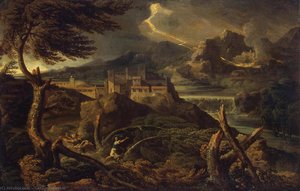
Gaspard Dughet
1613 - 1675 , Italy
Trumpa informacija
- Full Name: Gaspard Dughet
- Nationality: French
- Date Of Birth: 1613
- Date Of Death: 1675
- Place Of Birth: Rome, Italy
- Notable Artworks:
- Landscape with Cross
- View of the Hermitage of Camaldoli near Frascati
- Artistic Movement Or Style: Baroque Landscape
- Artists Who Influenced This Artist: Nicolas poussin
- Artists Or Movements Influenced By This Artist: British landscape painting
Susiję straipsniai
Cornelis van Poelenburch: Bridging Mannerism & the Dutch Baroque Landscape
Discover Cornelis van Poelenburch, a pivotal Dutch Baroque landscape painter bridging Mannerism & Italianate styles. Explore his life, key works, and lasting influence on 17th-century art with OriginalUniqueArt.

10 Romantinių Peizažų Simbolių: Tapybos Majestatės Viršūnės
Atraskite 10 legendinių romantinio peizažo kūrinių! Pasinerkite į Claude Lorrain, Caspar David Friedrich ir J.M.W. Turner genijaus pasaulį. Išmokite apie tapybos meistriškumą bei gamtos grožį. Aukščiausios kokybės meno reprodukcijos – OriginalUniqueArt.com. Tyrinėkite kolekciją!

Evocations of Place: A Historical Journey Through Landscape Art
Explore the rich history of landscape art with OriginalUniqueArt. Discover renowned artists, movements like Impressionism & Romanticism, and expert guidance for collecting timeless pieces. Find your perfect serene escape today!

Claude Lorrain: Master of Light & Landscape in the Golden Age
Explore the luminous landscapes of Claude Lorrain, a Baroque master renowned for his masterful use of light & atmosphere. Discover his life, techniques, key works & enduring influence on art history.

Evoking Atmosphere & Identity: A Journey Through Landscape Painting's History
Explore the rich history of landscape painting! Discover renowned artists, movements like Romanticism, & techniques such as atmospheric perspective. Find inspiration and quality reproductions at OriginalUniqueArt.