Perjungti į spausdinamus版作品
 Skaityti daugiau







































 Dėl meno kūrinių ar reprodukcijų, kurių bet kuri pusė yra didesnė nei 105 cm (apie 41 inch), rėmas bus siunčiamas kaip išskaidytas surinkimo rinkinys. Šis metodas užtikrina saugų pristatymą ir apsaugo nuo transportavimo metu galimos žalos.


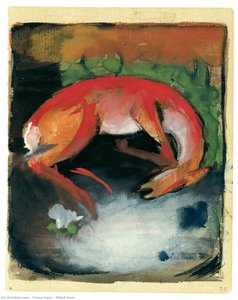
A Moment of Tranquility Captured in Color: Exploring Franz Marc’s “Sleeping Deer”
Franz Marc’s “Sleeping Deer,” painted in 1913, stands as a cornerstone of German Expressionism—a movement that sought to convey inner emotions and spiritual truths through bold artistic expression. More than just a depiction of an animal resting peacefully, this artwork embodies Marc's profound belief that art could serve as a conduit for accessing the sacred, reflecting his formative engagement with theology alongside his burgeoning fascination with the natural world.
The Style of Cubism – A Revolutionary Approach
- Cubist Influence: Marc’s stylistic choices align closely with the principles of Cubism, pioneered by Pablo Picasso and Georges Braque. Unlike traditional representational art that strives for accurate depiction, Cubism fragments objects into geometric planes, presenting multiple perspectives simultaneously.
- Simplified Forms: Observe how Marc reduces the deer's form to simplified shapes—primarily rectangular and triangular—emphasizing its essence rather than meticulous detail. This deliberate distortion contributes to the artwork’s expressive power.
Technique and Color Palette – Expressions of Emotion
Marc employed a tempera technique, known for its luminosity and durability. The vibrant hues he utilized—primarily reds, yellows, and blues—were not merely decorative; they functioned as symbolic representations of inner states. Red signifies passion and vitality, yellow embodies optimism and enlightenment, while blue evokes serenity and contemplation. These colors intertwine to create a harmonious yet dynamic visual experience.
Historical Context – The Blaue Reiter Circle and Spiritual Quest
“Sleeping Deer” emerged from the influential Blaue Reiter (“Blue Rider”) circle—a group of artists who championed abstraction as a means of conveying spiritual ideas. Marc, along with Wassily Kandinsky and Alexej von Jawlensky, believed that art could transcend materialism and connect directly to the divine. This conviction fueled their experimentation with color and form, aiming for an emotional resonance that surpassed mere visual representation.
Symbolism – Deer as Embodiment of Innocence and Spiritual Harmony
The deer itself holds significant symbolic weight within Marc’s oeuvre. Often interpreted as representing innocence, purity, and spiritual harmony—themes central to Christian iconography—the animal embodies Marc's desire to depict the sublime beauty of nature imbued with divine presence. Its posture—resting calmly on its paws—further reinforces this notion of tranquility and repose.
Emotional Impact – A Window into Inner Reflection
"Sleeping Deer" invites viewers into a meditative state, prompting contemplation on themes of peace, vulnerability, and the interconnectedness of life. Marc’s masterful use of color and form transcends mere visual observation, tapping into deeper emotional currents—a testament to his enduring legacy as one of Expressionism's most visionary artists.
Klausimai ir atsakymai
Kokia buvo „Sleeping Deer“ kūrimo metai ir kokiam stiliui jis priklauso?
„Sleeping Deer“ – Francas Markas sukurta 1912 m. ir priklauso German Expressionism stiliui.
Kokia yra „Sleeping Deer“ – Francas Markas spalvų gama?
„Sleeping Deer“ – Francas Markas kūryboje naudojama Earthy paletė, kurioje dominuoja Rosy Brown (#cdb286) spalva.
Ar yra vadovas kūriniui „Sleeping Deer“ – Francas Markas?
„Sleeping Deer“ – Francas Markas Informacinė medžiaga puslapioje galima rasti spausdinamą dviejų lapų informacinę lentelę: kūrinį su jo tapatybės lentele, laikotarpį nurodantį juostą, atitinkantį gyvenimo metus, kitus šio autoriaus darbus, išmatuotą spalvų paletę bei keturiomis stiliais paruoštus citavimo pavyzdžius.
 Peržiūrėti realaus dydžio版
 Pasidalinti
 Dalintis
 Išsamiau
 Vadovas

 Atsisiųsti
 Panašūs eksponatai
 Rentgeno spindulių nuotrauka
 Automatinė diorama
 Q&A
Q&A Statistika