Ecsalių versija
 Viskas apie Staircase 19







































 Dėl meno kūrinių ar reprodukcijų, kurių bet kuri pusė yra didesnė nei 105 cm (apie 41 inch), rėmas bus siunčiamas kaip išskaidytas surinkimo rinkinys. Šis metodas užtikrina saugų pristatymą ir apsaugo nuo transportavimo metu galimos žalos.


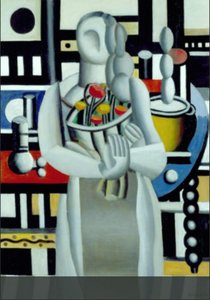
Fernand Léger, a prominent figure in the Cubism movement, created "Staircase" in 1914. This painting is a quintessential example of Cubist art, characterized by its geometric forms and fragmented objects.
Composition and Elements
The scene depicts a stairwell with various objects scattered throughout the space. Multiple cups of different sizes are placed on the steps, some closer to the viewer and others further away. A bowl is located near the center of the painting, while a vase is positioned towards the left side. Several bottles are scattered throughout the scene, with one close to the top right corner, another in the middle-right area, and two more on the bottom right side. A chair can be seen near the center of the painting, while a clock is located towards the upper left corner.Cubism and Proto-Cubism
Cubism, pioneered by Pablo Picasso and Georges Braque, revolutionized painting and visual arts in the early 20th century. The movement influenced artistic innovations in music, ballet, literature, and architecture. Cubist subjects are analyzed, broken up, and reassembled in an abstract form, depicting multiple perspectives to represent the subject in a greater context. Proto-Cubism, also referred to as Protocubism, Early Cubism, and Pre-Cubism or Précubisme, is an intermediary transition phase in the history of art chronologically extending from 1906 to 1910. This period is characterized by a move towards the radical geometrization of form and a reduction or limitation of the color palette.Artistic Influences
Fernand Léger's "Staircase" reflects the influence of Paul Cézanne's late works, which represented three-dimensional forms in a more geometric manner. The painting also showcases the artist's adherence to the principles of Cubism, as seen in the fragmented objects and multiple perspectives.Relevance and Legacy
Cubism has been considered the most influential art movement of the 20th century. Its impact was far-reaching and wide-ranging in the arts and popular culture. The movement introduced collage as a modern art form and influenced various offshoots, including Orphism, abstract art, Futurism, Suprematism, Dada, Constructivism, De Stijl, and Art Deco. In conclusion, Fernand Léger's "Staircase" is a significant work in the Cubist movement, showcasing the artist's skillful use of geometric forms and fragmented objects. The painting reflects the influence of Cézanne and the principles of Cubism, contributing to the movement's lasting impact on modern art.Klausimai ir atsakymai
Ar šis kūrinys Staircase 19 yra sukeitintas rankiniu būdu ar atspausdintas?
Ranko darbas: profesionalus pavežėjas rankiniu būdu nukopijuoja Staircase 19 aliejuje ant lino drobės.
Kokią dydį turėčiau pasirinkti darbui Staircase 19?
Dydviai svyra nuo 28.3 x 35.4 cm (€179) iki 196.6 x 245.8 cm (€1587); šioje pusėje pateiktoje lentelėje nurodyti pagrindiniai etapai ir jų kainos.
Kiek trunka pristatymas?
Pristatymas užtruks nuo 4 iki 5 savaičių, naudojant nemokamą ekspresinį siuntimą visame pasaulyje; šioje pusėje taip pat galite rinktis skubios gamybos variantą. Jūs galite grąžinti prekę per 100 dienų ir gauti visą sumokėtą sumą atgal, nepriklausomai nuo bet kokių sąlygų.
Kur yra originalas kūrinio Staircase 19?
Originalas yra Kunstmuseum Basel kolekcijoje, Bazelis.
Kokia technika buvo naudojama kūriniui Staircase 19 autoriu Fernand Léger?
Acrylic On Canvas
 Peržiūrėti realaus dydžio版

 Pasidalinti
 Dalintis
 Išsamiau
 Informacinė l lapelė


 Atsisiųsti
 Panašūs eksponatai
 Rentgeno spindulių nuotrauka
 Automatinė diorama
 问答

 Statistika