Ecsalių versija
 Viskas apie Spring







































 Dėl meno kūrinių ar reprodukcijų, kurių bet kuri pusė yra didesnė nei 105 cm (apie 41 inch), rėmas bus siunčiamas kaip išskaidytas surinkimo rinkinys. Šis metodas užtikrina saugų pristatymą ir apsaugo nuo transportavimo metu galimos žalos.


Introduction
This article provides an analysis of the painting 'Spring' by Edvard Munch, a Norwegian painter known for his Expressionist style. The focus will be on the artist, title, style, date, and composition, as well as the use of light and shadow in this masterpiece.The Artist: Edvard Munch
Edvard Munch (1863-1944) was a Norwegian painter and printmaker who played a significant role in the development of Expressionism. His work, which often depicted intense emotions and psychological states, was influenced by Symbolism, Romanticism, and Realism. He is best known for his iconic painting 'The Scream' (1893), but his oeuvre includes various themes such as love, death, and anxiety.Title: Spring
'Spring' (1889) is one of Munch's early works, painted during his stay in Paris. The painting reflects the artist's fascination with nature, human emotions, and the passing of time. It also marks a transition from his earlier Naturalist style to a more expressive approach that would become characteristic of his mature work.Style: Expressionism
Expressionism is an artistic movement that emerged in the late 19th and early 20th centuries, characterized by the distortion of reality for emotional effect. Artists sought to express their inner worlds, often using bold colors, exaggerated forms, and unconventional compositions. Munch's 'Spring' exemplifies these characteristics with its vivid hues, fluid brushstrokes, and emotionally charged atmosphere.Date: 1889
The year 1889 was significant for Munch as he began to explore new artistic directions during his stay in Paris. 'Spring' reflects the artist's growing interest in capturing the essence of human emotions and the transience of life, themes that would become central to his work.Composition and Use of Light and Shadow
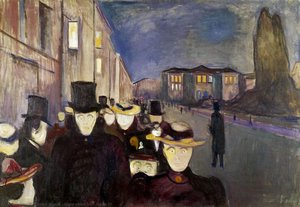
In 'Spring', Munch employs a simplified composition with two main figures: a woman in a red dress and a man in a black suit. The couple is depicted walking along a path, surrounded by lush vegetation and vibrant colors. The use of light and shadow creates depth and atmosphere, emphasizing the emotional connection between the characters and their environment. The artist masterfully employs chiaroscuro to enhance the dramatic effect of the scene. The contrast between light and dark areas adds tension and mystery, inviting viewers to explore the painting's deeper meaning. Munch also uses color symbolism to convey emotions: red represents passion and love, while black signifies melancholy and despair.Conclusion
Edvard Munch's 'Spring' (1889) is a powerful example of Expressionist art that showcases the artist's innovative approach to painting. By examining the composition, use of light and shadow, and symbolic elements, we can better understand Munch's unique vision and his contribution to modern art. OriginalUniqueArt.com offers high-quality hand-made oil paintings reproductions of 'Spring' by Edvard Munch, allowing art enthusiasts to appreciate this masterpiece in their homes or offices. Explore our collection and discover the beauty of Expressionist art.- Read more about: the Abstract Expressionism Art Movement
- Discover: Edvard Munch's 'Spring' painting
- Learn about: Muzeul K.h. Zambaccian, Bucharest, Romania, where some of Munch's works are exhibited.
Klausimai ir atsakymai
Ar šis kūrinys Spring yra sukeitintas rankiniu būdu ar atspausdintas?
Ranko darbas: profesionalus pavežėjas rankiniu būdu nukopijuoja Spring aliejuje ant lino drobės.
Kokią dydį turėčiau pasirinkti darbui Spring?
Dydviai svyra nuo 25.2 x 39.7 cm (€179) iki 153.9 x 242.4 cm (€1263); šioje pusėje pateiktoje lentelėje nurodyti pagrindiniai etapai ir jų kainos.
Kiek trunka pristatymas?
Pristatymas užtruks nuo 4 iki 5 savaičių, naudojant nemokamą ekspresinį siuntimą visame pasaulyje; šioje pusėje taip pat galite rinktis skubios gamybos variantą. Jūs galite grąžinti prekę per 100 dienų ir gauti visą sumokėtą sumą atgal, nepriklausomai nuo bet kokių sąlygų.
Kokia technika buvo naudojama kūriniui Spring autoriu Edvardas Munchas?
Acrylic On Canvas
 Peržiūrėti realaus dydžio版

 Pasidalinti
 Dalintis
 Išsamiau
 Informacinė l lapelė


 Atsisiųsti
 Panašūs eksponatai
 Rentgeno spindulių nuotrauka
 Automatinė diorama
 问答

 Statistika