 Ecsalių aliejus
 Viskas apie Stop Clock







































 Dėl meno kūrinių ar reprodukcijų, kurių bet kuri pusė yra didesnė nei 105 cm (apie 41 inch), rėmas bus siunčiamas kaip išskaidytas surinkimo rinkinys. Šis metodas užtikrina saugų pristatymą ir apsaugo nuo transportavimo metu galimos žalos.


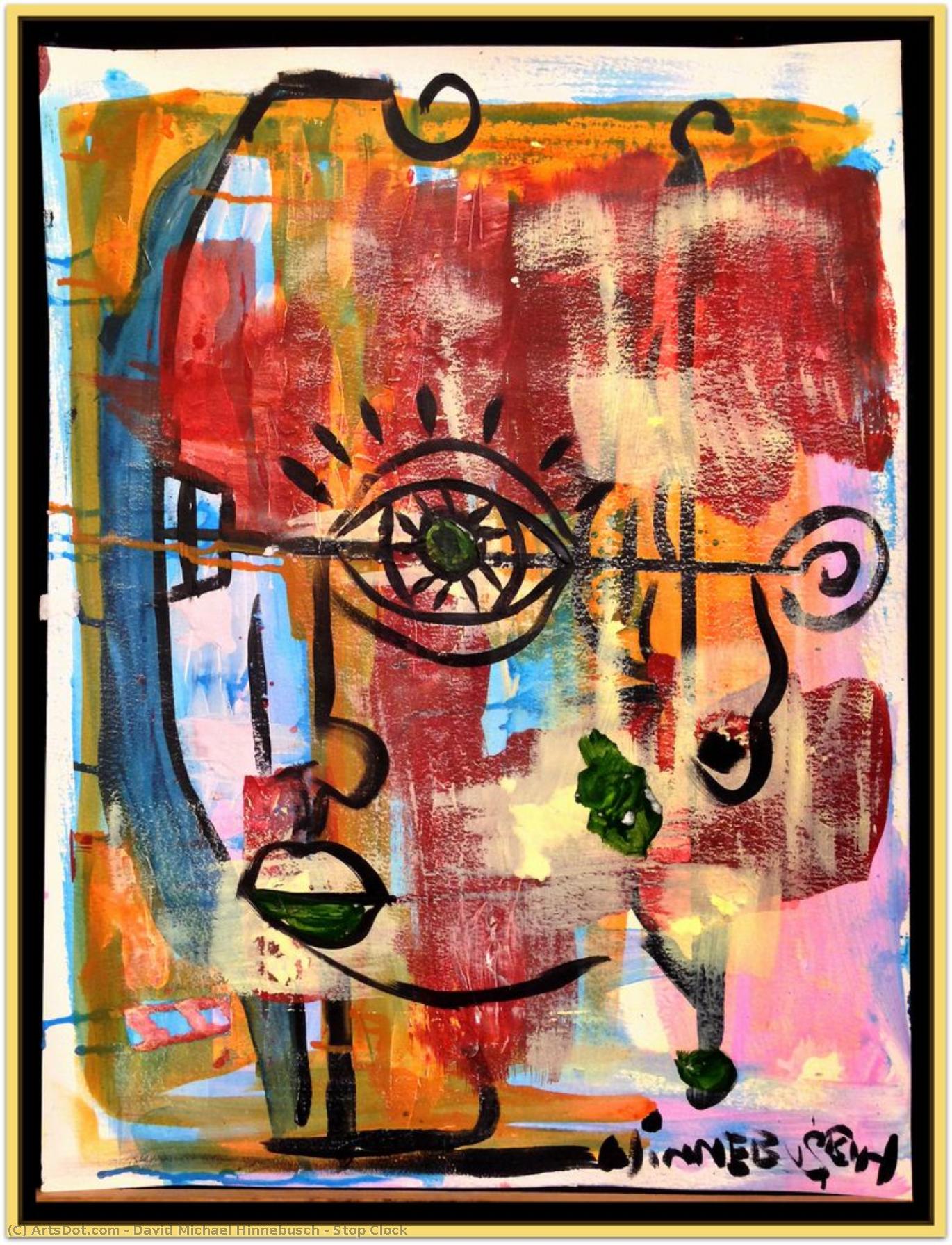
The Stylized Portrait of Stop Clock
In Stop Clock, David Michael Hinnebusch presents a stylized portrait of a human face that moves away from traditional likeness. Created in 2016, the work functions as an expressive interpretation of the human form rather than a literal representation. The subject is rendered through bold, black lines that define the eyes, nose, and mouth with a deliberate, slightly distorted simplicity. This approach allows the artist to prioritize the emotional weight of the gaze over anatomical precision.
The face is centrally positioned, drawing the viewer into a direct encounter with the subject. A single, prominent eye, represented by concentric circles, anchors the composition and suggests a sense of quiet observation. This focal point provides a moment of stillness amidst the energetic, layered colors that surround the figure. The portrait captures a specific tension between the recognizable features of a person and the abstract energy of the background.
David Michael Hinnebusch uses this abstraction to explore the internal landscape of the subject. The work avoids the comforts of realism, opting instead for a visual language that communicates intensity and awareness. By stripping the face down to its essential shapes, the artist invites a deeper engagement with the psychological presence of the figure. It is a quiet, forceful study of identity and perception.
Composition and Visual Elements
The portrait is centrally positioned within the frame, with the head occupying most of the vertical space. This placement creates an immediate sense of presence, pulling the viewer into a direct encounter with the subject. While the face itself maintains a degree of symmetry, the surrounding composition utilizes asymmetry to create a sense of movement. The background consists of layered washes and strokes of various hues, which swirl around the central figure in a way that feels both energetic and somewhat chaotic.
There is a striking economy in how the features are rendered. Thick, black lines define the eyes, nose, mouth, and eyebrows, eschewing fine detail for expressive, slightly distorted forms. The eye is particularly notable, represented by a large circle containing a smaller concentric circle within it. The nose is indicated by a simple vertical line, while the mouth is suggested by a single curved shape. These simplified elements allow the viewer to focus on the psychological weight of the gaze rather than anatomical precision.
Technique and Artistic Materials
In this work, the artist employs a tactile approach that emphasizes the physical presence of the medium. The surface is built through an energetic layering of washes and bold brushstrokes, suggesting a process of constant revision and movement. There is a clear evidence of a wet-on-wet technique, where colors are allowed to blend directly on the canvas, creating soft transitions amidst the more defined, gestural marks. This method lends the piece a sense of immediacy, as if the paint was applied with a certain urgency.
The texture is quite pronounced. You can see the evidence of the brush in the thick impasto and the way the paint sits upon the surface. This creates a three-dimensional quality that invites a closer look at the interplay between the colors. The materials appear to be acrylic paint applied to a canvas, or perhaps a similar suitable surface, which allows for such heavy, layered application without losing the clarity of the individual strokes. The result is a surface that feels lived-in and deeply textured.
Related Works by the Artist
To understand the trajectory of Hinnebusch’s recent output, one might look toward his 2017 pieces. Works such as I Will Buy Art Today and Vernon S Place offer a glimpse into the same period of intense creative activity that produced this piece. These works share a certain immediacy, reflecting the artist's continued engagement with the layered, gestural language that defines his practice.
The artist's exploration of form and emotion remains consistent across his various compositions. For instance, A Vision, created about 2017, and Ache, also from 2017, demonstrate his ability to navigate the space between the figurative and the abstract. In these works, the tension between structured imagery and spontaneous, expressive marks remains a central concern, much like the energy found within the layers of this portrait.
Klausimai ir atsakymai
Ar šis kūrinys Stop Clock yra rankų darbo ar atspausdintas?
Rankų darbas: profesionalus pavežėjas rankiniu būdu nukopijuoja Stop Clock aliejuje ant lino drobės.
Kokį dydį turėčiau pasirinkti darbui Stop Clock?
Originalo matmenys yra 61 x 46 cm. Dydviai svyra nuo 36.2 x 27.7 cm (€200) iki 240.8 x 184.2 cm (€1677); šioje pusėje pateiktoje lentelėje nurodyti galimi variantai ir jų kainos.
Kiek trunka pristatymas?
Pristatymas užtruks nuo 4 iki 5 savaičių (naudojant nemokamą ekspresinį siuntimą visame pasaulyje); šioje pusėje taip pat galite rinktis skubios gamybos variantą. Prekę galite grąžinti per 100 dienų ir gauti visą sumokėtą sumą atgal, nepriklausomai nuo bet kokių sąlygų.
Kokia technika buvo naudojama kūriniui Stop Clock autoriu Davidas Michaelis Hinnebuschas?
Acrylic On Canvas
 Peržiūrėti

 Pasidalinti
 Dalintis
 Išsamiau
 Informacinė lLapelė


 Atsisiųsti
 Panašūs eksponatai
 Rentgeno spindulių nuotrauka
 Automatinė diorama
 Klausimai ir atsakymai

 Statistika


