

 Peržiūrėti realaus dydžio版
 Siųsti
 Dalintis
 Išsamiau
 Vadovas

 Atsisiųsti
 Panašūs eksponatai
 Rentgeno spindulių nuotrauka
 Diaporama
 Statistika
PAYSAGE AUX CINQ BAIGNEUSES


 Rodyti daugiau
Giclée / Meno spausdinimas
Muziejų lygio „giclée“ arba drobos spausdinimas: greita gamyba ir lankstios apdailos parinktys. ( Pirkti rankomis tapytą reprodukciją Perejti prie skaitmeninių vaizdų)




P118B $10

P118H $10

P118W $10

P438Z $10

P508JH $12

P508YH $12

P805H $10

P805Z $10

P919BZ $10

P919G $10

P919XJ $10

P959ZH $10

P968JZ $12

W106C $8

W218G $10

W218JH $8

W218Y $10

W307PJ $10

W316G $10

W316PJ $8

W316Y $10

W398PJ $8

W4111J $10

W500HY $15

W500JH $15

W692G $12

W849H $8

W940BG $15

W953PJ $8




Pasirinkite iš mūsų nustatytų dydžių, atitinkančių originalaus meno kūrinio proporcijas.

Galite nurodyti savo matmenis, kad vaizdas atitiktų konkretų rėmą ar erdvę. Jei pasirinktas dydis nesutaps su originalaus paveikslėlio proporcijomis, mes arba apkirpsime kūrinį, arba išplėsime vaizdą naudojant veideliu atspindėtą arba vientisą šoną. Skaitmeninis maketas bus išsiųstas jums patvirtinti prieš pradedant gamybą.
Atkreipkite dėmesį, kad ekrane matomas vaizdinys neatspindi tikrojo apkirpimo ar išplėtimo. Tik maketas tiksliai parodytų galutinę kompoziciją.
Nors galima rinktis ir individualius dydžius, rekomenduojame pasirinkti vieną iš išanksti nustatytų matmenų, kad būtų išlaikytos originalios proporcijos.
Pristatymas visame pasaulyje () per 2 weeks, o ne įprastas 4/5 savaičių laikotarpis. (27 rugsėjis)

Nemokamas greitasis pristatymas visame pasaulyje

Aukštos kokybės lininis drobė

Pilnas siuntimo draudimas

Muitinės mokesčių grąžinimo garantija

Tikro spalvų atitikimo garantija

100 dienų grąžinimo politika (tik esant įtaigoms)

100% pinigų grąžinimo garantija

Nuolaida dideliems užsakymams
 Stiklo variantas prieinamas tik pasirinkus dydį iki 110 cm

PAYSAGE AUX CINQ BAIGNEUSES
Giclée / Meno spausdinimas
Reprodukcijos dydis
-


Visų pasirinktų variantų kaina
$ 80
A Symphony of Light and Myth
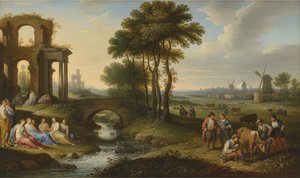
In the quiet, golden glow of an idealized Roman hillside, Cornelis van Poelenburch’s Paysage aux cinq baigneuses (Landscape with Five Bathers) invites the viewer into a realm where time seems to suspend itself. Executed between 1627 and 1630, this exquisite oil on copper masterpiece serves as a profound meditation on the harmony between humanity and the natural world. As one gazes upon the lush foliage and rugged rocky outcrops, there is an immediate sense of serenity, a palpable stillness that transcends the centuries. The painting does not merely depict a scene; it orchestrates an atmosphere, using a warm, diffused light to bathe five nude figures in a soft, ethereal radiance that suggests a moment of divine grace captured in the fleeting seconds of a summer afternoon.
The narrative woven into this landscape is deeply rooted in the humanist ideals of the seventeenth century. By portraying men and women engaged in the ritual of bathing amidst nymphs and satyrs, Van Poelenburch draws directly from the wellspring of classical mythology. This choice of subject matter elevates the work from a simple pastoral scene to a symbolic exploration of desire, beauty, and contemplation. The figures, rendered with a delicate grace, embody the Renaissance preoccupation with the human body as a vessel of both intellect and aesthetic perfection. For the discerning collector or interior designer, this piece offers more than visual splendor; it provides a window into an era that sought to find the sacred within the sensual, making it a captivating centerpiece for any space dedicated to reflection and elegance.
Mastery of the Baroque Brush
Technically, the work is a triumph of the Dutch Baroque tradition, showcasing Van Poelenburch’s ability to balance the dramatic tension of Mannerism with the clarity of the emerging Baroque style. The artist employs a sophisticated technique of layering oil paint to build a sense of profound depth and volume. While one might detect subtle distortions in form—a lingering influence from his Mannerist predecessors—the overall composition is defined by an exquisite equilibrium. The perspective recedes thoughtfully into hazy, distant mountains, creating a spatial ambiguity that draws the eye deeper into the landscape, while the organic shapes of trees and stone are anchored by a balanced, classical structure.
The color palette is a masterclass in understated luxury, dominated by earthy ochres, deep browns, and muted greens that ground the mythological fantasy in a sense of tangible reality. These somber tones are brilliantly punctuated by highlights of gold and pale blues in the sky, mirroring the way sunlight filters through a forest canopy. The texture of the skin is rendered with such smoothness that it almost invites a tactile response, contrasting beautifully with the ruggedness of the landscape. For those seeking to adorn a sophisticated interior, this painting offers a versatile emotional impact; its warm tones and tranquil subject matter can evoke feelings of peace and classical grandeur, seamlessly integrating into both traditional and contemporary settings as a testament to timeless artistic excellence.
Autoriaus biografija
Rašutis gyvenimas ir mokymas
Cornelis van Poelenburghas, iškilusis holandijos pejzažų dailininkas, gimė Utrechtėje, Holandijoje 1594 m. Jis pradėjo mokytis pas Akmeniu Bloemaertu, tuo metu garsiu dirbtiniu. Šis pagrindinis mokymas padarė pagrindą Van Poelenburghaus ateičiai sėklei.Dailės karjera ir įtakos
Van Poelenburghaus kelionės į Romą ankstyvo XVII amžiaus metu žymiai paepino jo kūrinį, panaudojant jį kaip pirmosios kartos holandijos pejzažų dailininkų lyderį, aktyvius Italijoje. Jo mažo formato vaizdai, dažnai su itališkais kraštomiliais, kuriuose atvaizduotas maži kūriniai, įgyvendinant biblingas ar mitologijas scenas, parodė jo unikalią stilių išsaugavimą.Žymūs kūriniai:- Satyrai, stebinantių nimfų (po 1627 m.), charakteringas Van Poelenburghaus kūrinis, atvaizduojantis arhaikiniais kraštomiliais su keliu, įkąpę žomis. (Peržiūrėti OriginalUniqueArt)
- Dievų Taryba (apsk. 1630 m.), vienas vaizdas, atvaizduojantis Van Poelenburghaus idealizuotą papurginį kraštomilį ir romane įkvėptas dieves, dabar saugomas Mauritshuise (Hagė, Holandija)>. (Peržiūrėti OriginalUniqueArt)
Palėjimas ir vėlesnis gyvenimas
Van Poelenburghaus kūriniai buvo labai vertinami jo bendraamživių, įskaitant Tuscanios didgubią ir holandijos statholdžerį. Vėliau jis grįžo į Utrechtę, kur mirė 1667 m., tik keliais metais po savo senesnio mokytojo Abraham Bloemaerto. Pagrindiniai punktai:- Gimė Utrechtėje, Holandijoje 1594 m.
- Mokėsi pas Abraham Bloemaerto
- Įkvėptas laiku Rimo
- Žinomas dėl mažo formato itališkų kraštomilžių su kūriniais
- Mirė Utrechtėje 1667 m. Peržiūrėti Cornelis van Poelenburghaus kūrinius OriginalUniqueArt Daugiau apie Cornelis van Poelenburghą į Wikipedia

Cornelis Van Poelenburch
1594 - 1667 , Netherlandija
Trumpa informacija apie kūrėją
- Artistic Movement Or Style: Holandijos pejzažas, Romanikas
- Artists Or Movements Influenced By This Artist: ['Klaudas Lorrainas']
- Artists Who Influenced This Artist: ['Abraham Bloemaert']
- Date Of Birth: 1594 m., Utrechtas, Holandija
- Date Of Death: 1667 m., Utrechtas, Holandija
- Full Name: Cornelis van Poelenburgh
- Nationality: Holandietis
- Notable Artworks:
- Satyrai, žinotų nimfų
- Dievų Taryba
- Place Of Birth: Utrechtas, Holandija
Susiję straipsniai

Masterpieces of Light: A Definitive Guide to the Landscapes of the Dutch Golden Age
Discover the luminous mastery of Dutch Golden Age landscapes. Our expert guide explores the atmospheric realism of masters like Van Goyen and Cuyp. Elevate your space with museum-quality, hand-painted oil reproductions from OriginalUniqueArt.com. Art history, beautifully realized.
Cornelis van Poelenburch: Bridging Mannerism & the Dutch Baroque Landscape
Discover Cornelis van Poelenburch, a pivotal Dutch Baroque landscape painter bridging Mannerism & Italianate styles. Explore his life, key works, and lasting influence on 17th-century art with OriginalUniqueArt.

Rembrandto van Rijn šedevrai: 25 paveikslai, įkvėpę amžius | OriginalUniqueArt
Atraskite 25 įspūdingiausius Rembrandto paveikslus! Išsami istorija, meno technikos ir simbolika. Olandų baroko šedevrai jūsų interjerui – aukštos kokybės reprodukcijos OriginalUniqueArt.com. Explore the full collection online!

Golden Light & Dutch Skies: The Timeless Magic of Dutch Golden Age Landscapes
Discover the breathtaking beauty of Dutch Golden Age landscapes. Explore the mastery of light, chiaroscuro, and 17th-century realism through an expert art history lens, celebrating the enduring legacy of the Dutch Masters for discerning collectors and art lovers.

Jan van Goyen: Master of Dutch Landscape & Atmospheric Perspective
Discover Jan van Goyen, the master of Dutch landscape painting. Explore his subtle technique, atmospheric realism & lasting influence on art history. Learn about this 17th-century pioneer at OriginalUniqueArt.