

 Peržiūrėti realybėje
 Pasidalinti
 Dalintis
 Išsamiau

 Atsisiųsti
 Panašūs eksponatai
 Rentgeno nuotrauka
 Automatinė diorama
In the moonlight


 Skaityti daugiau
Įsigykite aukštos skiriamosios raiškos, patobulintą skaitmeninį vaizdą, gerokai pranašesnį už internetinę peržiūrą.
Kiekvieną failą mūsų specialistai kruopščiai paruošia naudojant pažangias technologijas ir profesionalų rankinį retušavimą. Užtikriname, kad kiekvienas vaizdas pasižymėtų išskirtiniu aiškumu, tikslia spalvų atspalviu ir smulkiomis detalėmis.
Baigiamas failas el. paštu pristatomas per 72 valandas; jis optimizuotas nedelsiant naudojimui profesionalioje, redakcinėje ir spausdinimo aplinkoje. Tai ta pati kokybė, kuria pasitiki aukščiausios klasės dizaino studijos, leidyklos ir galerijos.
Skaitmeninis vaizdas
Atsisiųskite didelės raiškos failą asmeniniam naudojimui, spausdinimui ir kūrybiniams projektams. ( Pirkti spaudinį Pirkti rankomis tapytą paveikslą)
Kiekvieną skaitinio vaizdo užsakymą papildė
Profesionalus skaitmeninis pristatymas, garantuotas
Pasirinkę OriginalUniqueArt.com, jūs ne tik gaunate paveikslėlį – jūs gaunate profesionaliai patobudintą skaitmeninį kūrinį, sukurtą itin tikniai ir užtikrinantį pasitenkinimą. Štai viską, kas automatiškai pritékia jūsų užsakymui:

Greitas siuntimas el. paštu
Jūsų aukštos raiškos skaitmeninis vaizdo failas bus išsiųstas jums el. paštu per 72 valaudas nuo užsakymo – paruoštas naudojimui be jokių papildomų veiksmų.

Skaitmeninis failas su dirbtiniu intelektu
Jūsų meno kūrinys profesionaliai optimizuojamas naudojant pažangius dirbtinio intelekto įrankius ir rankinį redagavimą, užtikrinant maksimalią detalę, aiškumą ir spalvų tikslumą.

Nemokamas visam laikui pakartotinis siuntimas
Atsitiktinai ištrytikote ar praradote savo failą? Nebijokite – bet kuriuo metu atsiųsime jį jums vėl nemokamai.

Jokio importo mokesčio – niekada
Mėgaukitės savo meno kūriniu akimirka – skaitiniai failai visada yra neapmokestinami, todėl nereikės mokėti muitinės, mokesčių ar pristatymo mokesčių.

Spalvų tikslumo garantija
Naudodami profesionalią įrangą ir spalvų valdymo sistemas, užtikriname, kad jūsų skaitmeninis vaizdas kuo tiksliau atspindėtų originalias spalvas.

60 dienų pasitenkinimo garantija
Jei nebuvate patenkinti savo skaitinio vaizdo, per 60 dienų jį pertaisysime arba grąkinsime 100% sumą – be jokių klausimų.

100% pinigų grąžinimo garantija
Nepat 만족inti? Gaukite visą sumokėtą sumą per 60 dienų nuo skaitmeninio failo gavimo – be jokių papildomų klausimų.

Nuolaidos dideliems užsakymams
Pirkti 3 nuotraukas – pasiūla 10% - Pirkti 5 – pasiūla 15% - Pirkti 10 ir daugiau – pasiūla 20%. Puikiai tinka kūrybiniams projektams, galerijoms bei agentūroms.
Autoriaus biografija
The Soul Behind the Canvas: The Life and Legacy of Albert von Keller
Albert von Keller (1844–1920) stands as a singular figure in German art history—a painter who seamlessly blended the rigorous precision of realism with a burgeoning fascination for psychology and symbolism. Born in Gais, Switzerland, into a family steeped in intellectual tradition, Keller’s early life was marked by a disciplined curiosity. While his father, a professor of law, instilled in him a structured intellect, it was the pursuit of visual expression that would ultimately define his destiny. Though he initially moved toward the study of law at the Ludwig-Maximilians-Universität München, the siren call of the arts proved irresistible, leading him to abandon the courtroom for the studio, where he would spend the rest of his life exploring the profound depths of the human condition.
His formal training began at the prestigious Munich Academy under the guidance of Arthur von Ramberg. It was here that Keller developed a mastery of anatomical precision, particularly through controversial nude studies that challenged the social norms of his era. This technical foundation, however, was merely the beginning of his evolution. As he traveled extensively through Italy, France, England, and the Netherlands, Keller absorbed the luminous qualities of Impressionism and the delicate aesthetics of Japonisme. Yet, unlike many of his contemporaries who abandoned structure for pure light, Keller maintained a steadfast connection to the German Romantic tradition, creating a unique stylistic bridge between the observable world and the unseen psyche.
A Master of Psychological Realism
The true brilliance of von Keller lies in his ability to imbue portraiture and genre scenes with an almost haunting emotional resonance. He became a prominent figure in the Munich Secession, a movement that sought to push the boundaries of traditional art. His work often features female figures, rendered with a grace that oscillates between the ethereal and the tangible. Perhaps no subject was more central to his creative spirit than his wife, Irene von Eichthal. Their partnership, which lasted until her death in 1907, served as a profound muse; he would eventually paint over forty portraits of her, capturing not just her physical elegance but the very essence of her character.
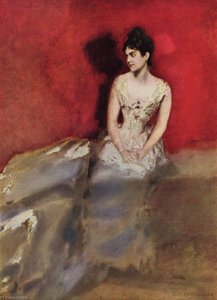
In masterpieces such as Deutsch Porträt der Frau des Künstlers, one can witness his technical prowess. He utilized striking juxtapositions—such as the pristine white of a lace gown against a deep, velvety crimson background—to create a sense of theatrical depth. This mastery of light and shadow allowed him to guide the viewer's eye through a silent dialogue of texture and tone. His ability to render the tactile quality of stone or the delicate fold of fabric served a higher purpose: to ground his more symbolic and psychological themes in a reality that felt undeniably present.
The Intersection of Science, Spirit, and Symbolism
As his career progressed, von Keller’s interests drifted toward the enigmatic. In 1886, he became a member of the Munich Psychological Society, a group devoted to the study of the paranormal under Albert von Schrenck-Notzing. This period marked a fascinating shift in his oeuvre, as he began to incorporate parapsychological motifs and themes of hypnosis into his compositions. Works like Hypnosis at Schrenck Notzing's demonstrate this transition, blending the muted tones of realism with the unsettling tension of the unknown. He explored themes of vulnerability, illness, and the subconscious, often connecting these modern psychological inquiries to classical Christian symbolism.
His international breakthrough at the Paris Salon with Roman Bath solidified his reputation as a painter of great atmospheric sensitivity, drawing comparisons to masters like Monet and Renoir. However, it was his ability to navigate the shadows of the human mind that secured his historical significance. By weaving together the following elements, he created a legacy that remains vital to the study of late 19th-century art:
- Technical Precision: A rigorous academic foundation in anatomy and light.
- Psychological Depth: The exploration of the subconscious, hypnosis, and emotional interiority.
- Symbolic Narrative: The use of genre scenes to communicate complex spiritual and human truths.
- Stylistic Synthesis: A unique blend of German Romanticism, Impressionist light, and Symbolist mystery.
Today, the works of Albert von Keller serve as a poignant reminder of an era when art was transitioning from the depiction of external reality to the exploration of internal truth. He remains a pioneer who dared to look beneath the surface of the skin to find the soul within.
albert von keller
1844 - 1920
Trumpai apie šį kūrėją
- Artistic Movement Or Style: Munich Secession
- Artists Or Movements Influenced By This Artist: ['Symbolism']
- Artists Who Influenced This Artist:
- Arthur von Ramberg
- Ludwig Maximilian University
- Date Of Birth: April 27, 1844
- Date Of Death: July 14, 1920
- Full Name: Albert Ritter von Keller
- Nationality: Swiss
- Notable Artworks:
- Hypnosis at Schrenck Notzing’s
- In the moonlight
- Place Of Birth: Gais, Switzerland

