Perjungti į spausdinamus版作品
 Skaityti daugiau







































 Dėl meno kūrinių ar reprodukcijų, kurių bet kuri pusė yra didesnė nei 105 cm (apie 41 inch), rėmas bus siunčiamas kaip išskaidytas surinkimo rinkinys. Šis metodas užtikrina saugų pristatymą ir apsaugo nuo transportavimo metu galimos žalos.


A Vision of Scientific Eminence
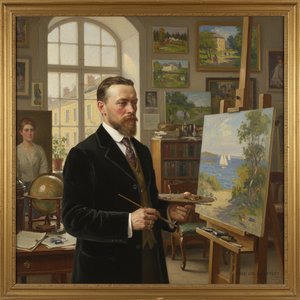
In the quiet, focused atmosphere of a late 19th-century laboratory, Albert Edelfelt captures a moment that transcends mere portraiture to become an icon of human intellect. Louis Pasteur dans son laboratoire is not simply a depiction of a man at work; it is a profound meditation on the dawn of modern medicine. The painting presents the legendary chemist and biologist amidst the glass and shadows of his sanctuary, surrounded by the very tools that would eventually dismantle the ancient myths of disease. As the viewer gazes upon Pasteur, there is an immediate sense of being drawn into a private ritual of discovery, where every flask and test tube holds the potential for a life-saving revelation.
Edelfelt, a master of Academic Realism, employs a technique that breathes life into the inanimate. Through the masterful use of chiaroscuro, the artist orchestrates a dramatic interplay of light and shadow that sculpts Pasteur’s figure with remarkable anatomical precision. The light does not merely illuminate; it directs our attention to the concentrated gaze of the scientist and the delicate transparency of the laboratory glassware. His brushstrokes are smooth and deliberate, creating a seamless texture that allows the viewer to feel the cool surface of the glass and the heavy, purposeful presence of the man himself. This meticulous approach ensures that the painting possesses a timeless, sculptural quality that commands attention in any sophisticated interior.
The Intersection of Art and Discovery
To understand the emotional weight of this masterpiece, one must consider the historical fervor of 1886. This was an era defined by the tension between old superstitions and the burgeoning power of empirical evidence. By placing Pasteur within his laboratory, Edelfeltt provides a visual testament to the Victorian values of progress and meticulous observation. The composition is rich with symbolic weight; the experimental apparatus serves as more than mere background detail—it represents the tangible instruments of the Germ Theory, the very foundation upon which modern public health was built. There is a palpable sense of quiet dignity in Pasteur’s posture, reflecting a man who carries the weight of scientific responsibility on his shoulders.
For the discerning collector or interior designer, this work offers an unparalleled opportunity to introduce a piece of intellectual history into a living space. The painting’s palette, characterized by deep, earthy tones and luminous highlights, provides a sophisticated anchor for a room, evoking a sense of stability, wisdom, and prestige. Whether placed in a private library, a study, or a grand salon, a high-quality reproduction of this work serves as a conversation piece that celebrates the enduring triumph of the human spirit over the unknown. It is an invitation to contemplate the beauty of logic and the profound impact of a single mind dedicated to the service of humanity.
Klausimai ir atsakymai
Kokia technika buvo panaudota kūriniam darbui „Louis Pasteur dans son laboratoire de l“ – Albertas Edelfeltas?
„Louis Pasteur dans son laboratoire de l“ – Albertas Edelfeltas technika – Oil On Canvas. Kopijos siekia atkartoti šios technikos vaizdą.
Kokia yra „Louis Pasteur dans son laboratoire de l“ – Albertas Edelfeltas technika ir kūrybos data?
„Louis Pasteur dans son laboratoire de l“ sukurtas 1886 m., naudojant Oil On Canvas.
Kokio meno kryžmės dalis yra „Louis Pasteur dans son laboratoire de l“ – Albertas Edelfeltas?
„Louis Pasteur dans son laboratoire de l“ – Albertas Edelfeltas priklauso Impressionistic Portraiture stiliui. Ši dailės kryptis suteikia kūriniui stilistinį kontekstą.
Daugiau informacijos apie šį paveikslą
 Peržiūrėti realaus dydžio版
 Pasidalinti
 Dalintis
 Išsamiau
 Vadovas

 Atsisiųsti
 Panašūs eksponatai
 Rentgeno spindulių nuotrauka
 Automatinė diorama
 问答
问答 Statistika