Hugo van der Goes portretas

Hugo van der Goes tapiai: 100 garsiausi πίναšiai, galerijos akimis

Atnaujinta lapkritis 2026 · pagal mūsų populiarumumo koeficientą (paieškos, lankytojai ir užsakymai kiekvienam kūriniui) · 137 Hugo van der Goes darbai mūsų kataloge

Trumpai tariant

Galerijos akimais, garsiausias Hugo van der Goes tapas yra Portinari triptychas (10) (1476), kurio originalas eksponuojamas Galleria degli Uffizi, Florencija. Šviesdiena Adoracijos Karūnų (Monforte Altorius) (1470) ir Adoration of the Magi (Triptych) (1460) užbaia trio, kurį atpažįsta kiekvienas ž)/\ Iš 137 Hugo van der Goes darbų mūsų kataloge, galerija žemiau pristato 100 garsiausius – kiekvienas yra originalus, su nurodytu metais, muziejumi bei unikaliu aprašymu.

1440 – 1482, Gentas Šiaurės renesansas Daugiausia darbų: Galleria degli Uffizi

10 geriausių galerijos Hugo van der Goes paveikslų

1
Portinari triptychas (10) (1476) aut. Hugo van der Goes

Portinari triptychas (10)

1476 · Aliejus · Galleria degli Uffizi, Florencija

Van der Goes magnum opus, *Portinari altarijus*, užsakytas Florencijos Santa Maria Nuova bažnyčios, yra lūžinis momentas meningės istorijoje. Apie 1476 metus užbaigtas šis monumentalus dielenės paveikslas įkvepia besivystantį Renesanso humanizmą ir įkūnija maldingumo bei kontemplacijos idealus, būdingus viduramžių sakraliam menui. Triptychas vaizduoja scenas iš Šv. Marija Magdalenos gyvenimo, rodant jos pakilimą į dangų kartu su angelais – tai galingi vizualiniai naratyvai, siekiantys įkvėpti dievdirbišką atsidavimą ir perteikti dvasinę transcendentaciją. Jo…

2
Šviesdiena Adoracijos Karūnų (Monforte Altorius) (1470) aut. Hugo van der Goes

Šviesdiena Adoracijos Karūnų (Monforte Altorius)

1470 · Aliejus ant drobės · Gemäldegalerie, Berlynas

„Karalių Gerame“ (Monforto Altorius) – Hugo van der Goes’ Relikvija Šis įspūdingas renesanso altoriukas, žinomas kaip „Karalių Geramas“ arba Monforto altorius, yra ne tik religijinio meno kūrinys, bet ir viso Hugo van der Goes tautosgardistės relikvija. 1470 metais sukurtas, jis įvykdyta išskirtinį momentą – pagarbos atakas, kai drieji magai atnešė savo dovanas Jumsėniui, kurio gimimo akimirką pildyta tikėjimu ir grožiu. Šis altoriukas yra ne tik istorinė relikvija, bet ir puikus…

3
Adoration of the Magi (Triptych) (1460) aut. Hugo van der Goes

Adoration of the Magi (Triptych)

1460 · Oil On Panel · Ermitažas, Šv. Peterburgas

The central panel holds a quiet, heavy gravity. A Virgin Mary, draped in a mantle of deep blue, cradles the Infant Jesus. Before them, a Magus in robes of saturated red kneels upon the earth. He offers gold, frankincense, and myrrh—treasures that catch the light against the dim, textured surroundings. The air in the painting feels thick with the weight of a divine encounter. Every fold of fabric and every…

4
Trinity (1480) aut. Hugo van der Goes

Trinity

1480 · Oil On Panel · Škotijos Nacionalinė galerija, Edinburgas

The air within this celestial realm feels heavy with a sacred, silent sorrow. A luminous golden background radiates from behind the central figures, casting a glow that seems to emanate from within the divine itself rather than from an external source. In this suspended moment of grace, God the Father reaches out to support the lifeless, pale body of Jesus Christ. The physical reality of the sacrifice is palpable in…

5
Calvary Triptych (central panel) (1465) aut. Hugo van der Goes

Calvary Triptych (central panel)

1465 · Oil On Canvas · Šv. Bavo katedra, Gentas

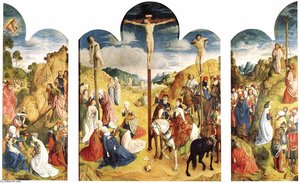
Hugo van der Goes’s “Calvary Triptych,” completed between 1465 and 1468, isn't merely a depiction of Christ’s crucifixion; it’s a profound meditation on sacrifice, redemption, and the human condition. Created during a pivotal moment in the burgeoning Northern Renaissance, this masterpiece transcends its religious subject matter to offer a remarkably intimate and psychologically astute portrayal of suffering and faith. The triptych format – a series of three panels hinged together…

6
Portinari Triptych (detail) (1478) aut. Hugo van der Goes

Portinari Triptych (detail)

1478 · Oil On Panel

Portinari Triptych (detail) is an artwork by Hugo van der Goes, dated 1478. This fragment belongs to the Northern Renaissance and the movement of Flemish Realism. It functions as a specific section of a larger religious triptych, focusing on a portrait of figures situated within a rocky landscape.

7
The Portinari Altarpiece, St. Thomas and St. Anthony the Hermit with Tommaso Portinari and two sons Antonio and Pigello, Left Wing (1475) aut. Hugo van der Goes

The Portinari Altarpiece, St. Thomas and St. Anthony the Hermit with Tommaso Portinari and two sons Antonio and Pigello, Left Wing

1475 · Oil On Panel · Galleria degli Uffizi, Florencija

Hugo van der Goes stands as a monumental figure in the history of Flemish painting, marking an undeniable shift from prevailing artistic conventions toward a breathtaking embrace of realism. Born around 1440 in Ghent, Belgium—a city brimming with artistic fervor—his life’s journey was interwoven with groundbreaking innovation and profound influence on both his contemporaries and subsequent masters across Europe. Unlike many artists of his time who prioritized idealized representations or…

8
Sts Margaret and Mary Magdalene with Maria Portinari (detail) (10) (1476) aut. Hugo van der Goes

Sts Margaret and Mary Magdalene with Maria Portinari (detail) (10)

1476 · Oil On Panel · Galleria degli Uffizi, Florencija

The air feels heavy with a quiet, spiritual weight as we gaze upon this intimate detail from the late fifteenth century. Within this fragment of the Portinari Triptych, a profound stillness settles over the figures. A woman, perhaps a nun or a saint, rests her hands upon a book, her presence anchored by the deep red of her clothing. Beside her, the scene breathes with life; horses move through the…

9
Sts Margaret and Mary Magdalene with Maria Portinari (detail) (13) (1476) aut. Hugo van der Goes

Sts Margaret and Mary Magdalene with Maria Portinari (detail) (13)

1476 · Oil On Panel · Galleria degli Uffizi, Florencija

This oil on panel painting presents a detailed view of several figures positioned within a wintry landscape. On the right side of the composition, a figure in red robes holds an open book. To the left, individuals move along a path; one person leads a donkey and a mule, while another sits atop a horse. The background contains rolling hills, bare trees, and a distant village situated under a cloudy…

10
Portinari Triptych (11) (1476) aut. Hugo van der Goes

Portinari Triptych (11)

1476 · Oil On Canvas · Galleria degli Uffizi, Florencija

Hugo van der Goes’s Portinari Triptych, completed around 1475, isn't merely a painting; it’s an immersive experience. This monumental work, now residing in the Uffizi Gallery in Florence, transcends its physical dimensions to offer a profound glimpse into the heart of late fifteenth-century Flanders and the burgeoning artistic currents flowing towards Italy. More than just portraits of a wealthy Florentine family – Tommaso and Maria Portinari – it’s a carefully…

Hugo van der Goes tapiai, rangos nuo 11 iki 100

11The Death of the Virgin (detail) (22) (1480) aut. Hugo van der GoesThe Death of the Virgin (detail) (22)1480 · Groeninge muziejus 12The Adoration of the Shepherds (detail) (19) (1476) aut. Hugo van der GoesThe Adoration of the Shepherds (detail) (19)1476 · Galleria degli Uffizi 13The Portinari tryptich (middle panel) (1478) aut. Hugo van der GoesThe Portinari tryptich (middle panel)1478 14The Adoration of the Shepherds (detail) (15) (1476) aut. Hugo van der GoesThe Adoration of the Shepherds (detail) (15)1476 · Galleria degli Uffizi 15Adoration of the Shepherds (detail) (10) (1480) aut. Hugo van der GoesAdoration of the Shepherds (detail) (10)1480 · Staatliche Museen zu Berlin 16Monforte Altarpiece (12) (1470) aut. Hugo van der GoesMonforte Altarpiece (12)1470 · Staatliche Museen zu Berlin 17Vienna Diptych (1470) aut. Hugo van der GoesVienna Diptych1470 · Kunsthistorisches Museum 18Monforte Altarpiece (detail) (23) (1470) aut. Hugo van der GoesMonforte Altarpiece (detail) (23)1470 · Staatliche Museen zu Berlin 19The Adoration of the Shepherds (1476) aut. Hugo van der GoesThe Adoration of the Shepherds1476 · Galleria degli Uffizi 20Monforte Altarpiece (detail) (26) (1470) aut. Hugo van der GoesMonforte Altarpiece (detail) (26)1470 · Staatliche Museen zu Berlin 21Monforte Altarpiece (11) (1470) aut. Hugo van der GoesMonforte Altarpiece (11)1470 · Staatliche Museen zu Berlin 22Sts Margaret and Mary Magdalene with Maria Portinari (1476) aut. Hugo van der GoesSts Margaret and Mary Magdalene with Maria Portinari1476 · Galleria degli Uffizi 23Portinari Triptych (12) (1476) aut. Hugo van der GoesPortinari Triptych (12)1476 · Galleria degli Uffizi 24Sts Anthony and Thomas with Tommaso Portinari (detail) (12) (1476) aut. Hugo van der GoesSts Anthony and Thomas with Tommaso Portinari (detail) (12)1476 · Galleria degli Uffizi 25The Death of the Virgin (1480) aut. Hugo van der GoesThe Death of the Virgin1480 · Groeninge muziejus 26Portrait of a Man (1475) aut. Hugo van der GoesPortrait of a Man1475 · Metropolitano meno muziejus 27Portinari Triptych (detail) (1478) aut. Hugo van der GoesPortinari Triptych (detail)1478 28The Adoration of the Shepherds (detail) (14) (1476) aut. Hugo van der GoesThe Adoration of the Shepherds (detail) (14)1476 · Galleria degli Uffizi 29Monforte Altarpiece (10) (1470) aut. Hugo van der GoesMonforte Altarpiece (10)1470 · Staatliche Museen zu Berlin 30The Trinity Altar Panels (detail) (1478) aut. Hugo van der GoesThe Trinity Altar Panels (detail)1478 31Monforte Altarpiece (detail) (15) (1470) aut. Hugo van der GoesMonforte Altarpiece (detail) (15)1470 · Staatliche Museen zu Berlin 32The Death of the Virgin (detail) (1480) aut. Hugo van der GoesThe Death of the Virgin (detail)1480 · Groeninge muziejus 33The Adoration of the Shepherds (detail) (13) (1476) aut. Hugo van der GoesThe Adoration of the Shepherds (detail) (13)1476 · Galleria degli Uffizi 34Portinari triptych - Mary Magdalen (with the pot of ointment) and Saint Margaret (with the book and the dragon) aut. Hugo van der GoesPortinari triptych - Mary Magdalen (with the pot of ointment) and Saint Margaret (with the book and the dragon) 35The Death of the Virgin (detail) (26) (1480) aut. Hugo van der GoesThe Death of the Virgin (detail) (26)1480 · Groeninge muziejus 36The Death of the Virgin (detail) (1480) aut. Hugo van der GoesThe Death of the Virgin (detail)1480 · Groeninge muziejus 37The Lamentation of Christ (1467) aut. Hugo van der GoesThe Lamentation of Christ1467 · Kunsthistorisches Museum 38The Adoration of the Shepherds (detail) (44) (1476) aut. Hugo van der GoesThe Adoration of the Shepherds (detail) (44)1476 · Galleria degli Uffizi 39The Portinari Altarpiece, St. Mary Magdalen and St. Margaret with Maria Baroncelli and Daughter Margherita Portinari, Right Wing (1475) aut. Hugo van der GoesThe Portinari Altarpiece, St. Mary Magdalen and St. Margaret with Maria Baroncelli and Daughter Margherita Portinari, Right Wing1475 · Galleria degli Uffizi 40Monforte Altarpiece (detail) (29) (1470) aut. Hugo van der GoesMonforte Altarpiece (detail) (29)1470 · Staatliche Museen zu Berlin 41Adoration of the Shepherds (detail) (15) (1480) aut. Hugo van der GoesAdoration of the Shepherds (detail) (15)1480 · Staatliche Museen zu Berlin 42Sts Anthony and Thomas with Tommaso Portinari (detail) (11) (1476) aut. Hugo van der GoesSts Anthony and Thomas with Tommaso Portinari (detail) (11)1476 · Galleria degli Uffizi 43Sts Anthony and Thomas with Tommaso Portinari (detail) (10) (1476) aut. Hugo van der GoesSts Anthony and Thomas with Tommaso Portinari (detail) (10)1476 · Galleria degli Uffizi 44Monforte Altarpiece (detail) (16) (1470) aut. Hugo van der GoesMonforte Altarpiece (detail) (16)1470 · Staatliche Museen zu Berlin 45Monforte Altarpiece (detail) (9) (1470) aut. Hugo van der GoesMonforte Altarpiece (detail) (9)1470 · Staatliche Museen zu Berlin 46The Death of the Virgin (detail) (23) (1480) aut. Hugo van der GoesThe Death of the Virgin (detail) (23)1480 · Groeninge muziejus 47Left wing of a Memorial Triptych, formerly called the Gertz Memorial Triptych, with nine male Donor Portraits with Saint John the Evangelist (inner), and Saint Peter (outer) (1527) aut. Hugo van der GoesLeft wing of a Memorial Triptych, formerly called the Gertz Memorial Triptych, with nine male Donor Portraits with Saint John the Evangelist (inner), and Saint Peter (outer)1527 · Rijksmuseum 48The Death of the Virgin (1480) aut. Hugo van der GoesThe Death of the Virgin1480 · Groeninge muziejus 49Monforte Altarpiece (detail) (28) (1470) aut. Hugo van der GoesMonforte Altarpiece (detail) (28)1470 · Staatliche Museen zu Berlin 50Monforte Altarpiece (detail) (30) (1470) aut. Hugo van der GoesMonforte Altarpiece (detail) (30)1470 · Staatliche Museen zu Berlin 51Deposition Diptych (Small Deposition, right wing) (1480) aut. Hugo van der GoesDeposition Diptych (Small Deposition, right wing)1480 · Staatliche Museen zu Berlin 52Genevieve (1479) aut. Hugo van der GoesGenevieve1479 · Kunsthistorisches Museum 53Virgin and Child (1474) aut. Hugo van der GoesVirgin and Child1474 · Philadelphia Museum of Art 54Adoration of the Magi before the stable on the hill (1483) aut. Hugo van der GoesAdoration of the Magi before the stable on the hill1483 · Gemäldegalerie 55Virgin and Child with saints (1474) aut. Hugo van der GoesVirgin and Child with saints1474 56Jacob and Rachel (1470) aut. Hugo van der GoesJacob and Rachel1470 · Christ Church Picture Gallery 57Joseph and Asenath (1475) aut. Hugo van der GoesJoseph and Asenath1475 58Mary with the Christ-child (1487) aut. Hugo van der GoesMary with the Christ-child1487 59The Descent from the Cross (1600) aut. Hugo van der GoesThe Descent from the Cross1600 · Museum of Fine Arts Ghent (MSK) 60Adoration of the Shepherds (1480) aut. Hugo van der GoesAdoration of the Shepherds1480 · Staatliche Museen zu Berlin 61The Fall (1467) aut. Hugo van der GoesThe Fall1467 · Kunsthistorisches Museum 62Sts Margaret and Mary Magdalene with Maria Portinari (detail) (16) (1476) aut. Hugo van der GoesSts Margaret and Mary Magdalene with Maria Portinari (detail) (16)1476 · Galleria degli Uffizi 63Adoration of the Magi aut. Hugo van der GoesAdoration of the Magi 64St. Luke drawing the Virgin (1400) aut. Hugo van der GoesSt. Luke drawing the Virgin1400 · Liaudies senovės meno nacionalinis muziejus 65Calvary Triptych (detail) (18) (1465) aut. Hugo van der GoesCalvary Triptych (detail) (18)1465 · Šv. Bavo katedra 66The Death of the Virgin (detail) (17) (1480) aut. Hugo van der GoesThe Death of the Virgin (detail) (17)1480 · Groeninge muziejus 67Follower of ) (1400) aut. Hugo van der GoesFollower of )1400 68Calvary Triptych (detail) (16) (1465) aut. Hugo van der GoesCalvary Triptych (detail) (16)1465 · Šv. Bavo katedra 69Flemish, ) (1440) aut. Hugo van der GoesFlemish, )1440 70Calvary Triptych (Right panel) (1468) aut. Hugo van der GoesCalvary Triptych (Right panel)1468 71Calvary Triptych (left panel) (1468) aut. Hugo van der GoesCalvary Triptych (left panel)1468 72Deposition Diptych (Small Deposition, right wing) (1480) aut. Hugo van der GoesDeposition Diptych (Small Deposition, right wing)1480 · Gemäldegalerie 73The Crucifixion (1470) aut. Hugo van der GoesThe Crucifixion1470 · Korero muziejus 74Portinari Triptych (detail) (1478) aut. Hugo van der GoesPortinari Triptych (detail)1478 75Portinari Triptych (detail) (1478) aut. Hugo van der GoesPortinari Triptych (detail)1478 76Portinari Triptych (detail) (1478) aut. Hugo van der GoesPortinari Triptych (detail)1478 77Christ on the cross (1480) aut. Hugo van der GoesChrist on the cross1480 78The Portinari Triptych (Close) (1478) aut. Hugo van der GoesThe Portinari Triptych (Close)1478 79Sts Margaret and Mary Magdalene with Maria Portinari (detail) (11) (1476) aut. Hugo van der GoesSts Margaret and Mary Magdalene with Maria Portinari (detail) (11)1476 · Galleria degli Uffizi 80The Nativity, at Night aut. Hugo van der GoesThe Nativity, at Night 81The fall of man aut. Hugo van der GoesThe fall of manKunsthistorisches Museum 82Calvary Triptych (1465) aut. Hugo van der GoesCalvary Triptych1465 · Šv. Bavo katedra 83Memorial Triptych, formerly called the Gertz Memorial Triptych, with the Lamentation (central panel), nine male Donor Portraits with Saint John the Evangelist (left wing, inner), nine female Donor Portraits with the Virgin and Child (right wing, inne.... (1527) aut. Hugo van der GoesMemorial Triptych, formerly called the Gertz Memorial Triptych, with the Lamentation (central panel), nine male Donor Portraits with Saint John the Evangelist (left wing, inner), nine female Donor Portraits with the Virgin and Child (right wing, inne....1527 · Rijksmuseum 84Adoration of the Shepherds (detail) (13) (1480) aut. Hugo van der GoesAdoration of the Shepherds (detail) (13)1480 · Staatliche Museen zu Berlin 85Mourning of Christ (Matthew 27:59–61; Mark 15:46–47; Luke 23:53–56; John 19:38–42) aut. Hugo van der GoesMourning of Christ (Matthew 27:59–61; Mark 15:46–47; Luke 23:53–56; John 19:38–42)Nacionalinis muziejus Varšuvoje 86The Adoration of the Kings (Monforte Altar) (1470) aut. Hugo van der GoesThe Adoration of the Kings (Monforte Altar)1470 87Monforte Altarpiece (detail) (13) (1470) aut. Hugo van der GoesMonforte Altarpiece (detail) (13)1470 · Staatliche Museen zu Berlin 88Virgin and Child With St. Anne and a Franciscan donor (1475) aut. Hugo van der GoesVirgin and Child With St. Anne and a Franciscan donor1475 89The Adoration of the Shepherds (detail) (25) (1476) aut. Hugo van der GoesThe Adoration of the Shepherds (detail) (25)1476 · Galleria degli Uffizi 90Adoration of the Shepherds (detail) (16) (1480) aut. Hugo van der GoesAdoration of the Shepherds (detail) (16)1480 · Staatliche Museen zu Berlin 91The Death of the Virgin (detail) (28) (1480) aut. Hugo van der GoesThe Death of the Virgin (detail) (28)1480 · Groeninge muziejus 92The Descent from the Cross aut. Hugo van der GoesThe Descent from the CrossMuseum of Fine Arts Ghent (MSK) 93The Virgin and Child aut. Hugo van der GoesThe Virgin and ChildMuseum of Fine Arts Ghent (MSK) 94The Lamentation, the Dead Christ Supported by John the Baptist, Joseph of Arimathea, and Nicodemus with the Virgin Mary and Mary Magdalene aut. Hugo van der GoesThe Lamentation, the Dead Christ Supported by John the Baptist, Joseph of Arimathea, and Nicodemus with the Virgin Mary and Mary Magdalene 95The descent from the cross aut. Hugo van der GoesThe descent from the cross 96portinari triptych - the adoration of the s(1 aut. Hugo van der Goesportinari triptych - the adoration of the s(1 97Benedictine Monk aut. Hugo van der GoesBenedictine Monk 98Portinari - The Adoration of the Shepherds (detail)8 aut. Hugo van der GoesPortinari - The Adoration of the Shepherds (detail)8 99The Adoration of the Shepherds. aut. Hugo van der GoesThe Adoration of the Shepherds. 100The Adoration of the Shepherds (detail) (26) (1476) aut. Hugo van der GoesThe Adoration of the Shepherds (detail) (26)1476 · Galleria degli Uffizi

žymios Hugo van der Goes tapiojamos, pagal laikotarpį

Temos, kurios domino Hugo van der Goes

Ketverios temos, dažniausiai pasikrausto originaluose, kiekvienos su savo puikiausiu pavyzdžiu.

Muziejai, kuriuose saugomi Hugo van der Goes originalūs darbai

8 muziejai, kuriuose saugoma daugiausia šioje pusėje esamų paveikslų.

Muzejaus Miestas Hugo van der Goes darbai Šiojo sąrašo paveikslai
Galleria degli Uffizi, FlorencijaGalleria degli Uffizi Florencija 22 Portinari triptychas (10), The Portinari Altarpiece, St. Thomas and St. Anthony the Hermit with Tommaso Portinari and two sons Antonio and Pigello, Left Wing, Sts Margaret and Mary Magdalene with Maria Portinari (detail) (10)
Staatliche Museen zu Berlin, BerlinasStaatliche Museen zu Berlin Berlinas 18 Adoration of the Shepherds (detail) (10), Monforte Altarpiece (12), Monforte Altarpiece (detail) (23)
Groeninge muziejus, BrugėGroeninge muziejus Brugė 9 The Death of the Virgin (detail) (22), The Death of the Virgin, The Death of the Virgin (detail)
Kunsthistorisches Museum, VienaKunsthistorisches Museum Viena 5 Vienna Diptych, The Lamentation of Christ, Genevieve
Šv. Bavo katedra, GentasŠv. Bavo katedra Gentas 7 Calvary Triptych (central panel), Calvary Triptych (detail) (18), Calvary Triptych (detail) (16)
Gemäldegalerie, BerlynasGemäldegalerie Berlynas 6 Šviesdiena Adoracijos Karūnų (Monforte Altorius), Adoration of the Magi before the stable on the hill, Deposition Diptych (Small Deposition, right wing)
Museum of Fine Arts Ghent (MSK), GentasMuseum of Fine Arts Ghent (MSK) Gentas 3 The Descent from the Cross, The Descent from the Cross, The Virgin and Child
Rijksmuseum, AmsterdamasRijksmuseum Amsterdamas 2 Left wing of a Memorial Triptych, formerly called the Gertz Memorial Triptych, with nine male Donor Portraits with Saint John the Evangelist (inner), and Saint Peter (outer), Memorial Triptych, formerly called the Gertz Memorial Triptych, with the Lamentation (central panel), nine male Donor Portraits with Saint John the Evangelist (left wing, inner), nine female Donor Portraits with the Virgin and Child (right wing, inne....

Hugo van der Goes, po vieno ikoninio paveikslio kiekvienam dešimtmenės laikotarpiui

Darbai pagal dešimtmečius

Pasirinkite dešimtmetį, kad pamatytėte jį apibrėžusį originalą.

Hugo van der Goes tapyiniai: galerijos atsakymai

Kuris Hugo van der Goes paveikslas yra pats garsiausias iš visų?Atsakymas

Portinari triptychas (10) (1476), Galleria degli Uffizi, Florencija. Toliau seka Šviesdiena Adoracijos Karūnų (Monforte Altorius) (1470) ir Adoration of the Magi (Triptych) (1460).

Kiek metų buvo Hugo van der Goes, kai sukūrė Portinari triptychas (10)?Atsakymas

36 metų amžiaus: Portinari triptychas (10) sukurta 1476 m. Nr. Hugo van der Goes gimė 1440.

Kuriose yra 10 geriausių Hugo van der Goes paveikslų?Atsakymas

Portinari triptychas (10), Šviesdiena Adoracijos Karūnų (Monforte Altorius), Adoration of the Magi (Triptych), Trinity, Calvary Triptych (central panel), Portinari Triptych (detail), The Portinari Altarpiece, St. Thomas and St. Anthony the Hermit with Tommaso Portinari and two sons Antonio and Pigello, Left Wing, Sts Margaret and Mary Magdalene with Maria Portinari (detail) (10), Sts Margaret and Mary Magdalene with Maria Portinari (detail) (13) ir Portinari Triptych (11). Viršuje esančioje reitingo sąraše nurodyta kiekvieno kūrinio metis ir muziejus.

Kiek kūrinių sukūrė Hugo van der Goes?Atsakymas

Mūsų kataloge yra 137 Hugo van der Goes darbų, skirtų laikotarpiui nuo 1460 iki 1480.

Kur kabinami garsiausi Hugo van der Goes originalūs darbai?Atsakymas

Daugiausia – Galleria degli Uffizi (Florencija), Staatliche Museen zu Berlin (Berlinas) ir Groeninge muziejus (Brugė). Viršuje esančiame muziejų sąraše yra visi jie.

Kada Hugo van der Goes sukūrė savo garsiausias paveikslus?Atsakymas

1470s laikotarpiu: 52 iš 100 šioje pusėje esančių darbų buvo sukurtos tada, iš jų Portinari triptychas (10).

Kokie yra ankstyviausi ir vėliausi garsieji Hugo van der Goes kūriniai?Atsakymas

Šioje pusėje seniausias darbas yra Adoration of the Magi (Triptych) (1460), o naujausias – Trinity (1480).

Kurią temą Hugo van der Goes kūrė dažniausiai?Atsakymas

Religious scene (21), Medieval art (20) ir Flemish painting (17) iš 100 šioje pusėje esamų darbų.

Kurią techniką Hugo van der Goes naudojo dažniausiai?Atsakymas

Oil On Panel, iš 100 šios puslapio darbų – 52.

Su kokiu kierliu siejama Hugo van der Goes?Atsakymas

Šiaurės renesansas, vadovaujantis šios puslapio originalais kūriniais.

Kurių Hugo van der Goes originalų turi Galleria degli Uffizi?Atsakymas

Portinari triptychas (10), The Portinari Altarpiece, St. Thomas and St. Anthony the Hermit with Tommaso Portinari and two sons Antonio and Pigello, Left Wing ir Sts Margaret and Mary Magdalene with Maria Portinari (detail) (10): Galleria degli Uffizi, Florencija kolekcijoje yra 21 šioje pusėje esančių darbų.

Hugo van der Goes: menininkas

Šiaurės Renesanso Vizionierius: Hugo van der Goes Gyvenimas ir Kūryba

Apie 1440 metais Gandavo mieste, Belgijoje, gimęs Hugo van der Goes tapo vienu iš svarbiausių Šiaurės Renesanso dailininkų. Nors jo ankstyvieji gyvenimo etapai apgaubti paslaptingumu – apie juos žinoma nedaug – neabejotina jo įtaka XV amžiaus antrosios pusės tapybos raidai. Van der Goes nebuvo tik dailininkas; jis buvo novatorius, radikaliai pakeitęs meno raiškos būdą ir įkvėpęs meistrus tiek Flandrijoje, tiek klestinčiame Italijos Renesanse. 1467 metais įstojęs į Gandavo tapytojų gildiją, jis formaliai įsitvirtino kaip profesionalus amatininkas, tačiau būtent jo unikalios vizijos – intensyvaus realizmo, psichologinio gilumo ir dramatiškos kompozicijos derinys – jį išskyrė. Prieš Van der Goes flandrių tapyba, nors ir techniškai puiki, dažnai laikėsi nusistatytų konvencijų; jis drąsiai jas pažeidė, įkviepdamas savo darbams precedento neturintį žmogiškumo emocijų ir apčiuopiamo tikrovės lygio.

Inovacijos ir Meno Stilius

Van der Goes’o meninis bruoždas slypi jo gebėjime į religines scenas įkviepti stebinančio tiesmumo ir emocinio svorio. Jis peržengė ankstesnės flandrių tapybos stilizuotas konvencijas, suteikdamas savo figūroms apčiuopiamo buvimo ir individualaus charakterio. Jo spalvų naudojimas buvo apgalvotas ir dažnai niūrus, sukuriant rimumo ir dvasinės intensyvumo jausmą. Tai nebuvo tik išvaizdos atkūrimas; tai buvo vidinių būsenų – susižavėjimo, liūdesio, pagarbos – perteikimas subtiliomis gestais, raiškingu veidais ir kruopščiu šviesos ir šešėlio valdymu. Jo monumentalus stilius, pasižymintis didelio masto kompozicijomis ir įspūdingomis figūromis, dar labiau sustiprino šį emocinį poveikį. Jis neslėpė trūkumų; jo figūros dažnai turi žalią, netgi neraminančią tikrovę, kuri jas skiria nuo ankstesnės meno tradicijos idealizuotų atvaizdų. Šis įsipareigojimas vaizduoti žmoniją visame jos sudėtingume buvo revoliucinis tuo metu, įkvėpęs menininkus, siekiančius peržengti gryną techninį meistriškumą ir tyrinėti žmogiškosios patirties gelmes. Jano van Eycko kruopštaus detalių perteikimo įtaka yra akivaizdi, tačiau Van der Goes pranoksta imitaciją, sukūręs stilių, kuris yra visiškai unikalus.

Šedevrai ir Ilgalaikis Poveikis

Galbūt garsiausias Van der Goes’o darbas – Portinari altorius, užsakytas Tommaso Portinari, italų bankininko, gyvenusio Briugėje. Baigtas apie 1475 metus, šis nuostabus triptikas – dabar saugomas Uffizi galerijoje Florencijoje – yra jo meistriškumo kompozicijos, spalvų ir psichologinės įžvalgos liudijimas. Ypač ryški scena, vaizduojanti Ganytojų pagarbinimą, stebina dramatiška šviesa, tikrovišku kuklių figūrų atvaizdavimu ir apčiuopiamo susižavėjimo jausmu. Altoriaus atvykimas į Italiją turėjo didelį poveikį Florencijos menininkams, įskaitant Domenico Ghirlandaio, kurie buvo sužavėti jo novatorišku realizmu ir emocine galia. Kitas reikšmingas darbas – Magių pagarbinimas (Monforte altorius), šiuo metu saugomas Berlyno Gemäldegalerie. Šiame kūrinyje demonstruojamas jo įgūdis kurti dinamiškas scenas, kupinas sudėtingų detalių ir simbolinės reikšmės. Be šių ikoniškų darbų, Van der Goes prisidėjo prie daugelio pilietinių projektų, įskaitant heralding dekoracijas Karolio Drąsaus ceremoninėms išvykoms į Gandavą, rodydamas savo universalumą kaip menininką. Jo įtaka apėmė ne tik tapybą; jis turėjo įtakos knygų iliustracijų raidai per savo dizainus, kuriuos platino tokie menininkai kaip Alexander Bening.

Gyvenimo Posūkis: Iš Dirbtuvės Į Vienuolyną

Netikėtai pasukus gyvenimo keliui, 1477 metais, savo kūrybos aukštumoje, Van der Goes staigiai uždarė savo klestinčią dirbtuvę ir įstojo į Roode Klooster vienuolyną netoli Auderghemo. Šis sprendimas išlieka tam tikra mįslė, nors manoma, kad jį lėmė gili dvasinė troškulys arba galbūt kova su psichine sveikata. Nors priėmęs religinius įsipareigojimus kaip brolis vienuolis, jis toliau priėmė tapybos užsakymus, netgi ėmėsi vertinti Dieric Bouts’o neužbaigtus darbus Leuven miesto naudai. Tačiau jo paskutiniai gyvenimo metai buvo žymimi vis didesniais depresijos ir psichologinio streso priepuoliais. Pasakojama, kad 1482 metais jis patyrė sunkų nervinį sukrėtimą, tragiškai pasibaigusį savižudybe netrukus po to. Ši liūdna genialaus karjeros pabaiga prideda dar vieną sudėtingumo sluoksnį Hugo van der Goes palikimui – vyrui, kurio menas tyrinėjo žmogiškosios būklės gelmes, o pats kovojo su vidinėmis kančiomis. Aplinkybės, susijusios su jo mirtimi, sukėlė spekuliacijų šimtmečius, pridedant paslaptingumo aplink šį išskirtinį menininką.

Per Laiką Tęsiantis Palikimas

Hugo van der Goes’o įtaka apėmė gerokai ilgesnį laikotarpį nei jo santykinai trumpas gyvenimas. Jo novatoriškos technikos ir gili psichologinė įžvalga nutiesė kelią ateities kartoms menininkų, tiek Flandrijoje, tiek Italijoje. Jo darbus šiandien galima rasti prestižiniuose muziejuose, tokiuose kaip Karališkieji dailės muziejai Briuselyje, suteikiant žvilgsnį į šio pionieriaus flandrių meistro genialumą. Jis išlieka įkvepianti figūra – meno galios liudijimas užfiksuoti žmogiškos būklės sudėtingumą ir peržengti kultūrinius barjerus. Jo palikimas tebetoja susižavėjimo ir pagarbos, įtvirtindamas jo vietą kaip vieną svarbiausių Šiaurės Renesanso menininkų.