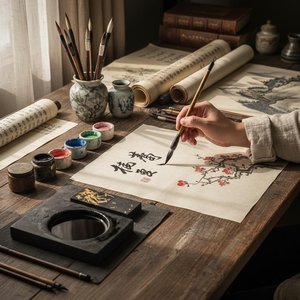
The Convergence of Tradition and Modernity
Wu Zuoren’s life was a profound journey through the heart of artistic evolution, bridging the ancient soul of Chinese ink painting with the vibrant, textured language of European oil techniques.Born in 1908 amidst the storied landscapes of Suzhou, his early years were deeply shaped by the cultural heritage of the Jiangsu Province. His path was irrevocably altered when he encountered the legendary Xu Beihong, a mentor who not only recognized his burgeoning talent at Shanghai Art University but also instilled in him a reverence for capturing the very essence of nature. This foundational connection would later serve as the anchor for Wu’s lifelong pursuit: to create a visual language that felt both authentically Chinese and globally resonant.
Seeking to expand the horizons of his medium, Wu traveled to Europe, immersing himself in the rigorous traditions of the West. His studies at the Lucien Simon Studio in Paris and the Bastien Studio in Belgium provided him with a sophisticated command of light, shadow, and form. This period of exploration was not an abandonment of his roots, but rather an enrichment of them, allowing him to bring a new, muscular vitality to the delicate traditions of his homeland.
A Masterpiece of Texture and Spirit
The true brilliance of Wu Zuoren lies in his ability to weave disparate styles into a seamless, emotive whole. He did not merely paint landscapes; he breathed life into them through a deliberate fusion of textures.In works such as the evocative Boat Tracker, created in 1933, one can witness this masterful balance. The painting utilizes thick, purposeful brushstrokes characteristic of European modernism to give weight to the figures and their vessels, yet it retains a lyrical fluidity that mirrors the rhythmic pulse of the water. This duality allowed him to depict the ruggedness of life alongside its poetic stillness.
His subject matter often turned toward the majestic and the untamed, celebrating the grandeur of the Chinese wilderness. He found profound inspiration in the serene beauty of the Foziling Reservoir and the powerful, roaming presence of yaks upon the Tibetan plateau. Through his eyes, the landscape became more than a setting; it became a living character, imbued with an atmosphere that felt both physically present and spiritually transcendent.
An Enduring Artistic Legacy
Throughout a career spanning many decades, Wu Zuoren’s contributions to modern Chinese art remained steadfast. He stood as a bridge between eras, ensuring that the classical values of calligraphy and ink wash were not lost in the tide of modernization, but rather strengthened by it.His legacy is defined by several key achievements:
- The successful integration of Western oil techniques with traditional Chinese aesthetics.
- A profound ability to capture the spirit of China's diverse natural landscapes and wildlife.
- A lasting influence on subsequent generations of artists seeking to innovate within the framework of tradition.