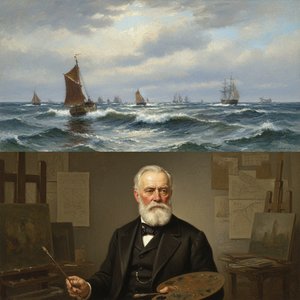
A Life Between Sea and Canvas
The life of Wilm Steffens was shaped by the salt spray and the heavy discipline of the Dutch navy. Born in Amsterdam, he lived a life that was split between the rigid duties of a naval officer and the observant eye of a painter. He did not merely observe the sea from the safety of a shore; he lived within its movements, experiencing the spray of the waves and the thunder of cannons firsthand. This dual existence meant that his perspective was never that of a detached spectator, but rather that of a man who understood the weight of a vessel and the chaos of naval engagement.
His years of activity, spanning from 1855 to 1873, coincided with a period of significant maritime movement. As he navigated the waters, his hand began to translate the sights of his profession onto canvas. He was a man of two worlds, where the precision required for naval service met the fluid requirements of marine art. This intersection of duty and creativity allowed him to capture moments of history with a directness that only a sailor could possess.
The Depiction of Naval Conflict
Steffens’s work often focused on the mechanics of naval power and the intensity of combat. His paintings frequently documented specific historical engagements, capturing the smoke of battle and the silhouette of warships against the horizon. He had a particular interest in the steam-powered vessels of his era, documenting the transition from sail to steam with technical accuracy. His compositions often centered on the following elements:
- The presence of steam corvettes and paddle steamers in active service.
- The heavy bombardment of coastal fortifications and sultanates.
- The specific details of naval expeditions, such as those in Atjeh.
- The structural forms of screw steamships and various classes of naval vessels.
In his depictions of the bombardment of the fortifications of the Sultan of Djambi in 1858, or the later expeditions in Atjeh in 1873, one senses the immediacy of the scene. He recorded the presence of specific ships, such as the Zr.Ms. Medusa or the Zr.Ms. Celebes, ensuring that the technical reality of the fleet was preserved. His art functioned as a visual record of the navy's reach and the specific machinery of war.
A Legacy in the Maritime Record
The final years of his life took him far from the canals of Amsterdam, leading him to the Dutch East Indies, where he died in 1885. His contributions remain tied to the history of maritime exploration and naval warfare. Because he was both an officer and an artist, his paintings carry a weight of authenticity that purely decorative marine art often lacks. He did not just paint ships; he painted the lived experience of the navy.
Today, his works are held in significant collections, such as the Maritime Museum Rotterdam, where they continue to provide a window into the naval history of the nineteenth century. Through his brush, the movements of the Zr.Ms. Riouw and the smoke of the North Coast of Atjeh are kept alive, offering a glimpse into a vanished era of maritime power.
Q&A
키워드별로 분류된 Wilm Steffens의 작품은 어디에서 볼 수 있나요?
Wilm Steffens의 키워드별 탐색 페이지에서는 작가의 작품들을 키워드별로 모아볼 수 있습니다.
Wilm Steffens의 모든 작품을 어디에서 볼 수 있나요?
이 사이트에 등록된 Wilm Steffens의 모든 작품은 작가의 전체 작품 보기 페이지에서 만나보실 수 있습니다.
Wilm Steffens의 예술 세계는 시간이 흐름에 따라 어떻게 진화했나요?
Wilm Steffens의 작품 세계를 시간순으로 정리한 기록은 아티스트 연대기 페이지에서 확인하실 수 있으며, 이곳에서는 각 시기별로 분류된 챕터를 따라 작품들을 제작 순서대로 만나보실 수 있습니다.
Wilm Steffens의 작품 중 몇 점을 둘러보실 수 있나요?
전체 작품 보기 페이지에서 Wilm Steffens의 작품 작품 6점점을 만나보실 수 있습니다.