William Scharf: A Weaver of Dreams and Symbols
William Scharf (February 22, 1927 – January 15, 2018) wasn’t a name that frequently echoed through the halls of the art world during his lifetime. Yet, beneath the surface of his quietly assured style lay a profound depth—a capacity to conjure hauntingly beautiful landscapes populated by enigmatic symbols and imbued with an almost palpable sense of longing. He was, in essence, a master of suggestion, inviting viewers into a realm where memory, myth, and personal experience intertwined, creating works that continue to resonate with a quiet intensity decades after his death.
Born in Media, Pennsylvania—a small town just outside Philadelphia—Scharf’s artistic journey began early. His childhood was marked by a formative friendship with N.C. Wyeth, the renowned illustrator, who recognized and nurtured a nascent talent within the young boy. Wyeth's encouragement led to studies at the Pennsylvania Academy of the Fine Arts, where Scharf honed his skills under influential mentors like Franklin Watkins, Daniel Garber, and Walter Stuempfig. This foundation provided him with a rigorous training in traditional techniques while simultaneously exposing him to the burgeoning currents of modern art.
Scharf’s early career was characterized by a deliberate exploration of various styles—from Abstract Expressionism to Color Field painting—reflecting his engagement with the dynamic artistic landscape of post-war New York. He spent time in Paris, immersing himself in European art and culture, before establishing himself as a significant figure within the American abstract movement. His relocation to New York City in 1952 proved pivotal, placing him at the heart of a vibrant community of artists including Mark Rothko, Dorothy Miller, and Willie Dennis—individuals who profoundly shaped his artistic vision.
The Language of Symbolism
Scharf’s work is immediately recognizable for its rich symbolic vocabulary. He didn't simply paint; he constructed narratives, layering images with carefully chosen symbols that alluded to a deeper, often elusive, meaning. Recurring motifs—the crown of thorns, ladders, fish, and crosses—appear throughout his oeuvre, functioning not as straightforward religious icons but rather as keys unlocking hidden layers of interpretation. These symbols aren’t presented directly; instead, they emerge subtly within the composition, inviting viewers to actively participate in deciphering their significance.
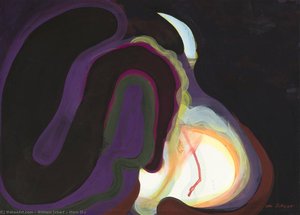
Influenced by Surrealism, particularly the work of Arshile Gorky, Scharf employed a dreamlike quality in his paintings—a sense of disorientation and mystery that draws upon the subconscious. He wasn’t interested in literal representation but rather in capturing the emotional essence of an experience or memory. His palette was often luminous and vibrant, yet tempered with shadows and muted tones, creating a captivating interplay between light and darkness.
Collaboration and Influence
Scharf's relationship with Mark Rothko proved particularly significant. The two artists shared a deep respect for color’s expressive potential, and Scharf benefited immensely from Rothko’s guidance. He even assisted Rothko on preliminary studies for the Rothko Chapel in Houston—a monumental project that cemented his place within the Color Field movement. This collaboration exposed him to the scale and ambition of Rothko's vision, further refining his own approach to color and composition.
Beyond Rothko, Scharf’s work was influenced by a diverse range of sources—from literature and mythology to the natural world. He drew inspiration from the landscapes of Pennsylvania, the vibrant colors of Europe, and the psychological depths explored by writers like James Joyce and Virginia Woolf. His paintings are not simply visual experiences; they are invitations to contemplate complex themes of memory, loss, and the human condition.
A Legacy of Quiet Intensity
William Scharf’s artistic legacy is one of quiet intensity—a testament to his unwavering commitment to exploring the depths of human experience through the evocative power of color and symbolism. He wasn't a flamboyant or overtly expressive artist, but rather a subtle master of suggestion, creating works that linger in the memory long after they have been viewed.
His paintings are often described as “haunting” or “dreamlike,” qualities that reflect his ability to tap into the subconscious and evoke profound emotional responses. Despite not achieving widespread fame during his lifetime, Scharf’s work has gained increasing recognition in recent years, solidifying his place as a significant figure within the history of American abstract art. His paintings continue to invite viewers on journeys into realms of mystery and emotion—a testament to the enduring power of his vision.
Q&A
William Scharf 작가는 어떤 사조의 작품 활동을 했나요?
William Scharf 작가의 작품을 예술 사조별로 모아둔 모든 미술 사조 페이지에서 해당 작가가 활동했던 사조를 확인하실 수 있습니다.
특정 주제별로 William Scharf의 작품을 어떻게 찾아볼 수 있나요?
특정 주제의 William Scharf 작품을 찾으려면 키워드별로 작품이 분류된 작가의 키워드별 탐색 페이지를 이용해 보세요.
William Scharf의 작품 전체 목록을 볼 수 있는 곳이 있나요?
이 사이트에 등록된 William Scharf의 모든 작품은 작가의 전체 작품 보기 페이지에서 만나보실 수 있습니다.