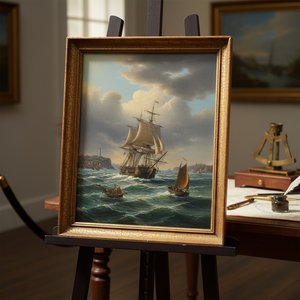
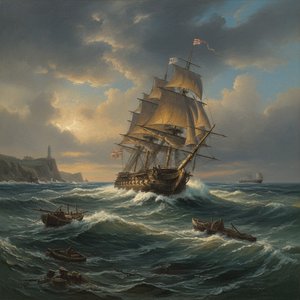
A Life Captured in Landscape and Sea
Born in Southwark, London, William Marlow emerged as a distinguished figure in the late eighteenth-century art world, carving out a niche as an English landscape and marine painter and etcher. His artistic journey began under the mentorship of the marine painter Samuel Scott, with whom he studied for five formative years. This early training provided him with a foundational understanding of the sea and light, which would later define much of his repertoire. Seeking to refine his classical sensibilities, Marlow also attended the St. Martin's Lane Academy, an education that helped shape his ability to translate the natural world onto canvas and paper.
Marlow’s career was marked by a deep connection to both the British landscape and the vistas of continental Europe. On the advice of the Duchess of Northumberland, he embarked on a significant period of travel through France and Italy between 1765 and 1768. These journeys were not merely excursions but essential periods of artistic development, providing him with a wealth of sketches and impressions that would later inform his more mature works. Upon returning to London, he established himself within the city's vibrant artistic community, eventually taking up residence in Leicester Square.
Artistic Vision and Technical Mastery
The work of William Marlow is characterized by a delicate touch and an observant eye, particularly when capturing the shifting moods of water and sky. His technical repertoire was diverse, encompassing oils, watercolours, drawing, and etching. While some contemporary critics noted that his watercolour method leaned toward a more subtle tinting rather than bold structural advancement, they nonetheless praised the truthfulness and delicate colour found in his views of the Thames. His influence was clearly drawn from masters such as Richard Wilson and Canaletto, a fact evident in his ability to compose architectural fantasies and serene topographical scenes.
His subject matter often bridged the gap between the local and the exotic. He was frequently employed to paint views of country houses and contributed significantly to the documentation of Kew Gardens, producing watercolours for William Chambers's designs. Beyond the English countryside, his Italian sketches allowed him to explore more Mediterranean themes, even venturing into the realm of the capriccio—an architectural fantasy where he famously transposed St Paul's Cathedral into a Venetian setting. Whether engraving the bridges of Westminster and Blackfriars or capturing the moonlight over a ferry in Twickenham, Marlow possessed a unique ability to render both the monumental and the intimate.
Legacy and Contributions to Art
Throughout his life, Marlow was an active participant in the institutional life of British art. He was a member of the Incorporated Society of Artists and later became a Fellow of the Society of Artists in 1771. His presence at major exhibitions was a constant, contributing to the exhibitions in Spring Gardens during the early 1760s and exhibiting regularly at the Royal Academy from the late eighteenth century until the early nineteenth century. His prolific output is evidenced by his total exhibition record, which includes:
- 125 works exhibited at the Society of Artists
- Two works at the Free Society of Artists
- 25 works presented to the Royal Academy
Today, the historical significance of William Marlow is preserved through the enduring presence of his works in some of the world's most prestigious institutions. His ability to document the changing landscapes of his era ensures that his legacy remains a vital part of the English maritime and landscape tradition. Collectors and historians can find his traces in the following collections:
- Tate Gallery
- The Metropolitan Museum of Art
- National Galleries of Scotland
- Government Art Collection
- V & A
- Derby Art Gallery
Q&A
William Marlow의 작품을 분위기별로 모아둔 곳은 어디인가요?
아티스트의 무드 룸 페이지에서는 William Marlow의 작품들을 분위기에 따라 큐레이션된 형태로 만나보실 수 있습니다.
William Marlow은(는) 어느 시대의 작품을 남겼나요?
William Marlow은(는) Early Modern 시대에 활동했습니다. 이 시기는 역사적 맥락 속에서 작가의 예술적 위치를 보여줍니다.
William Marlow의 예술 세계는 시간이 흐름에 따라 어떻게 진화했나요?
William Marlow의 연대기는 작가의 활동 시기별로 분류된 작품들을 연대순으로 보여주는 스크롤 방식의 타임라인입니다.