The Quiet Observer of Surrey: The Life and Legacy of William Freeman
In the soft, diffused light of the late Victorian era, a period defined by both rapid industrial expansion and a deep-seated nostalgia for the pastoral, the works of William Freeman (1838–1918) offered a sanctuary of stillness. Born in Kingston upon Thames, Surrey, Freeman was more than a mere chronicler of his surroundings; he was a poet of the English landscape. His life and art were inextricably linked to the rolling hills, meandering rivers, and quaint villages of his home county, capturing a world that felt both permanent and delicately fleeting. Through his mastery of watercolor, Freeman invited viewers into a realm where the textures of stone, grass, and water were rendered with a devotion that bordered on the spiritual.
While the biographical records of Freeman’s early years remain somewhat veiled in the mists of time, his artistic foundation appears to have been built upon the rigorous academic traditions of London. It is widely believed that he pursued formal training at the Royal Academy School, an experience that undoubtedly instilled in him a disciplined command over composition and anatomical precision. This academic rigor did not, however, stifle his sensitivity to nature. Instead, it provided him with the technical vocabulary necessary to translate the subtle nuances of the Surrey countryside onto paper. One can detect the echoes of great topographical masters like John Ruskin in his work—a shared commitment to a realism that sought to honor the inherent truth of the natural world.
A Mastery of Light and Texture
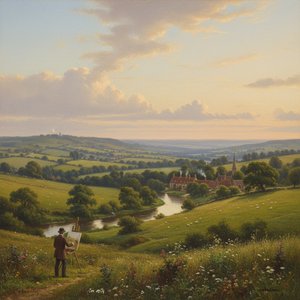
Freeman’s artistic development was characterized by an unwavering dedication to detail, distinguishing him from the burgeoning Impressionist movement that sought to capture the ephemeral flicker of light. Where others saw motion and blur, Freeman found beauty in the static and the specific. His technique involved a meticulous application of watercolor, utilizing tonal gradations to create a palpable sense of depth and atmosphere. To gaze upon one of his landscapes is to experience a profound sense of place; he did not merely paint a view, but rather the very essence of the Surrey air and the weight of its ancient landscapes.
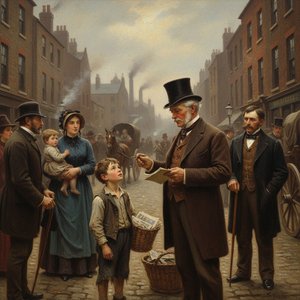
His approach to the medium allowed for an extraordinary tactile quality in his work. In his depictions of local architecture and street life—such as his evocative 1905 rendering of the Junction between London Road & Richmond Road—he achieved a remarkable balance between the bustling energy of Edwardian England and the enduring stability of Victorian structures. His ability to render the following elements with such precision remains his greatest technical achievement:
- The interplay of light and shadow across undulating hills and woodland edges.
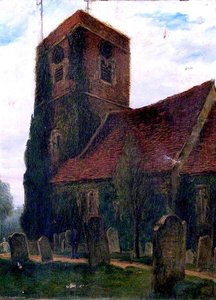
- The delicate textures of nature, from the dampness of riverbanks to the ruggedness of stone walls.
- Architectural fidelity, capturing the character of Kingston’s streets with historical accuracy.
- Atmospheric depth, using subtle washes to suggest the presence of mist or the clarity of a summer afternoon.
Historical Significance and Enduring Charm
As the 19th century gave way to the 20th, the world Freeman painted began to transform under the pressures of modernity. Yet, his watercolors remain frozen in a state of grace, serving as vital historical documents of a Surrey that was once defined by its pastoral serenity. His significance lies not only in his technical skill but in his role as a custodian of local identity. He captured the soul of Kingston upon Thames and the surrounding reaches of Surrey at a pivotal moment in British history, preserving the charm of a landscape before it was irrevocly altered by urban sprawl.
Today, the works of William Freeman continue to resonate with collectors and art enthusiasts who find solace in his quiet, observant style. His legacy is one of unwavering devotion—a devotion to the truth of the eye and a profound respect for the beauty found in the familiar. In an age of constant movement, Freeman’s landscapes offer a rare opportunity to pause, to breathe, and to rediscover the timeless elegance of the English countryside.
Q&A
특정 주제별로 William Freeman의 작품을 어떻게 찾아볼 수 있나요?
특정 주제의 William Freeman 작품을 찾으려면 키워드별로 작품이 분류된 작가의 키워드별 탐색 페이지를 이용해 보세요.
William Freeman 작가의 작품에서 가장 자주 나타나는 색상은 무엇인가요?
William Freeman 작가 작품의 컬러 프로필은 작가의 팔레트 지놈 페이지에서 확인하실 수 있습니다.
William Freeman 작가의 작품을 감상할 수 있는 가상 박물관에 방문할 수 있나요?
William Freeman의 3D 갤러리는 작가의 작품들을 가상 3D 갤러리로 감상할 수 있는 페이지입니다.