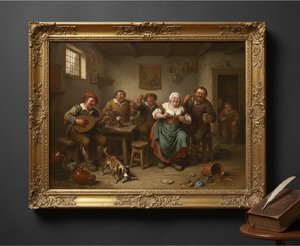
A Life Woven in Paint: The World of Vincent Laurensz van der Vinne
Vincent Laurensz van der Vinne, born in Haarlem in 1628 and passing in 1702, was a figure deeply embedded in the artistic and religious currents of his time. More than simply a painter, he was a linen-weaver by trade, a diligent diarist, and a committed Mennonite—a confluence of identities that shaped both his life and his art. His story is one of travel, observation, and a quiet dedication to capturing the essence of 17th-century Dutch life, imbued with a subtle moral weight. Van der Vinne’s early artistic training began within the esteemed studio of Frans Hals, though for a relatively brief nine months in 1647. This foundational experience instilled in him a boldness of brushwork and a keen eye for character that would subtly inform his later compositions. He quickly became a member of the Haarlem Guild of St. Luke in 1649, solidifying his position within the artistic community. However, it was not merely technical skill that defined Van der Vinne; he possessed an insatiable curiosity and a thirst for experience that propelled him beyond the confines of his workshop.The Grand Tour and a Witness to History
In 1652, Van der Vinne embarked on a grand tour—a common rite of passage for aspiring Dutch painters seeking inspiration in Italy. Yet, unlike many of his contemporaries, he never reached the sun-drenched landscapes of the Italian peninsula. His journey took him through Germany, Switzerland, and France, meticulously documented in detailed diaries that stand as invaluable historical records. Accompanied by fellow artists like Dirck Helmbreker and Cornelis Bega, Van der Vinne’s travels were not without peril. He faced hardship, even kidnapping, and navigated a politically volatile landscape. His anxieties about being mistaken for a military surveyor led him to abandon sketching outdoors at times, revealing the ever-present dangers of travel in that era. The Alps proved particularly daunting, skirted for weeks but never crossed despite multiple attempts. This deviation from the traditional grand tour route resulted in an unusual westward trajectory, taking him through regions less frequented by Haarlem artists. His experiences during the Swiss peasant war of 1653—being briefly taken prisoner by farmers—underscored the fragility of peace and the realities of rural unrest. Perhaps most profoundly, Van der Vinne witnessed firsthand the brutal massacre of the Waldensians in Piedmont in 1655, an event that deeply affected him and inspired a powerful poem expressing his outrage.Still Life, Genre Scenes, and the Echoes of *Vanitas*
Upon returning to Haarlem, Van der Vinne embraced a diverse range of subjects, accepting any commission regardless of its scale—earning him the playful moniker “the Raphael of sign-boards” from Job Adriaenszoon Berckheyde. While he produced landscapes and portraits, it is his still lifes and genre scenes that have secured his place in art history. These works are often characterized by a subtle interplay of light and shadow, reminiscent of Hals’ influence, and a meticulous attention to detail. A recurring motif in Van der Vinne's oeuvre is the *vanitas*—a symbolic representation of the transience of life, the futility of pleasure, and the certainty of death. Skulls, decaying fruit, extinguished candles, and wilting flowers appear frequently, serving as poignant reminders of mortality. He often incorporated a trompe l’oeil element into these compositions, depicting a sketch or paper seemingly affixed to a desk, sometimes even including a self-portrait copied from a drawing by Leendert van der Cooghen. This playful illusionism adds another layer of complexity to his work, inviting viewers to contemplate the nature of representation itself.Legacy and Influence
Van der Vinne’s style resonated with other artists of his time, notably Evert Collier, Pieter van Eisen, and Barent van Eisen, who adopted elements of his technique and thematic concerns. His emphasis on *vanitas* symbolism and trompe l'oeil effects contributed to the development of these genres in Dutch painting. Beyond his artistic contributions, Van der Vinne’s diaries remain a valuable source of information about 17th-century life in Haarlem and beyond. They offer insights into the social, political, and religious landscape of the era, as well as the challenges and rewards of travel for an artist seeking inspiration. He was also actively involved in his Mennonite community, serving as deacon of “de blok” in 1689. His life exemplifies a harmonious blend of artistic pursuit, intellectual curiosity, and spiritual devotion—a testament to the rich cultural tapestry of the Dutch Golden Age. Vincent Laurensz van der Vinne remains a compelling figure, whose works continue to captivate viewers with their quiet beauty, subtle symbolism, and enduring relevance. His paintings are not merely depictions of objects; they are meditations on life, death, and the human condition.질의응답
Vincent I Laurensz van der Vinne 작가의 작품을 감상할 수 있는 가상 박물관에 방문할 수 있나요?
Vincent I Laurensz van der Vinne의 3D 뮤지엄는 작가의 작품들을 가상 3D 갤러리로 선보이는 페이지입니다.
Vincent I Laurensz van der Vinne의 작품 중 몇 점을 둘러보실 수 있나요?
모든 작품 보기 페이지에서 Vincent I Laurensz van der Vinne의 작품 작품 17점점을 만나보실 수 있습니다.
Vincent I Laurensz van der Vinne의 모든 작품은 어디에서 볼 수 있나요?
본 웹사이트에 등록된 Vincent I Laurensz van der Vinne의 모든 작품은 작가의 모든 작품 보기 페이지에서 확인하실 수 있습니다.
Vincent I Laurensz van der Vinne 작품의 연도별 타임라인이 있나요?
Vincent I Laurensz van der Vinne의 작품 연표를 확인해 보세요: 작품 연대기 페이지에서 작품들을 제작 날짜순으로 보실 수 있습니다.
특정 주제에 따른 Vincent I Laurensz van der Vinne의 작품을 어떻게 찾을 수 있나요?
특정 주제의 Vincent I Laurensz van der Vinne 작품을 찾으려면 키워드별로 작품이 분류된 작가의 키워드별로 페이지를 이용해 보세요.
특정 매체로 분류된 Vincent I Laurensz van der Vinne의 모든 작품을 어떻게 찾을 수 있나요?
특정 매체로 제작된 Vincent I Laurensz van der Vinne의 모든 작품을 확인하시려면, 작가의 모든 매체 페이지를 이용해 주세요.
Vincent I Laurensz van der Vinne의 작품 중 조회수가 가장 높은 것은 무엇인가요?
Vincent I Laurensz van der Vinne의 통계 페이지에서는 본 웹사이트에 등록된 작가의 작품들을 바탕으로 산출된 통계 정보를 제공합니다.
Vincent I Laurensz van der Vinne의 출생 도시와 국가는 어디인가요?
Vincent I Laurensz van der Vinne은(는) Netherlands의 Haarlem에서 태어났습니다.