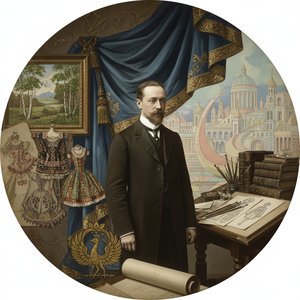
The Life and Artistic Evolution of Varvara Stepanova
Born in Kaunas, Lithuania, Varvara Stepanova was a multifaceted artist whose work spanned painting, design, poetry, illustration, and textile art. After studying at the Kazan Art School, where she met her collaborator and husband Alexander Rodchenko, she became a central figure in the Russian avant-garde. Her creative output was deeply tied to the Constructivist movement, which favored revolutionary values over traditional aesthetics. Stepanova’s practice was diverse, encompassing graphic art, stage scenery, and performance art. She contributed to significant exhibitions, such as the Fifth and Tenth State Exhibitions in 1919, and was a member of the first Working Group of Constructivists. Her work often sought to move away from contemplative art toward a process of construction that engaged directly with the development of society.
Design, Textiles, and Graphic Work
Stepanova’s dedication to production led her to specialize in functional design, particularly in the realms of clothing and textiles. She categorized clothing into prozodezhda (production or working clothing) and sportodezhda (sports costumes). Her designs emphasized:
Beyond textiles, she was active in graphic design, practicing typography and book design, and contributing to the magazine
LEF. Her work in theater included designing sets for The Death of Tarelkin in 1922, where she used graphic costumes to transform the human body into a dynamic composition of shapes.Q&A
Varvara Stepanova의 작품을 색상별로 정렬해서 볼 수 있나요?
컬러 인덱스 페이지에서는 Varvara Stepanova의 작품들을 색상별로 모아 보실 수 있습니다.
Varvara Stepanova의 작품 중 몇 점을 둘러보실 수 있나요?
전체 작품 보기 페이지에서 Varvara Stepanova의 작품 작품 9점점을 만나보실 수 있습니다.
Varvara Stepanova의 출생지와 출생 연도는 어떻게 되나요?
Varvara Stepanova은(는) 1894년 Kaunas에서 태어났습니다.
Varvara Stepanova 작가 작품의 컬러 프로필은 어디에서 확인할 수 있나요?
Varvara Stepanova의 팔레트 지놈에서는 작가의 작품 세계를 구성하는 컬러 프로필을 확인하실 수 있습니다.