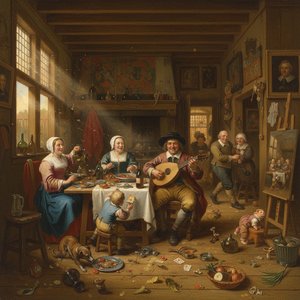
A Life in Lines and Color
Born in Amsterdam to a merchant father and an English mother, Valentijn Bing grew up in a world of commerce and diverse influences. His early years in the Netherlands shaped a perspective that would eventually find its way onto canvas and stone. He sought formal training at the Koninklijke Akademie, where he studied under Jan Adam Kruseman. This period of study provided the foundation for a career that would span many decades and various artistic disciplines.
His early professional life was marked by a steady presence in the Dutch art scene. He became a member of the prestigious Arti et Amicitiae, a sign of his standing among his peers. While he was a painter, he was equally skilled as a draftsperson, a lithographer, and a steel engraver. This versatility allowed him to move between the delicate precision of engraving and the broader strokes of genre painting.
The Art of Observation
Bing’s work was characterized by a commitment to the details of everyday life. He did not shy away from the complexities of the human form or the specificities of a landscape. His subjects were varied, ranging from quiet religious scenes to the bustling energy of cityscapes. He possessed a sensitive approach to color and composition, finding a balance between the need for documentary accuracy and the expression of an artist.
His interests often turned toward the preservation of Dutch identity through visual documentation. This was particularly evident in his collaborative efforts to record the traditional ways of his country. His output included:
- Genre scenes depicting daily life
- Religious compositions
- Portraits of individuals
- Cityscapes of urban environments
- Studies of traditional Dutch costumes
In 1857, he worked alongside Jan Braet von Überfeldt to produce Nederlandsche kleederdragten, naar de natuur geteekend, a significant work focused on the traditional clothing of the Netherlands. This interest in the factual details of dress and custom was a recurring theme in his professional life, leading him to publish instructional books on drawing in the 1860s.
Teaching and Legacy
As he matured, Bing transitioned into the role of an educator. From 1843, he served as a teacher at the Akademie, passing his technical knowledge to a new generation of artists. His influence can be seen in the work of his students, such as Jacques Carabain and Jan Portielje. His dedication to the craft was recognized in 1868 when he received a silver medal from the Akademie's engraving school.
His personal life changed significantly in his later years. After living with his sisters in Amsterdam for much of his life, he married Antonia Johanna Heiligers when he was fifty-one. They eventually moved to Bleskensgraaf, and later to Nieuwpoort, where he spent his final years. He died in Nieuwpoort at the age of eighty-two, leaving behind a body of work that captured the textures and traditions of a changing Netherlands.
Q&A
Valentijn Bing의 작품 중 몇 점을 둘러보실 수 있나요?
전체 작품 보기 페이지에서 Valentijn Bing의 작품 작품 2점점을 만나보실 수 있습니다.
Valentijn Bing의 활동 시기는 어떻게 구분되어 있나요?
Valentijn Bing의 예술적 여정은 연대기 페이지에서 시기별로 펼쳐집니다. 이곳에서는 작가의 활동 시기를 장(chapter)으로 나누어 작품들을 연대순 타임라인 형태로 한눈에 확인할 수 있습니다.
키워드로 Valentijn Bing의 작품을 찾아볼 수 있나요?
Valentijn Bing의 키워드별 탐색 페이지에서는 작가의 작품들을 키워드별로 모아볼 수 있습니다.