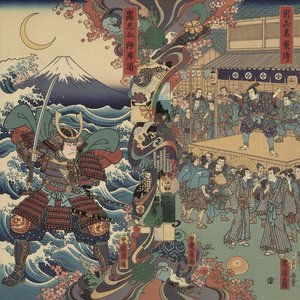
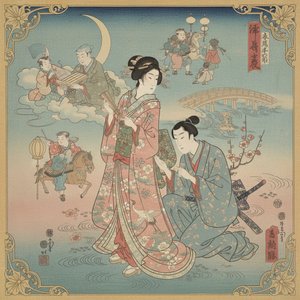
Toriyama Sekien: A Pioneer of Yōkai Illustration and Ukiyo-e Innovation
- Name: Toriyama Sekien (also known as Sano Toyofusa)
- Born: 1712, Tokyo, Japan
- Died: 1788
- Origin: OriginalUniqueArt
Early Life and Artistic Training
- Sekien was born into a family of high-ranking servants to the Tokugawa Shogunate, affording him access to elite artistic training.
- He received instruction from prominent artists of the Kanō school, Kanō Gyokuen and Kanō Chikanobu. While not formally recognized as a member of the Kanō school, this rigorous training significantly shaped his artistic foundation.
- His early work demonstrates a clear influence from the Kanō style, characterized by its emphasis on traditional Japanese techniques and formal composition. However, Sekien would later diverge to forge his own unique path.
Contributions to Ukiyo-e and the World of Yōkai
- Sekien is celebrated for being among the first artists to apply Kanō school techniques to ukiyo-e printmaking. This was a revolutionary step, bringing greater sophistication and detail to the genre.
- He invented fuki-bokashi, an innovative method allowing for the replication of subtle color gradations in prints. This technique significantly enhanced the visual complexity and nuance achievable in ukiyo-e.
- His most significant contribution lies in his illustrated books of yōkai (supernatural creatures from Japanese mythology). These works, such as "Tokaido Yotsuya Kaiki" and "Eliminations of Demons," popularized depictions of yōkai like tanuki and tengu, shaping their image in popular culture.
- As a teacher, Sekien mentored influential artists including Kitagawa Utamaro and Utagawa Toyoharu, whose works reflect his influence.
Major Works and Artistic Development
- Tokaido Yotsuya Kaiki: A collection of illustrations depicting various yōkai encountered along the Tokaido highway. This work is considered a cornerstone of Japanese folklore illustration.
- Eliminations of Demons (Konpaku Zatsuwa): Another significant series showcasing Sekien's imaginative depictions of supernatural beings, often accompanied by explanatory text.
- His artistic development involved moving beyond the strict formalism of the Kanō school to embrace a more dynamic and expressive style suitable for ukiyo-e and the depiction of fantastical subjects. He experimented with color palettes and composition to create visually striking and memorable images.
Historical Significance and Legacy
- Sekien’s work played a crucial role in shaping the public perception of yōkai, solidifying their place in Japanese folklore and popular imagination. His illustrations became iconic representations of these creatures.
- His innovative printmaking techniques, particularly fuki-bokashi, significantly advanced the capabilities of ukiyo-e art, influencing subsequent generations of artists.
- Sekien’s legacy extends to contemporary artists like Kawanabe Kyōsai and Mizuki Shigeru, who continue to draw inspiration from his work. He is recognized as a pivotal figure in the history of Japanese art, bridging traditional techniques with innovative approaches and contributing significantly to both ukiyo-e and folklore illustration.
Q&A
Toriyama Sekien의 작품을 분위기별로 모아둔 곳은 어디인가요?
Toriyama Sekien의 무드 룸에서는 작가의 작품들을 분위기별로 만나보실 수 있습니다.
키워드별로 분류된 Toriyama Sekien의 작품은 어디에서 볼 수 있나요?
특정 주제의 Toriyama Sekien 작품을 찾으려면 키워드별로 작품이 분류된 작가의 키워드별 탐색 페이지를 이용해 보세요.
Toriyama Sekien의 다른 이름이나 별칭에는 무엇이 있나요?
Toriyama Sekien은(는) تورياما سيكين, Торияма Секиен, Τοριγιάμα Σέκιεν, 鳥山石燕, 도리야마 세키엔라는 이름으로도 활동하고 있습니다.