가와나베 교사이의 초상화

세상에 단 하나뿐인, 가장 유명한 가와나베 교사이 작품 72선

11월 2026 업데이트 · 인기 점수 기준 순위 (각 작품의 검색, 방문 및 주문 수) · 72점의 가와나베 교사이 작품 (당사 카탈로그 기준)

요약하자면

Three Kyōgen Dancers (801)은(는) 가와나베 교사이의 작품 중 가장 많은 시선을 사로잡는 회화이며, 원작은 뉴욕에 위치한 메트로폴리탄 미술관에 소장되어 있습니다. 그다음 시선은 Sketches of East Asian Legendary Figures (801)와 Yang Guifei Adjusting her Hair (1850)로 향합니다. 우리 카탈로그에 수록된 가와나베 교사이의 작품 72점 중, 가장 유명한 72점을 소개합니다. 각 작품은 제작 연도, 소장 박물관, 그리고 시대를 초월해 사랑받는 이유와 함께 독창적인 원작으로 제시됩니다.

1831 – 1889, 코가 Ukiyo-e 최다 소장처: 메트로폴리탄 미술관

갤러리의 시선으로 선정한 가와나베 교사이의 명작 Top 10

1
Three Kyōgen Dancers (801) 의 가와나베 교사이

Three Kyōgen Dancers

801 · Ink · 메트로폴리탄 미술관, 뉴욕

A preliminary ink drawing captures three performers in the midst of a kyōgen dance. These figures, rendered with a fluid and spontaneous energy, embody the comedic essence of traditional Japanese theater. Each dancer is frozen in a distinct, expressive pose that suggests movement and rhythmic timing. One figure holds a drum, another a fan, and the third a bag, marking the specific roles and props essential to the performance. The…

2
Sketches of East Asian Legendary Figures (801) 의 가와나베 교사이

Sketches of East Asian Legendary Figures

801 · Ink · 메트로폴리탄 미술관, 뉴욕

The ink flows across the paper, capturing a moment of quietude and myth. In this black and white drawing, figures from the realm of legend emerge from the shadows of the everyday. We see Japanese figures like Daikoku and Urashima Tarō sharing space with Chinese immortals and the Twenty-Four Paragons of Filial Piety. There is a strange, casual intimacy to the scene, as if these divine and legendary beings have…

3
Yang Guifei Adjusting her Hair (1850) 의 가와나베 교사이

Yang Guifei Adjusting her Hair

1850 · Ink On Paper · 로스앤젤레스 카운티 미술관, 로스앤젤레스

In "Yang Guifei Adjusting her Hair" by Kawanabe Kyōsai, the brush captures a moment of quiet preparation. The subject is Yang Guifei, a woman known to history as Lady Yang. She was the beloved consort of Emperor Xuanzong of Tang and remains celebrated as one of the Four Beauties of ancient China. Here, she is a figure of grace, focused on the delicate task of arranging her hair.

4
Yamauba and Kintarō (1850) 의 가와나베 교사이

Yamauba and Kintarō

1850 · Ink On Paper · 로스앤젤레스 카운티 미술관, 로스앤젤레스

In this vertical composition, Kawanabe Kyōsai presents a dynamic encounter between two figures from Japanese folklore. The work, created about 1850, centers on the mountain hag Yamauba and the superhuman child Kintarō. A large, standing female figure dominates the space, her presence defined by the voluminous folds of her robes. Beside her, a smaller, crouching male figure provides a sense of scale and tension. The arrangement of these two bodies…

5
Hell Courtesan (1870) 의 가와나베 교사이

Hell Courtesan

1870 · 클리블랜드 미술관, 클리블랜드

The scene unfolds within the delicate confines of a hanging scroll, where the figure of the Hell Courtesan, known in Japanese as Jigoku Tayū, emerges from the silk. This work, titled Hell Courtesan, captures a moment of profound stillness and spiritual weight. The artist, Kawanabe Kyōsai, brings this legendary character to life through a composition that balances the elegance of a high-ranking courtesan with the unsettling imagery of the afterlife.…

6
Frolicking Figures and Animals (1870) 의 가와나베 교사이

Frolicking Figures and Animals

1870 · Ink On Paper · 메트로폴리탄 미술관, 뉴욕

In this horizontal handscroll from 1870, we find a quiet, almost whispered dialogue between human presence and the natural world. The composition relies heavily on the use of negative space, a deliberate emptiness that allows the viewer to focus entirely on the gestural energy of the brushstrokes. It is a work of profound restraint, where the absence of color speaks more loudly than a full palette could. The monochromatic shades…

7
Calligraphy and Painting Party (1877) 의 가와나베 교사이

Calligraphy and Painting Party

1877 · Ink On Paper

Calligraphy and Painting Party is a hanging scroll created by the Japanese painter and caricaturist Kawanabe Kyōsai. Born in 1831 in Koga, Japan, the artist navigated the shifting tides of the Edo and Meiji periods. This work dates to 1880, a moment when his brush captured the restless energy of a changing nation. His hand moved with the precision of a trained scholar and the wit of a satirist.

8
Wisteria Maiden and Demon Priest (1872) 의 가와나베 교사이

Wisteria Maiden and Demon Priest

1872 · Ink · 미니애폴리스 미술관, 미니애폴리스

In this work, Wisteria Maiden and Demon Priest, Kawanabe Kyōsai presents a dramatic encounter between a maiden and a demon priest. The composition is centered on a woman dressed in an ornate, multi-colored kimono featuring red, blue, and white patterns. She appears to dance or float gracefully above a crouching, monstrous figure. This figure, the demon priest, is depicted with a weathered, muscular, and grotesque face, wearing dark, heavy robes…

9
Painting Party (1880) 의 가와나베 교사이

Painting Party

1880 · Woodblock Print · 클리블랜드 미술관, 클리블랜드

Painting Party is a traditional Japanese ukiyo-e woodblock print by Kawanabe Kyōsai. The artist, born in 1831 in Koga, Japan, lived until 1889. This work emerged from a life defined by the shifting currents of the Meiji era. It captures a specific moment of social gathering through the precision of the woodblock medium.

10
Night Procession of One Hundred Demons (1880) 의 가와나베 교사이

Night Procession of One Hundred Demons

1880 · Ink

Kawanabe Kyōsai painted Night Procession of One Hundred Demons about 1880. The work captures a Hyakki Yagyō, a traditional Japanese Night Parade of One Hundred Demons. This supernatural event brings a chaotic procession of various yokai into the light of the viewer's gaze. It is a rhythmic movement of spirits passing through the dark.

가와나베 교사이의 유명 작품, 11~72번

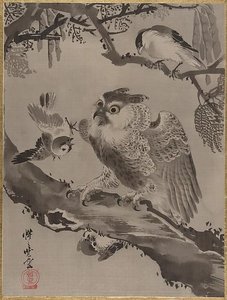
11Hell Courtesan (1880) 의 가와나베 교사이Hell Courtesan1880 12Jurōjin [center of a triptych] (1884) 의 가와나베 교사이Jurōjin [center of a triptych]1884 · 미니애폴리스 미술관 13Theatre Curtain of Shintomi-za, with an Impromputu Sketch Monster (1880) 의 가와나베 교사이Theatre Curtain of Shintomi-za, with an Impromputu Sketch Monster1880 14Squirrels Eating Chestnuts (1886) 의 가와나베 교사이Squirrels Eating Chestnuts1886 · 로스앤젤레스 카운티 미술관 15A Beauty in Front of King Enma's Mirror (1887) 의 가와나베 교사이A Beauty in Front of King Enma's Mirror1887 16Urashima Tarō Riding on a Tortoise (1888) 의 가와나베 교사이Urashima Tarō Riding on a Tortoise1888 · 메트로폴리탄 미술관 17Two Children Playing with Goldfish (1887) 의 가와나베 교사이Two Children Playing with Goldfish1887 · 메트로폴리탄 미술관 18Two Birds on a Branch (1887) 의 가와나베 교사이Two Birds on a Branch1887 · 메트로폴리탄 미술관 19Singing Bird on a Branch (1887) 의 가와나베 교사이Singing Bird on a Branch1887 · 메트로폴리탄 미술관 20滝に燕図 Swallows by a Waterfall (1887) 의 가와나베 교사이滝に燕図 Swallows by a Waterfall1887 · 메트로폴리탄 미술관 21Tale of the Tongue-cut Sparrow (1800) 의 가와나베 교사이Tale of the Tongue-cut Sparrow1800 · 로스앤젤레스 카운티 미술관 22Sketches of Birds and Animals (1870) 의 가와나베 교사이Sketches of Birds and Animals1870 · 메트로폴리탄 미술관 23Three Crossbills on a Leafless Tree (1878) 의 가와나베 교사이Three Crossbills on a Leafless Tree1878 · 미니애폴리스 미술관 24Chinese-style Landscape with Man Fishing from a Boat by Moonlight [right of a triptych] (1884) 의 가와나베 교사이Chinese-style Landscape with Man Fishing from a Boat by Moonlight [right of a triptych]1884 · 미니애폴리스 미술관 25Landscape with River in Mountainous Country [left of a triptych] (1884) 의 가와나베 교사이Landscape with River in Mountainous Country [left of a triptych]1884 · 미니애폴리스 미술관 26猿を襲う鷲図 Eagle Attacking a Monkey (1885) 의 가와나베 교사이猿を襲う鷲図 Eagle Attacking a Monkey1885 · 메트로폴리탄 미술관 27兎を追う鷲図 Eagle Pursuing Rabbit (1885) 의 가와나베 교사이兎を追う鷲図 Eagle Pursuing Rabbit1885 · 메트로폴리탄 미술관 28Eagle Attacking a Mountain Lion (1885) 의 가와나베 교사이Eagle Attacking a Mountain Lion1885 · 메트로폴리탄 미술관 29White Eagle Eyeing a Mountain Lion (1885) 의 가와나베 교사이White Eagle Eyeing a Mountain Lion1885 · 메트로폴리탄 미술관 30Rocky Landscape (1887) 의 가와나베 교사이Rocky Landscape1887 · 메트로폴리탄 미술관 31Crow on a Branch (1887) 의 가와나베 교사이Crow on a Branch1887 · 메트로폴리탄 미술관 32Untitled (D2X7KF) (1887) 의 가와나베 교사이Untitled (D2X7KF)1887 · 메트로폴리탄 미술관 33Fox Catching Bird (1887) 의 가와나베 교사이Fox Catching Bird1887 · 메트로폴리탄 미술관 34Bird and Frog (1887) 의 가와나베 교사이Bird and Frog1887 · 메트로폴리탄 미술관 35松に鴉図 Two Crows on a Pine Branch (1887) 의 가와나베 교사이松に鴉図 Two Crows on a Pine Branch1887 · 메트로폴리탄 미술관 36Cranes in Marsh (1887) 의 가와나베 교사이Cranes in Marsh1887 · 메트로폴리탄 미술관 37Buffalo and Herdsman (1887) 의 가와나베 교사이Buffalo and Herdsman1887 · 메트로폴리탄 미술관 38柳に鴉図 Crow and Willow Tree (1887) 의 가와나베 교사이柳に鴉図 Crow and Willow Tree1887 · 메트로폴리탄 미술관 39岩に鴉図 Crow on a Rock (1887) 의 가와나베 교사이岩に鴉図 Crow on a Rock1887 · 메트로폴리탄 미술관 40Owl Mocked by Small Birds (1887) 의 가와나베 교사이Owl Mocked by Small Birds1887 · 메트로폴리탄 미술관 41木に鴉図 Crow on a Branch (1887) 의 가와나베 교사이木に鴉図 Crow on a Branch1887 · 메트로폴리탄 미술관 42竹に鴉図 Crow on a Bamboo Branch (1887) 의 가와나베 교사이竹に鴉図 Crow on a Bamboo Branch1887 · 메트로폴리탄 미술관 43旭に群鴉図 Flock of Crows at Dawn (1887) 의 가와나베 교사이旭に群鴉図 Flock of Crows at Dawn1887 · 메트로폴리탄 미술관 44ムクドリ図 Starlings on a Branch (1887) 의 가와나베 교사이ムクドリ図 Starlings on a Branch1887 · 메트로폴리탄 미술관 45Fish in a Whirlpool (1887) 의 가와나베 교사이Fish in a Whirlpool1887 · 메트로폴리탄 미술관 46富士図 Mount Fuji (1887) 의 가와나베 교사이富士図 Mount Fuji1887 · 메트로폴리탄 미술관 47Rocky Landscape (1887) 의 가와나베 교사이Rocky Landscape1887 · 메트로폴리탄 미술관 48瓜に鼠図 Mice in a Melon (1887) 의 가와나베 교사이瓜に鼠図 Mice in a Melon1887 49Eagle Attacking Fish (1887) 의 가와나베 교사이Eagle Attacking Fish1887 · 메트로폴리탄 미술관 50Squirrels Gathering Chestnuts (1887) 의 가와나베 교사이Squirrels Gathering Chestnuts1887 · 메트로폴리탄 미술관 51Monkey Hanging from Grapevines (1887) 의 가와나베 교사이Monkey Hanging from Grapevines1887 · 메트로폴리탄 미술관 52雪中鴉図 Crow Flying in the Snow (1887) 의 가와나베 교사이雪中鴉図 Crow Flying in the Snow1887 · 메트로폴리탄 미술관 53Waterfall, Eagle and Monkey (1887) 의 가와나베 교사이Waterfall, Eagle and Monkey1887 · 메트로폴리탄 미술관 54月に鴉図 Crow and the Moon (1887) 의 가와나베 교사이月に鴉図 Crow and the Moon1887 · 메트로폴리탄 미술관 55Pheasant Caught by a Snake (1887) 의 가와나베 교사이Pheasant Caught by a Snake1887 · 메트로폴리탄 미술관 56Shakyamuni Conquering the Demons (Shaka Gōma zu) (1888) 의 가와나베 교사이Shakyamuni Conquering the Demons (Shaka Gōma zu)1888 · 메트로폴리탄 미술관 57Eagle Holding Small Bird (1887) 의 가와나베 교사이Eagle Holding Small Bird1887 · 메트로폴리탄 미술관 58Monkeys (1888) 의 가와나베 교사이Monkeys1888 · 메트로폴리탄 미술관 59Deer and Monkeys (1887) 의 가와나베 교사이Deer and Monkeys1887 · 메트로폴리탄 미술관 60Rabbits (1887) 의 가와나베 교사이Rabbits1887 · 메트로폴리탄 미술관 61Cat Catching a Frog (1887) 의 가와나베 교사이Cat Catching a Frog1887 · 메트로폴리탄 미술관 62水辺に鴉図 Crow and Reeds by a Stream (1887) 의 가와나베 교사이水辺に鴉図 Crow and Reeds by a Stream1887 · 메트로폴리탄 미술관 63白衣観音図 White Robed Kannon (1887) 의 가와나베 교사이白衣観音図 White Robed Kannon1887 · 메트로폴리탄 미술관 64Playful Demon 의 가와나베 교사이Playful Demon예일 대학교 미술관 65Frolicking Animals, Nekomata and Tanuki Badger 의 가와나베 교사이Frolicking Animals, Nekomata and Tanuki Badger 66Long Arms [right of a pair of Long Legs and Long Arms] 의 가와나베 교사이Long Arms [right of a pair of Long Legs and Long Arms]미니애폴리스 미술관 67Long Legs [left of a pair of Long Legs and Long Arms] 의 가와나베 교사이Long Legs [left of a pair of Long Legs and Long Arms]미니애폴리스 미술관 68Seven Otafukus 의 가와나베 교사이Seven Otafukus미니애폴리스 미술관 69Tanuki (Racoon Dog) Viewing Its Reflection in Water (801) 의 가와나베 교사이Tanuki (Racoon Dog) Viewing Its Reflection in Water801 · 메트로폴리탄 미술관 70Boy’s Day Carp Streamer and Shōki Banner (1870) 의 가와나베 교사이Boy’s Day Carp Streamer and Shōki Banner1870 · 메트로폴리탄 미술관 71Figure Sketches 의 가와나베 교사이Figure Sketches 72Frolicking Figures and Animals 의 가와나베 교사이Frolicking Figures and Animals

가와나베 교사이의 시대별 명작

가와나베 교사이의 시선을 사로잡은 주제들

이 오리지널 작품들에서 가장 자주 등장하는 네 가지 주제와 그 정수를 보여주는 대표작들.

가와나베 교사이의 원작을 소장하고 있는 미술관

이 페이지에 있는 작품을 가장 많이 소장하고 있는 5개의 미술관

소장 미술관 도시 가와나베 교사이의 작품 이 목록의 작품들
메트로폴리탄 미술관, 뉴욕메트로폴리탄 미술관 뉴욕 48 Three Kyōgen Dancers, Sketches of East Asian Legendary Figures, Frolicking Figures and Animals
미니애폴리스 미술관, 미니애폴리스미니애폴리스 미술관 미니애폴리스 8 Wisteria Maiden and Demon Priest, Jurōjin [center of a triptych], Three Crossbills on a Leafless Tree
로스앤젤레스 카운티 미술관, 로스앤젤레스로스앤젤레스 카운티 미술관 로스앤젤레스 4 Yang Guifei Adjusting her Hair, Yamauba and Kintarō, Squirrels Eating Chestnuts
클리블랜드 미술관, 클리블랜드클리블랜드 미술관 클리블랜드 2 Hell Courtesan, Painting Party
예일 대학교 미술관, 뉴헤이븐예일 대학교 미술관 뉴헤이븐 1 Playful Demon

수십 년에 걸친 가와나베 교사이의 작품: 각 시대의 유일무이한 원화

연대별 작품 수

그 시대를 정의하는 오리지널 작품을 만나보려면 연대를 선택하세요.

가와나베 교사이의 작품: 갤러리에 문의하기

가와나베 교사이의 가장 대표적인 작품은 무엇인가요?정답 확인하기

Three Kyōgen Dancers (801), 메트로폴리탄 미술관, 뉴욕. 다음은 Sketches of East Asian Legendary Figures (801)와 Yang Guifei Adjusting her Hair (1850)입니다.

가와나베 교사이의 작품 중 가장 유명한 10가지 명작은 무엇인가요?정답 확인하기

Three Kyōgen Dancers, Sketches of East Asian Legendary Figures, Yang Guifei Adjusting her Hair, Yamauba and Kintarō, Hell Courtesan, Frolicking Figures and Animals, Calligraphy and Painting Party, Wisteria Maiden and Demon Priest, Painting Party 및 Night Procession of One Hundred Demons. 위 순위는 각 작품의 제작 연도와 소장 박물관을 나타냅니다.

가와나베 교사이의 작품은 몇 점인가요?정답 확인하기

저희 카탈로그에는 1850년부터 1888년 사이의 가와나베 교사이 작가의 작품 72점이 수록되어 있습니다.

가장 유명한 가와나베 교사이의 원작은 어디에서 볼 수 있나요?정답 확인하기

대부분 메트로폴리탄 미술관 (뉴욕), 미니애폴리스 미술관 (미니애폴리스) 및 로스앤젤레스 카운티 미술관 (로스앤젤레스)에 소장되어 있습니다. 위의 박물관 목록에서 전체 목록을 확인하실 수 있습니다.

가와나베 교사이의 가장 유명한 작품들은 어느 시기에 제작되었나요?정답 확인하기

1880s 동안: 이 페이지의 총 72점의 작품 중 52점이 해당 시기에 제작되었으며, 그중 Painting Party점입니다.

가와나베 교사이의 유명 작품 중 가장 먼저 그려진 작품과 가장 나중에 그려진 작품은 무엇인가요?정답 확인하기

이 페이지에서 가장 오래된 작품은 Yang Guifei Adjusting her Hair (1850)이며, 가장 최근 작품은 Urashima Tarō Riding on a Tortoise (1888)입니다.

가와나베 교사이 작가는 어떤 주제를 주로 다루었나요?정답 확인하기

이 페이지의 72점의 작품에 걸쳐 있는 Animals (8), Woman (6) 및 Black ink (6)

가와나베 교사이 작가가 가장 많이 사용한 재료는 무엇인가요?정답 확인하기

이 페이지의 총 72점의 작품 중 8점의 Ink

가와나베 교사이의 작품은 어떤 미술 사조에 속하나요?정답 확인하기

이 페이지의 원작들을 기준으로 볼 때, Ukiyo-e

메트로폴리탄 미술관에서 어떤 가와나베 교사이의 원화를 볼 수 있나요?정답 확인하기

Three Kyōgen Dancers, Sketches of East Asian Legendary Figures 및 Frolicking Figures and Animals: 메트로폴리탄 미술관, 뉴욕은(는) 이 페이지에 있는 작품 중 48점을 소장하고 있습니다.

가와나베 교사이: 작가의 초상화

먹과 반항의 삶

가와나베 교사이는 1831년 고가에서 사무라이 가문의 일원으로 세상에 태어났습니다. 그의 어린 시절은 죽음이라는 실존적 공포와 마주하며 강렬한 흔적을 남겼는데, 아홉 살 무렵 칸다강에서 시신과 분리된 사람의 머리를 발견한 사건이 그러했습니다. 이 충격적인 경험은 이후 가노 학파의 거장들과 우타가와 쿠니요시 아래에서 정식 교육을 받기 전의 전조였습니다. 그는 전통이 요구하는 정교한 필치를 완벽히 익혔음에도 불구하고, 그의 영혼은 대중적인 화파들의 보다 자유로운 양식에 이끌렸습니다. 에도로 이주한 후 아버지가 막부의 공식 소방관으로 활동하게 되면서, 교사이는 자신의 예술 인생을 정의할 독특한 페르소나를 구축하기 시작했습니다.

그의 행보는 결코 조용한 순응의 길은 아니었습니다. 에도 시대에서 메이지 시대에 이르는 격동의 정치적 변화 속에서, 그는 매혹과 갈등을 동시에 불러일으키는 인물이 되었습니다. 정부 관료를 조롱하고 당시의 정책을 비판하는 풍자적인 작품들로 인해 막부 당국에 세 차례나 체포되기도 했습니다. 그러나 이러한 법적 마찰은 그의 창작 열정을 꺾기는커녕, 오히려 독립적인 사상가로서의 명성을 공고히 해주었습니다. 그의 예술은 봉건 국가에서 근대 국가로 변모해가는 국가적 혼란을 그대로 투영하고 있었습니다.

붓의 귀신

교사이가 가진 기술적 숙련도는 거칠고 길들여지지 않은 에너지와 맞닿아 있었습니다. 그는 작품 속에 다양한 인장을 사용하는 방식을 통해 '그림 귀신'이라는 뜻의 슈추 가키(Shuchu gaki)라는 별명을 얻었으며, 이를 스스로도 기꺼이 받아들였습니다. 그의 소재는 종교적인 것부터 기괴한 것에 이르기까지 방대하고 때로는 기이했습니다. 그는 캔버스 위에 요괴, 해골, 개구리, 동물들을 배치하고, 그들에게 인간적인 유머나 정치적 의미를 불어넣곤 했습니다. 특히 한 손바닥 크기의 두루마리 그림인 방귀의 전투(The battle of the farts)는 날카로운 희화화를 통해 당대의 정치적 격랑을 포착해낸 걸작으로 꼽힙니다.

그의 창작 과정은 그가 다루는 소재만큼이나 전설적이었습니다. 밤새 술을 마신 뒤에도 붓이 본능적인 속도로 움직이는 무아지경의 상태에서 그림을 그릴 수 있었다고 전해집니다. 때때로 '미친 그림'을 뜻하는 쿄가(kyōga)라고 불리는 이 즉흥적인 화풍은 살아 움직이는 듯한 유려한 필치를 가능케 했습니다. 가노 학파의 기술적 토대를 갖추었음에도 불구하고, 그의 작품은 정적인 경외감보다는 혼돈과 희극을 향해 기울어져 있었습니다. 그는 또한 교사이 햐쿠즈(Kyōsai hyakuzu)와 대중의 공감을 얻었던 다양한 나마즈에(namazu-e) 판화 등을 제작한 뛰어난 목판화 예술가이기도 했습니다.

선으로 남긴 유산

개별 작품을 넘어, 교사이는 시각적 스토리텔링의 진화에 크게 기여했습니다. 1874년, 그는 카나가키 로분과 함께 최초의 만화 잡지로 간주되는 에신분 닛폰치(Eshinbun Nipponchi)를 만드는 데 일조했습니다. 비록 단 3호로 발행이 중단되었으나, 이는 새로운 형태의 그래픽 미디어를 향한 초기 시도를 상징했습니다. 그의 영향력은 일본을 넘어 대영박물관과 파리의 기메 박물관 같은 세계적인 컬렉션에까지 미쳤습니다. 조시아 콘더와 같은 건축가를 포함한 서구 방문객들조차 그의 비범한 능력을 기록에 남겼습니다.

이 예술가는 1889년 위암으로 세상을 떠났습니다. 그는 판화, 스케치, 앨범을 아우르는 1만 점 이상의 방대한 작품 세계를 남겼습니다. 그의 삶은 그가 살았던 시대의 거울과도 같았습니다—격동적이고, 과도기적이며, 매우 복잡했습니다. 그의 먹빛을 통해 중세에서 현대 산업 사회로 넘어가는 거대한 전환기는 가장 표현력 풍부한 목소리를 찾을 수 있었습니다.