Theodore Hancock: A Watercolorist of Industry and the Space Age
Theodore Hancock (1923-1989) wasn’t a name immediately recognized by the public, yet his modernist watercolors hold a unique and compelling place in art history. He was an official NASA artist, capturing the burgeoning technological landscape of the mid-20th century with a keen eye for detail and a subtle, almost understated, elegance. More than just documenting engineering marvels, Hancock imbued his scenes with a sense of wonder and humanity, elevating industrial subjects to the realm of artful observation. His work reflects a fascination with precision, power, and the transformative potential of human ingenuity – particularly as it manifested in the Apollo space program.
Born in Britain but later establishing himself primarily in America, Hancock’s artistic journey was shaped by a confluence of influences. While his early training remains somewhat obscure, he clearly absorbed the principles of British watercolor painting, known for its delicate washes and atmospheric effects. However, it was the rise of modernism – with its emphasis on abstraction, geometric forms, and industrial subject matter – that truly ignited his artistic vision. The post-war era, marked by rapid technological advancement and a growing awareness of global engineering feats, provided an unparalleled source of inspiration. He wasn’t simply depicting machines; he was capturing the *feeling* of progress, the energy of innovation, and the ambition of humankind pushing beyond its earthly boundaries.
The NASA Years: A Unique Commission
Hancock's career took a pivotal turn in 1963 when he was selected as an official NASA artist. This wasn’t merely a matter of illustrating space missions; it represented a significant commission to document the agency’s activities and projects. He spent years traveling extensively, visiting facilities like the Marshall Space Flight Center (MSFC) in Huntsville, Alabama, where he meticulously rendered scenes of rocket development, testing, and assembly. These weren't romanticized depictions of space exploration; they were precise, technical studies – a testament to the complex engineering involved. His watercolors of Saturn V rockets, launch pads, and control rooms are particularly striking for their accuracy and quiet beauty.
The NASA commission afforded Hancock unparalleled access and insight into a world largely unseen by the public. He wasn’t just an observer; he was actively engaged in documenting the process, capturing not only the finished products but also the individuals who brought them to life. This intimate perspective is evident in his portraits of engineers, technicians, and scientists – figures often relegated to the background in traditional depictions of technological advancement. His work served as a visual record of a transformative era, solidifying his legacy as one of the key chroniclers of the Apollo program.
Technique and Style: Precision with a Delicate Touch
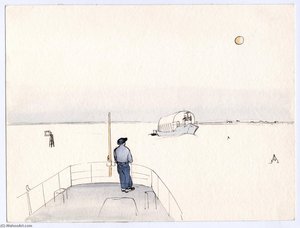
Hancock’s watercolor technique was characterized by remarkable precision and control. He employed layering techniques to build up color gradually, creating subtle gradations and atmospheric effects. His use of light and shadow was masterful, lending depth and realism to his subjects. Despite the technical detail, his paintings never feel cold or sterile; there's a warmth and humanity that permeates each piece.
He favored a limited palette – primarily blues, greens, grays, and browns – which he skillfully manipulated to evoke mood and atmosphere. His compositions often featured strong geometric forms, reflecting the inherent structure of the industrial subjects he depicted. There’s a deliberate restraint in his style; he avoids excessive detail or ornamentation, focusing instead on capturing the essence of his subject matter with clarity and elegance. This understated approach is what makes his work so enduring – it speaks to the beauty of functionality and the power of human ingenuity without resorting to sentimentality.
Legacy and Recognition
While largely unknown during his lifetime, Theodore Hancock’s work has gained increasing recognition in recent years. His paintings are now included in museum collections across the United States, testament to their artistic merit and historical significance. They offer a unique window into a pivotal moment in human history – the dawn of the space age – and serve as a reminder of the power of art to document and interpret our collective experience.
Hancock’s legacy extends beyond his individual artworks; he represents a fascinating intersection of art, science, and technology. His work continues to inspire artists and viewers alike, prompting reflection on the relationship between humanity and its creations – and the enduring allure of progress and exploration.
Q&A
Theodore Hancock가 그린 모든 주제를 한눈에 볼 수 있는 개요가 있나요?
Theodore Hancock의 작품은 작가의 주제별 작품 모음 페이지에서 주제별로 찾아보실 수 있습니다.
Theodore Hancock 작가의 작품 관련 통계 정보는 어디에서 확인할 수 있나요?
이 사이트에서 Theodore Hancock의 작품에 관한 통계를 확인할 수 있는 방문 통계 페이지를 만나보세요.
Theodore Hancock의 작품 중 몇 점을 둘러보실 수 있나요?
전체 작품 보기 페이지에서 Theodore Hancock의 작품 작품 62점점을 만나보실 수 있습니다.
Theodore Hancock 작품의 연도별 타임라인이 있나요?
Theodore Hancock의 작품을 연도별로 정리하여 보여주는 작품 연대기 페이지입니다.