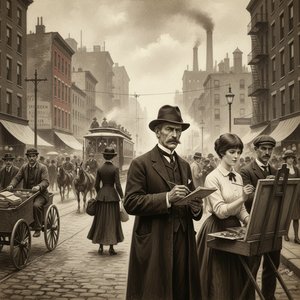
The Architect of Wit and Elegance
Henry Maximilian Beerbohm, known to the world as Sir Max Beerbohm, was a singular figure who navigated the twilight of the Victorian era and the dawn of the Edwardian age with unparalleled grace. Born in Munich to German parents, his journey through the hallowed halls of Eton and Trinity College Cambridge instilled in him a profound reverence for classical literature and intellectual debate. He was not merely an artist or a writer; he was a dandy of the intellect, a man whose very existence seemed a performance of refined irony. His prose and his pen worked in tandem to capture the shifting sands of British society, distilling the complexities of a changing world into forms that were as deceptively simple as they were biting in their social commentary.
Mastery of the Meticulous Line
In the realm of illustration, Beerbohm’s genius resided in his ability to marry naive realism with a sophisticated, stylized elegance. His technique, primarily centered on the delicate medium of pen and ink, allowed him to sculpt characters through the careful application of hatching and stippling. There was an ethereal quality to his work, a subtle grace that could convey deep emotion or sharp mockery with a single, well-placed stroke. Whether he was creating intricate woodcut prints like Quis Custodiet Ipsum Custodem or capturing the formal gravity of a gathering in Annual Banquet, his hand remained steady and his eye remained keen. His drawings were more than mere caricatures; they were psychological portraits that utilized:
- Meticulous detail to ground his subjects in a tangible reality.
- Layered lines to create a sense of profound depth and texture.
- Tonal variations achieved through masterful, delicate shading.
This artistic precision ensured that even his most satirical works possessed an aristocratic charm, making the sting of his critique all the more palatable to the very society he sought to lampoon.
A Legacy Written in Ink
Beyond the ink-stained page of the illustrator lay the profound literary legacy of a master parodist. Beerbohm’s writing, most notably his fantastical reimagining of Shakespeare in Zuleika Dobson, showcased a command of language that was both playful and erudite. He possessed a rare linguistic dexterity, capable of weaving tales that were simultaneously absurd and deeply insightful. Through his contributions to the Saturday Review and his various essays, he championed a brand of intellectual honesty that refused to shy away from the follies of his contemporaries. His life, spanning from the late nineteenth century to the mid-twentieth, serves as a bridge between eras, leaving behind a body of work that remains a testament to the power of wit, the beauty of the line, and the enduring relevance of social satire.
Q&A
Sir Max Beerbohm은(는) 어느 시대의 작품을 남겼나요?
Sir Max Beerbohm은(는) Modern 시대에 활동했습니다. 이 시기는 역사적 맥락 속에서 작가의 예술적 위치를 보여줍니다.
Sir Max Beerbohm의 모든 작품을 어디에서 볼 수 있나요?
이 사이트에 등록된 Sir Max Beerbohm의 모든 작품은 작가의 전체 작품 보기 페이지에서 만나보실 수 있습니다.
Sir Max Beerbohm의 연도별 활동 기록이 있나요?
Sir Max Beerbohm의 작품 세계를 시간순으로 정리한 기록은 아티스트 연대기 페이지에서 확인하실 수 있으며, 이곳에서는 각 시기별로 분류된 챕터를 따라 작품들을 제작 순서대로 만나보실 수 있습니다.