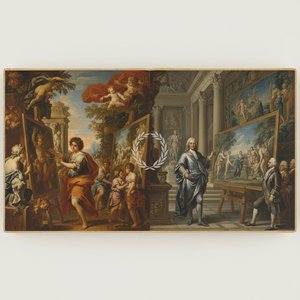
Simone Pignoni: A Morbid Sensuality Embodied in Baroque Florence
Simone Pignoni (1611-1698) stands as a singular figure within the Florentine Baroque, an artist whose oeuvre possesses a distinctive blend of anatomical precision and unsettling psychological depth. Unlike many of his contemporaries who adhered to stricter academic conventions championed by Domenico Passignano, Pignoni cultivated a style profoundly influenced by Francesco Furini—a fascination with the female nude that bordered on obsession and imbued his canvases with a palpable sense of morbid sensuality. This stylistic choice wasn’t merely aesthetic preference; it reflected a broader preoccupation with mortality and decay, themes central to Furini's artistic vision and powerfully conveyed in Pignoni’s own self-portrait circa 1650—a haunting depiction of the artist constructing a female figure from skeletal remains.- Early Life & Training: Born in Florence during the turbulent years following the Sack of Rome, Simone Pignoni received his formative artistic education under Fabrizio Boschi and Domenico Passignano. However, it was Francesco Furini who truly shaped his aesthetic sensibilities, fostering a preoccupation with idealized female forms that would dominate his subsequent output.
- Furini’s Influence & Anatomical Precision: The stylistic kinship between Pignoni and Furini is undeniable. Like Furini, Pignoni meticulously studied human anatomy—a skill honed through rigorous dissection—resulting in remarkably accurate representations of the nude figure. This dedication to anatomical realism distinguishes him from many other artists of his time, elevating his work beyond mere decorative embellishment.
- Notable Works: Pignoni’s artistic legacy rests upon a select group of paintings that exemplify his unique style and thematic concerns. Among these are *St. Agatha Cured by St. Peter*, attributed to him in Trieste; *St. Louis Providing a Banquet for the Poor* housed in Santa Felicita Cathedral, Florence; and *Madonna and Child in Glory with Archangels Saints Michael and Raphael in Battle Armor* adorning Santissima Annunziata Chapel. His allegorical masterpiece, *Peace*, commissioned by Palazzo Vecchio, continues to captivate viewers with its symbolic grandeur.
- Later Life & Conversion: Giovanni Camillo Sagrestani’s biography recounts a pivotal moment in Pignoni's life—a profound spiritual awakening triggered by illness and prompted by the encouragement of his confessor. This conversion marked a dramatic shift from Furini’s sensual explorations to more pious depictions, evidenced by *The Penitent Magdalen*, now residing in Palazzo Pitti.
Symbolism & Psychological Depth: Exploring Themes of Mortality and Beauty
Pignoni's artistic vision wasn't simply about replicating the human form; it was about confronting existential anxieties—the inevitability of death and the paradoxical allure of beauty amidst decay. This preoccupation is vividly articulated in his self-portrait, where the artist symbolically dismantles a female nude from a skeleton—a gesture that speaks to the fragility of existence and the transformative power of artistic contemplation. The artist’s meticulous anatomical studies served not merely as technical skill but as a conduit for grappling with profound philosophical questions about human nature and spirituality.Legacy & Historical Significance
Simone Pignoni's contribution to Florentine Baroque art is significant, representing a departure from prevailing academic trends toward a more psychologically nuanced approach. His influence extended beyond his immediate contemporaries, shaping the artistic sensibilities of subsequent generations. He stands as a testament to the enduring power of observation and imagination—qualities that enabled him to capture not only the physical beauty of the human form but also its underlying vulnerability and spiritual yearning. As Filippo Baldinucci noted, Pignoni’s work embodies “the scandalous imitation of (Furini's) licentious inventions,” cementing his place as a pivotal figure in Florentine art history—a painter who dared to confront mortality with unsettling grace and artistic brilliance.Q&A
Simone Pignoni 작가의 국적은 어디인가요?
Simone Pignoni은(는) Italy 출신입니다.
Simone Pignoni은(는) 어느 시대의 작품을 남겼나요?
Simone Pignoni은(는) Early Modern 시대에 활동했습니다. 이 시기는 역사적 맥락 속에서 작가의 예술적 위치를 보여줍니다.
Simone Pignoni의 작품을 컬러 팔레트별로 둘러볼 수 있나요?
컬러 팔레트별로 보기 페이지에서는 Simone Pignoni의 작품들을 색상 팔레트별로 모아볼 수 있습니다.