Early Life and Artistic Training
Samuel Lancaster Gerry entered the art world from a position of self-reliance. Born in Boston in 1813, he lacked the formal academic instruction typical of many of his contemporaries. Instead, he developed his technical skills through direct practice and observation. This self-taught foundation allowed him to bypass traditional institutional training, focusing instead on the practical application of his craft. By the age of 20, his ability to handle composition and form was sufficient to secure a place in the public eye. In 1833, he held his first exhibit at the Boston Athenaeum Art Gallery, marking an early entry into the professional art scene of New England.
The years following his first exhibition were defined by the commercial realities of a working artist. Between 1834 and 1839, Gerry operated an ornamental and sign painting business alongside James Burt. This period of his life was less about fine art and more about the precision required for commercial work. Such work demanded a disciplined hand and an understanding of decorative aesthetics. This pragmatic period of labor provided the technical stability necessary to sustain a career in a competitive urban market. His transition from sign painting to more formal subjects reflects a practical evolution common to many successful 19th-century painters.
Professional Life in Boston
Gerry’s career was anchored in Boston. Aside from a three-year period spent abroad, his professional existence was tied to this city. He was not a solitary figure working in isolation; he was deeply embedded in the institutional fabric of the New England art scene. His involvement with the New England Art Union and the Boston Artists' Association demonstrates a commitment to the organized structures of 19th-century American art. He was a builder of institutions, not just a participant in them.
In 1857, he co-founded the Boston Art Club, a move that solidified his position within the local establishment. His influence extended beyond the city limits through formal participation in national discourse. He attended the 1860 convention of the National Art Association in Washington, DC, asserting his presence among the leading figures of the era. This was a period of active engagement, where his presence in Boston served as a constant through decades of shifting artistic trends.
Landscape and Portrait Painting
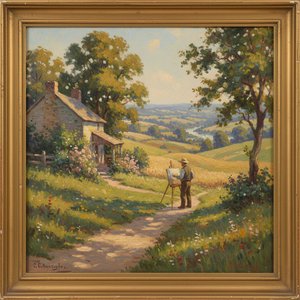
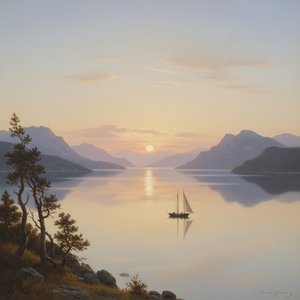
Gerry’s output was defined by a dual focus on the human likeness and the rugged topography of New England. While his portraiture provided a steady professional foundation, his landscapes secured his reputation as a prolific chronicler of the region. He did not merely observe these environments; he captured the specific character of the White Mountains and the Lakes Region of New Hampshire. His first foray into this specific terrain occurred in 1836, producing a scene on the Ellis River in Jackson, New Hampshire. This early engagement with the White Mountains established a pattern of seasonal and topographical study that would persist throughout his career.
His geographic reach extended beyond the mountains. He moved through the Catskills, the Hudson River Valley, and along the Maine coast, sketching the varied textures of the American Northeast. This movement allowed him to develop a visual vocabulary for different environments, from coastal lines to river valleys. His ability to translate these locales into oil and watercolor made him a popular choice for those seeking a direct representation of New England scenery. He was a practical painter, responding to the specific demands of a market that valued topographical accuracy and the depiction of local landmarks.
Notable Works and Techniques
Gerry’s technical range was broad, moving between the precision of oil on panel and the more fluid applications of oil on canvas. He utilized watercolor, charcoal, and sketching to capture his subjects, demonstrating a versatility that supported both his landscape and portrait work. His ability to manipulate these mediums allowed him to document the specific textures of the New England terrain with directness. He did not rely on a single method, instead choosing the medium that best suited the specific demands of the scene or the sitter.
His engagement with the White Mountains began early, evidenced by a 1836 painting of a scene on the Ellis River in Jackson, N.H. This early focus on the region's topography established a pattern of observation that continued for decades. Later, in 1886, he produced "Old Man of the Mountains near Profile House, White Mts," an oil on canvas work that remains a concrete example of his late-career output. These works show a commitment to the specificities of the landscape rather than a generalized interpretation.
The artist also explored more intimate, structured compositions. His work "The Four Seasons: Autumn," created about 1857, was executed as an oil on panel. This choice of a rigid support suggests a preference for controlled, detailed execution in his smaller-scale studies. Through these varied techniques and subjects, Gerry maintained a consistent presence in the New England art scene, producing work that was as much about topographical accuracy as it was about formal composition.
Q&A
Samuel Lancaster Gerry의 작품을 컬러 팔레트별로 둘러볼 수 있나요?
특정 색상 팔레트의 Samuel Lancaster Gerry 작품을 찾으시려면, 작가의 컬러 팔레트별로 보기 페이지를 이용해 보세요.
Samuel Lancaster Gerry의 작품을 기법별로 모아볼 수 있는 곳은 어디인가요?
Samuel Lancaster Gerry의 작품은 작가 페이지인 모든 매체별에서 매체별로 둘러보실 수 있습니다.
Samuel Lancaster Gerry 작가 작품의 컬러 프로필은 어디에서 확인할 수 있나요?
Samuel Lancaster Gerry 작가 작품의 컬러 프로필은 작가의 팔레트 지놈 페이지에서 확인하실 수 있습니다.