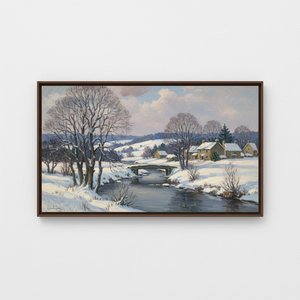
The Quiet Observer of the Natural World
Born in the coastal air of Halifax, Nova Scotia, Robert David Wilkie began to find his voice through the brush around 1849. His early years in the British colony provided a foundation for a life that would eventually find its center in the bustling artistic circles of the American East. By the middle of the nineteenth century, his hand was already busy contributing landscape views to publications like Gleason's Pictorial Drawing Room Companion. He was a man of many roles, moving through the world as a painter, a draftsman, and an educator, always seeking to capture the subtle nuances of the environment around him.
As the years passed, his residence shifted toward the urban energy of Boston and Roxbury, where he remained until the turn of the century. This period of his life saw him deeply embedded in the visual culture of the era. He did not merely paint for his own pleasure; he worked as a correspondent for Frank Leslie's Illustrated Weekly and collaborated with the lithographer Louis Prang. His ability to translate the world onto paper and canvas made him a vital part of the nineteenth-century visual landscape.
A Versatile Hand and Diverse Subjects
Wilkie possessed a curiosity that refused to be confined to a single subject. His studio was a place where the stillness of a still life met the movement of the wild. He moved between mediums with ease, applying oil, watercolor, ink, and chalk to his various pursuits. His repertoire was broad, reflecting a keen eye for both the grand and the minute:
- Landscape scenes that captured the breadth of the horizon.
- Genre paintings depicting moments of human life.
- Still life compositions that studied the play of light on objects.
- Detailed bird paintings that required a precise, observational touch.
One of his most notable achievements involved a deep engagement with literature. Between 1896 and 1899, he translated the written word into visual form by painting over a hundred watercolor scenes inspired by the novels of Charles Dickens. This work required a specific kind of empathy, a way to see the atmosphere of a story through color and line.
Legacy in Ink and Oil
The final years of his life were spent in Swampscott, Massachusetts, leaving behind a body of work that moved from the pages of periodicals to the walls of galleries. His presence in the art world was felt in the institutions that preserved his vision, including the Museum of Fine Arts in Boston and the Art Gallery of Nova Scotia. Even long after his passing, his works continued to find their way into the hands of collectors, such as when a large collection of his paintings was exhibited at the Vose Galleries in 1948.
His life was a steady progression of observation and translation. From the forests where he painted birds to the literary worlds of his watercolor studies, Robert David Wilkie remained a dedicated chronicler of the visible and the imagined. He left behind a record of the nineteenth century, captured through the careful application of pigment and a tireless commitment to his craft.
Q&A
Robert David Wilkie은(는) 어느 시대의 작품을 남겼나요?
Robert David Wilkie은(는) 19th Century 시대에 활동했습니다. 이 시기는 역사적 맥락 속에서 작가의 예술적 위치를 보여줍니다.
Robert David Wilkie 작가의 작품을 감상할 수 있는 3D 갤러리는 어디인가요?
가상 방문이 가능합니다: Robert David Wilkie의 3D 갤러리 페이지에서 3D 갤러리를 통해 작가의 작품들을 만나보실 수 있습니다.
Robert David Wilkie의 예술 세계는 시간이 흐름에 따라 어떻게 진화했나요?
Robert David Wilkie의 예술적 여정은 연대기 페이지에서 시기별로 펼쳐집니다. 이곳에서는 작가의 활동 시기를 장(chapter)으로 나누어 작품들을 연대순 타임라인 형태로 한눈에 확인할 수 있습니다.