로 스케자의 초상화

갤러리 엄선, 가장 유명한 로 스케자 작품 26선

10월 2026 업데이트 · 인기 점수 기준 순위 (각 작품의 검색, 방문 및 주문 수) · 29점의 로 스케자 작품 (당사 카탈로그 기준)

요약하자면

로 스케자가 남긴 모든 원작 중 가장 유명한 작품은 필라델피아의 필라델피아 미술관에 소장된 Portrait of a Lady (1460)입니다. 그 뒤를 이어 Game of Civettino (detail) (1450)와 Virgin and Child Enthroned with Saints Anthony Abbot and Julian and a Donor (1430)가 뒤를 잇습니다. 로 스케자의 작품 29점을 보유하고 있습니다. 갤러리는 세계가 가장 찬사하는 26점을 엄선하여 각 작품의 제작 연도, 소장 미술관 및 작품에 담긴 이야기를 함께 소개합니다.

1406 – 1486, 산조반니발다르노 Early renaissance 최다 소장처: Museo di Palazzo Davanzati

로 스케자의 베스트 작품 10선: 갤러리 선정

1
Portrait of a Lady (1460) 의 로 스케자

Portrait of a Lady

1460 · Tempera On Panel · 필라델피아 미술관, 필라델피아

A single subject is captured in profile, facing left against a deep, monochromatic background. This stark contrast emphasizes the luminosity of her pale complexion and the delicate strands of her blonde hair. The composition focuses entirely on the subject's features and attire, utilizing a classic profile view that provides a shallow depth. Her gaze is fixed toward the distance, lending an air of dignity and restraint to her posture.

2
Game of Civettino (detail) (1450) 의 로 스케자

Game of Civettino (detail)

1450 · Tempera On Panel · Museo di Palazzo Davanzati, Florence

In this detail from the 1450 work, we observe a moment of youthful rivalry. The scene depicts two infants engaged in a playful wrestling match, a depiction of childhood play captured with remarkable immediacy. Rather than a scene of conflict, the interaction suggests the innocent struggle for dominance often found in early childhood. The figures are set within a composition that includes onlookers and a sense of a lived environment,…

3
Virgin and Child Enthroned with Saints Anthony Abbot and Julian and a Donor (1430) 의 로 스케자

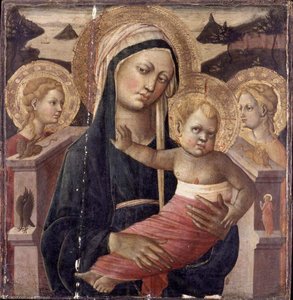
Virgin and Child Enthroned with Saints Anthony Abbot and Julian and a Donor

1430 · Tempera On Panel · Courtauld Gallery, 런던

The air within the frame feels heavy with a quiet, luminous stillness. At the center of this sacred assembly, the Virgin Mary sits upon a throne, her presence commanding yet gentle. She holds the Christ Child, whose small form radiates a soft light against the deep blues of her robes. Surrounding them, the saints emerge from a background of shimmering gold leaf, their figures caught in a moment of eternal…

4
Saint Anthony Abbot Tempted by Gold (1400) 의 로 스케자

Saint Anthony Abbot Tempted by Gold

1400 · Tempera On Panel · Birmingham Museum of Art, Birmingham

The painting titled Saint Anthony Abbot Tempted by Gold is a work by the Italian artist Giovanni di ser Giovanni Guidi, who is also known by the name Lo Scheggia. This tempera on panel work dates to the mid-15th century. The subject matter focuses on the figure of Saint Anthony Abbot, who is depicted with a golden halo. The saint holds a red book and a staff in his hands.

5
Madonna and Child with two Angels (1450) 의 로 스케자

Madonna and Child with two Angels

1450 · Tempera On Panel · Musée du Petit Palais, 아비뇽

The painting titled Madonna and Child with two Angels is a work by the Florentine artist Giovanni di ser Giovanni Guidi. Created about 1450, the panel captures a quiet moment of divine presence. The figures are centered in a tight, vertical arrangement, held within a space of gold and deep ultramarine blue. This composition focuses on the Virgin Mary as she holds the Christ Child, flanked by two celestial beings.

6
Three panels adorning a Wedding Cassone (1467) 의 로 스케자

Three panels adorning a Wedding Cassone

1467 · Tempera On Panel

The wood bears the weight of centuries, its surface etched with fine cracks that trace the passage of time. These three panels, once part of a wedding cassone, carry the quiet gravity of the Quattrocento. Tempera on wood, the medium allows for a precise, linear clarity that defines every movement. A ceremonial procession moves across the top panel, a frieze of horses and carriages winding through a landscape of architectural…

7
The Triumph of a Roman General (1462) 의 로 스케자

The Triumph of a Roman General

1462 · Tempera On Panel · 스코틀랜드 국립 미술관, 에든버러

A horizontal frieze of movement unfolds across the panel. A Roman general sits within a raised golden chariot, a singular point of stillness amidst a rhythmic surge of soldiers. The landscape stretches toward distant, rolling hills and pale skies, creating a sense of immense scale. Beneath the chariot, the terrain is rendered in earthy ochres and browns, while the sky holds a deep, quiet blue. The composition relies on a…

8
The Seven Liberal Arts (1460) 의 로 스케자

The Seven Liberal Arts

1460 · Tempera On Panel · 카탈루냐 국립 미술관, 바르셀로나

The Seven Liberal Arts is an allegorical painting by Giovanni di Ser Giovanni Guidi. Created around 1460, this work offers a structured look into the intellectual disciplines of the Renaissance. The artist, who was also known as Lo Scheggia, approached the subject with a specific sense of order and decorative intent. Each figure within the composition represents a particular branch of knowledge, arranged in a rhythmic, architectural sequence.

9
Triumph of Julius Caesar (1455) 의 로 스케자

Triumph of Julius Caesar

1455 · Tempera On Panel · New York Historical Society, 뉴욕

The work is organized as a long, horizontal frieze-like arrangement, guiding the eye across a crowded procession. Numerous figures, horses, and animals move steadily from left to right through a landscape. This movement creates a sense of continuous narrative, as if we are witnessing a single moment of a historical or allegorical triumphal procession. The perspective remains somewhat flattened, a characteristic approach for the mid-15th century, yet the artist achieves…

10
Church of San Lorenzo (San Giovanni Valdarno), Toscana, Italy (1457) 의 로 스케자

Church of San Lorenzo (San Giovanni Valdarno), Toscana, Italy

1457 · Fresco

The work known as Church of San Lorenzo (San Giovanni Valdarno), Toscana, Italy, was executed by Giovanni di ser Giovanni Guidi. This artist, often referred to by the nickname Lo Scheggia, was born in San Giovanni Valdarno, Italy, and remained connected to this region throughout his life until his death in 1486. His presence in the Florentine Renaissance is often noted through his relationship to his brother, Masaccio, though his…

로 스케자 컬렉션이 계속됩니다, 11부터 26까지

로 스케자의 시대별 명작

로 스케자의 시선을 사로잡은 주제들

이 오리지널 작품들에서 가장 자주 등장하는 네 가지 주제와 그 정수를 보여주는 대표작들.

로 스케자의 원작을 소장하고 있는 미술관

이 페이지에 있는 작품을 가장 많이 소장하고 있는 8개의 미술관

소장 미술관 도시 로 스케자의 작품 이 목록의 작품들
Museo di Palazzo Davanzati, FlorenceMuseo di Palazzo Davanzati Florence 3 Game of Civettino (detail), Game of Civettino (a Birth Salver), Game of Civettino (a Birth Salver)
Birmingham Museum of Art, BirminghamBirmingham Museum of Art Birmingham 2 Saint Anthony Abbot Tempted by Gold, Saint Bernardino of Siena Preaching
Musée du Petit Palais, 아비뇽Musée du Petit Palais 아비뇽 2 Madonna and Child with two Angels, Reclining Youth
필라델피아 미술관, 필라델피아필라델피아 미술관 필라델피아 1 Portrait of a Lady
Courtauld Gallery, 런던Courtauld Gallery 런던 1 Virgin and Child Enthroned with Saints Anthony Abbot and Julian and a Donor
스코틀랜드 국립 미술관, 에든버러스코틀랜드 국립 미술관 에든버러 1 The Triumph of a Roman General
카탈루냐 국립 미술관, 바르셀로나카탈루냐 국립 미술관 바르셀로나 1 The Seven Liberal Arts
New York Historical Society, 뉴욕New York Historical Society 뉴욕 1 Triumph of Julius Caesar

로 스케자의 시대별 걸작: 시대를 정의하는 오리지널 작품들

연대별 작품 수

그 시대를 정의하는 오리지널 작품을 만나보려면 연대를 선택하세요.

로 스케자의 작품에 관한 컬렉터들의 질문

로 스케자의 가장 대표적인 작품은 무엇인가요?정답 확인하기

Portrait of a Lady (1460), 필라델피아 미술관, 필라델피아. 다음은 Game of Civettino (detail) (1450)와 Virgin and Child Enthroned with Saints Anthony Abbot and Julian and a Donor (1430)입니다.

Portrait of a Lady이(가) 제작되었을 당시 로 스케자의 나이는 몇 살이었나요?정답 확인하기

54세: Portrait of a Lady은(는) 1460년 작품이며, 로 스케자은(는) 1406년에 태어났습니다.

로 스케자의 가장 유명한 작품 10가지는 무엇인가요?정답 확인하기

Portrait of a Lady, Game of Civettino (detail), Virgin and Child Enthroned with Saints Anthony Abbot and Julian and a Donor, Saint Anthony Abbot Tempted by Gold, Madonna and Child with two Angels, Three panels adorning a Wedding Cassone, The Triumph of a Roman General, The Seven Liberal Arts, Triumph of Julius Caesar 및 Church of San Lorenzo (San Giovanni Valdarno), Toscana, Italy. 위 순위는 각 작품의 제작 연도와 소장 박물관을 나타냅니다.

로 스케자 작가가 남긴 작품은 몇 점인가요?정답 확인하기

저희 카탈로그에는 1430년부터 1467년 사이의 로 스케자 작가의 작품 29점이 수록되어 있습니다.

로 스케자의 걸작은 어느 박물관에 전시되어 있나요?정답 확인하기

대부분 Museo di Palazzo Davanzati (Florence), Birmingham Museum of Art (Birmingham) 및 Musée du Petit Palais (아비뇽)에 소장되어 있습니다. 위의 박물관 목록에서 전체 목록을 확인하실 수 있습니다.

로 스케자의 가장 유명한 작품들은 어느 연도에 그려졌나요?정답 확인하기

1450s 동안: 이 페이지의 총 26점의 작품 중 12점이 해당 시기에 제작되었으며, 그중 Game of Civettino (detail)점입니다.

로 스케자의 첫 번째와 마지막 유명 원작은 무엇인가요?정답 확인하기

이 페이지에서 가장 오래된 작품은 Virgin and Child Enthroned with Saints Anthony Abbot and Julian and a Donor (1430)이며, 가장 최근 작품은 Three panels adorning a Wedding Cassone (1467)입니다.

로 스케자 작가가 가장 자주 선택한 주제는 무엇인가요?정답 확인하기

이 페이지의 26점의 작품에 걸쳐 있는 Woman (6), Architecture (5) 및 People (4)

로 스케자 작가가 가장 많이 사용한 기법은 무엇인가요?정답 확인하기

이 페이지의 총 26점의 작품 중 12점의 Tempera On Panel

로 스케자은(는) 어떤 미술 사조에 속하나요?정답 확인하기

이 페이지의 원작들을 기준으로 볼 때, Early renaissance

Museo di Palazzo Davanzati에는 어떤 로 스케자의 작품이 전시되어 있나요?정답 확인하기

Game of Civettino (detail), Game of Civettino (a Birth Salver) 및 Game of Civettino (a Birth Salver): Museo di Palazzo Davanzati, Florence은(는) 이 페이지에 있는 작품 중 3점을 소장하고 있습니다.

로 스케자: 생애와 작품 세계

The Splinter of Florentine Elegance

In the grand, sun-drenched tapestry of the Florentine Renaissance, certain names shine with a revolutionary brilliance that alters the course of art history forever. While his brother Masaccio is celebrated as the pioneer of groundbreaking realism, Giovanni di Ser Giovanni—affectionately known to history as Lo Scheggia, or "the splinter"—carved out a legacy defined by a different, more delicate kind of mastery. Born in San Giovanni Valdarno, Italy, he was part of a family deeply rooted in the artistic traditions of Tuscany, an environment that nurtured his innate talent for visual storytelling and intricate craftsmanship.

The nickname Lo Scheggia likely derived from his slender build, but it also perhaps alluded to his specialized relationship with wooden artifacts. His grandfather, Mone, was a cassaio—a craftsman specializing in the construction of chests—and this heritage profoundly influenced Giovanni’s artistic path. Rather than pursuing the visceral, muscular drama seen in the works of his brother, Lo Scheggia found his calling in the decoration of domestic furnishings, such as wedding chests, birth trays, and spalliera panels.

A Journey Through Workshops and Traditions

The journey of this Florentine master began in earnest when he moved to the heart of the Renaissance. His early years were shaped by rigorous discipline within the workshop of Lorenzo Bicci, an artist still bound to more traditional stylistic features that lacked the modern sophistication of the International Gothic or the emerging perspective approaches. Seeking greater innovation, Giovanni eventually moved to the workshop of his brother, Masaccio, living alongside him and their mother in Via de’ Servi.

Despite the monumental shadow cast by his brother's revolution, Lo Scheggia demonstrated a remarkable sense of artistic integrity. In 1428, he famously declined to inherit Masaccio's estate, a decision that suggests a man deeply committed to forging his own creative identity. His work represents a realm of quieter elegance, where meticulous detail and profound spiritual contemplation reign supreme, stepping away from the heavy realism of his brother to embrace a more graceful, decorative aesthetic.

Mastery of Detail and Symbolism

Lo Scheggia’s technical prowess is most evident in his ability to manipulate tempera paint to create depth and luminosity. His works often feature a meticulous attention to detail that draws the viewer into an intimate, almost private world. One of his most captivating achievements is the Game of Civettino (a Birth Salvor), painted around 1450. This circular painting, executed in tempera on gessoed panel, captures a poignant window into the burgeoning artistic sensibilities of the Early Renaissance through its depiction of two infants engaged in a playful wrestling match.

His ability to blend decorative richness with symbolic depth is further showcased in his commissions for the most powerful families of the era. His work on the Triumph of Fame, part of a large birth tray commissioned for the birth of Lorenzo de’ Medici, illustrates his skill in navigating the complex heraldry and allegorical language of the time. Through the use of muted golds, browns, and ochres, Lo Scheggia created compositions that were both visually captivating and deeply embedded in the social and familial narratives of Renaissance Florence.