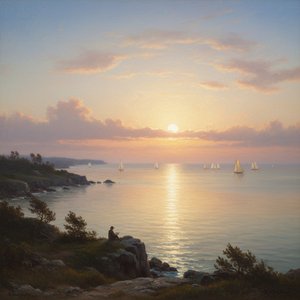
The Soul of the Portrait: The Life and Legacy of Richard Rothwell
In the grand tapestry of nineteenth-century art, few threads are as intricately woven with both classical elegance and Romantic emotion as those left by Richard Rothwell. Born in Dublin on November 20, 1800, Rothwell emerged from a background of relative comfort to become a painter whose brush captured not just the likeness of his subjects, but their very essence. His journey was one of constant movement and profound artistic evolution, stretching from the academic halls of Ireland to the vibrant studios of London and the sun-drenched landscapes of Italy. As an artist working during the height of the Romantic era, Rothwell possessed a rare sensitivity to the human form, allowing him to navigate the delicate balance between meticulous realism and the evocative power of light and shadow.
The foundations of his mastery were laid in the Dublin Society's school of art, where he studied with rigorous discipline from 1814 until 1820. It was here that his burgeoning talent first earned formal recognition, marked by the achievement of a silver medal—a precursor to the international acclaim that would follow. His early years were defined by this disciplined training, yet his spirit was always drawn toward larger horizons. By 1829, Rothwell had migrated to London, where he entered the studio of the legendary Sir Thomas Lawrence. This period served as a transformative apprenticeship; under Lawrence’s mentorship, Rothwell absorbed the sophisticated techniques of high-society portraiture, learning how to imbue a canvas with dignity, status, and a certain luminous grace that would become hallmarks of his own style.
A Journey Through Light and Landscape
The death of Sir Thomas Lawrence in 1830 presented Rothwell with both a profound challenge and a monumental opportunity. Tasked with completing many of his master's unfinished works, Rothwell found himself momentarily positioned as a successor to one of Britain’s most celebrated portraitists. During the years between 1829 and 1831, he reached the zenith of his professional influence. However, rather than resting upon the laurels of portraiture alone, Rothwell sought a deeper connection to the roots of classical art. This ambition led him on an extensive tour of Italy from 1831 to 1834, a pilgrimage intended to study the masters and refine his ability to compose grand history paintings.
This Italian sojourn infused his work with a new dimension of light and atmosphere. While he remained a specialist in portraiture, his encounters with the Italian landscape tradition introduced a sense of veduta and classical grandeur to his oeuvre. His portraits from this era often reflect a more profound, contemplative depth, moving beyond mere social documentation toward something more poetic. Even as his popularity fluctuated following his return to London, Rothwell’s technical prowess remained undiminished. Whether capturing the delicate features of Miss Knowles in 1850 or the rugged, youthful innocence of The Little Roamer in 1843, his ability to manipulate oil on canvas allowed him to communicate a wide spectrum of human experience.
Final Years and Enduring Significance
The later years of Rothwell’s life were as geographically diverse as his early career, with his work finding audiences in the United States, Ireland, and across Europe. Despite the shifting tides of art movements—from the structured elegance of his training to the more emotive textures of the mid-century—Rothwell remained steadfast in his commitment to craftsmanship. His personal life was marked by stability amidst his travels, notably through his marriage to Rosa Marshall in 1842, yet his professional life remained a restless pursuit of beauty.
The end of his journey came far from his Dublin birthplace. In 1868, while working in Rome—the very city that had once inspired his artistic expansion—Rothwell contracted a fever that claimed his life. He was laid to rest in the Protestant Cemetery in Rome, a fitting final resting place for an artist whose soul was so deeply connected to the classical traditions of the Mediterranean. Today, Richard Rothwell is remembered not merely as an assistant to a master, but as a significant figure in nineteenth-century art whose works continue to resonate with their:
- Meticulous craftsmanship and attention to anatomical detail;
- Romantic sensibility that captured the psychological depth of his sitters;
- Versatile mastery of both the intimate portrait and the expansive, light-filled landscape.
질의응답
Richard Rothwell 작가는 어떤 사조에 참여했나요?
Richard Rothwell의 작품은 작가의 모든 사조 페이지에서 사조별로 둘러보실 수 있습니다.
Richard Rothwell의 작품을 분위기별로 모아둔 곳은 어디인가요?
Richard Rothwell의 작품은 각 작품에 담긴 분위기에 따라 분류된 아티스트의 무드 룸 페이지에서 무드별로 감상하실 수 있습니다.
특정 매체로 분류된 Richard Rothwell의 모든 작품을 어떻게 찾을 수 있나요?
특정 매체로 제작된 Richard Rothwell의 모든 작품을 확인하시려면, 작가의 모든 매체 페이지를 이용해 주세요.
Richard Rothwell은(는) 어느 시대에 활동했나요?
Richard Rothwell은(는) 19th Century 시대에 활동했습니다. 이 시기는 역사적 맥락에서 작가의 활동 위치를 보여줍니다.
Richard Rothwell의 모든 작품은 어디에서 볼 수 있나요?
본 웹사이트에 등록된 Richard Rothwell의 모든 작품은 작가의 모든 작품 보기 페이지에서 확인하실 수 있습니다.
Richard Rothwell의 작품 중 몇 점을 둘러보실 수 있나요?
모든 작품 보기 페이지에서 Richard Rothwell의 작품 작품 32점점을 만나보실 수 있습니다.
Richard Rothwell 작가는 어떤 색상을 가장 자주 사용했나요?
Richard Rothwell 작가 작품의 컬러 프로필은 작가의 팔레트 지놈 페이지에서 확인하실 수 있습니다.