Piotr Baracz: Echoes of Resilience in Polish Art
Piotr Baracz (1924-1985) emerged as a significant figure within the Polish postwar artistic landscape, embodying the spirit of rebuilding and remembrance following the devastation of World and War II. Born in Poland during a period marked by profound societal upheaval, Baracz’s artistic journey was inextricably linked to the nation's struggle for identity and cultural renewal—a theme that consistently resonated throughout his oeuvre. His work stands as a testament to both personal introspection and a broader engagement with the collective memory of his time, capturing the quiet strength found in the wake of catastrophe.
His formative years were shaped by the turbulent political climate of Communist Poland, a period where art often served as a vessel for navigating complex social realities. Baracz pursued formal artistic education at the Warsaw Academy of Art, honing his skills in painting and sculpture under influential mentors who instilled in him a dedication to realism and expressive observation. This rigorous grounding in traditional techniques would prove crucial to his later stylistic choices, allowing him to translate the heavy atmosphere of his era into tangible, visual narratives.
Style, Symbolism, and the Polish Landscape
Baracz’s distinctive style was characterized by meticulous detail and a profound tonal subtlety. This mastery was particularly evident in his landscapes, which captured the melancholic beauty of Poland's recovering countryside. He did not merely paint scenery; he painted the soul of a nation in transition. Through his brush, the landscape became a living character, reflecting the resilience of the land itself. Recurring motifs in his work included depictions of rural life and portraits that reflected the faces of ordinary Poles grappling with both hardship and hope.
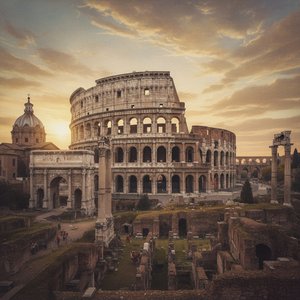
His ability to blend direct observation with symbolic representation allowed him to convey emotions far beyond mere visual description. He explored architectural spaces imbued with historical significance, using light and shadow to evoke a sense of time passing and the weight of history. In his hands, a crumbling structure or a quiet village street became an exploration of endurance. His work often featured:
- Tonal Gradation: A sophisticated use of light to create psychological depth and atmosphere.
- Meticulous Realism: A commitment to capturing the textures of rural life and historical architecture.
- Symbolic Landscapes: Using the natural world as a metaphor for the human condition and national recovery.
Legacy and Notable Achievements
Throughout his career, Baracz achieved significant milestones that cemented his place in the annals of Polish art. His ability to capture the psychological nuance of his subjects made him a master of portraiture. One of his most celebrated works, “Roman Polanski” (1963), exemplifies this mastery; it is a monumental portrait that captures the solemn gaze of the celebrated filmmaker through expert tonal gradation.
Beyond portraiture, his landscapes remain some of his most iconic contributions to the medium. In “The Old Mill” (1970), Baracz portrays a crumbling grain mill set against a dramatic, sweeping sky. This piece serves as a powerful visual metaphor for Poland's enduring spirit amidst decay, illustrating how beauty and strength can persist even within ruins. His legacy remains a vital part of the postwar Polish artistic canon, offering a window into a period of profound transformation and the indomable human will to create amidst the shadows of history.
질의응답
특정 주제에 따른 Piotr Baracz의 작품을 어떻게 찾을 수 있나요?
특정 주제의 Piotr Baracz 작품을 찾으려면 키워드별로 작품이 분류된 작가의 키워드별로 페이지를 이용해 보세요.
Piotr Baracz의 작품을 연도순으로 어디에서 볼 수 있나요?
Piotr Baracz의 작품은 작가의 작품 연대기 페이지에서 연도별로 확인하실 수 있습니다.
특정 매체로 분류된 Piotr Baracz의 모든 작품을 어떻게 찾을 수 있나요?
특정 매체로 제작된 Piotr Baracz의 모든 작품을 확인하시려면, 작가의 모든 매체 페이지를 이용해 주세요.