The Weaver of Dreams and Floral Tapestries
Patricia Faulkner, born in 1946, stands as a singular voice in contemporary American art, an artist whose canvases serve as portals to a realm where the boundaries between reality and myth dissolve. Her creative essence is deeply rooted in the primordial landscapes of her youth; the sprawling, mysterious swamps and marshes of Louisiana provided her earliest lessons in the beauty of the untamed. These childhood explorations instilled in her a profound reverence for the natural world, a fascination that would later evolve into a sophisticated artistic language characterized by an intricate dance between botanical precision and fantastical narrative. In Faulkner’s work, one does not merely observe nature, but enters a dreamscape where every petal and vine holds the potential for enchantment or peril.
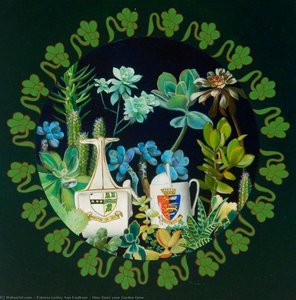
The aesthetic of Faulkner is famously defined by its lush, symbolic complexity. Her compositions are often populated by serpentine figures—creatures that glide through opulent floral arrangements, acting as potent symbols of transformation, rebirth, and the hidden wisdom of the earth. This interplay between the organic and the mythical creates a tension that is both captivating and unsettling. By weaving together elements of the Victorian era’s romanticism with deep-seated mythological archetypes, she constructs landscapes that feel simultaneously ancient and timeless. Her dedication to botanical accuracy, particularly in her rendering of lilies and orchids, provides a grounding realism that makes the more surreal, dreamlike elements of her work feel startlingly tangible.
Technique, Texture, and Artistic Lineage
The formal evolution of Faulkner’s style can be traced back to her rigorous training at the prestigious Pratt Institute in New York City. While her academic foundation in oil painting and printmaking provided her with essential technical mastery, she famously resisted the constraints of rigid formalism. Instead, she sought a more expressive, tactile approach that prioritized emotional resonance over mere anatomical or botanical perfection. Influenced by the dramatic, illustrative power of Gustave Doré and the decorative, nature-centric ideals of William Morris, Faulkner developed a technique that celebrates the physical presence of paint itself.
Her canvases are masterclasses in texture, often utilizing thick impasto layers to create a sculptural quality. This heavy application of pigment allows her to capture light in ways that produce luminous, shifting effects across the surface of the work. Through meticulous blending and a sophisticated understanding of color harmony, she achieves a depth that invites the viewer to linger on the subtle gradations of a petal or the shimmering scales of a serpent. This tactile approach ensures that her art is not just a visual experience, but a sensory one, where the weight and movement of the medium mirror the richness of the themes she explores.
A Legacy of Narrative and Scale
Throughout her prolific career, Faulkner has demonstrated an extraordinary versatility, proving that her visionary style can adapt to vastly different scales and mediums. Her body of work spans from intimate watercolor studies—where she documents rare botanical specimens with scientific reverence—to monumental public murals that transform entire architectural spaces into immersive environments. This breadth of output reflects a lifelong commitment to the idea that art should occupy both the private sanctuary of the collector and the shared landscape of the public.
The historical significance of her work lies in its ability to bridge disparate eras and styles, creating a cohesive visual mythology that speaks to universal human experiences. Whether she is depicting scenes reminiscent of the French Renaissance or exploring contemporary surrealist themes, her hand remains unmistakable. Her achievements are marked by a consistent ability to evoke wonder, making her a vital figure for those who seek art that transcends the mundane. In the works of Patricia Faulkner, the natural world is never just a subject; it is a living, breathing tapestry of memory, myth, and magic.
질의응답
Patricia Lesley Ann Faulkner의 경력은 어떻게 시기별로 구분되어 있나요?
Patricia Lesley Ann Faulkner의 예술적 여정은 연대기 페이지에서 시기별로 펼쳐집니다. 이곳에서는 작가의 활동 시기를 장(chapter)으로 나누어 작품들을 연대순 타임라인 형태로 한눈에 확인할 수 있습니다.
Patricia Lesley Ann Faulkner의 모든 작품은 어디에서 볼 수 있나요?
본 웹사이트에 등록된 Patricia Lesley Ann Faulkner의 모든 작품은 작가의 모든 작품 보기 페이지에서 확인하실 수 있습니다.
Patricia Lesley Ann Faulkner 작가는 어떤 사조에 참여했나요?
Patricia Lesley Ann Faulkner 작가가 활동했던 예술 사조는 작품을 사조별로 분류하여 보여주는 작가의 모든 사조 페이지에서 확인하실 수 있습니다.