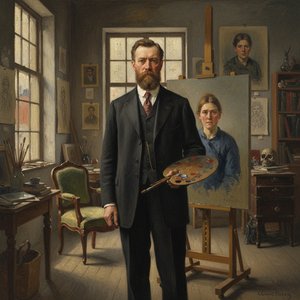
A Visionary of the Norwegian Soul
Otto Ludvig Sinding was a multifaceted creator whose artistic spirit breathed life into the very essence of Norway. As a painter, illustrator, poet, and dramatist, he possessed a rare ability to capture the profound connection between the human experience and the rugged beauty of the natural world. His work often drew deeply from motives found within Norwegian nature, folk life, and history, weaving a tapestry of cultural identity through his brush and pen. Born in Kongsberg, Norway, Sinding was part of a remarkably gifted family; he was the older brother of the sculptor Stephan Sinding and the composer Christian Sinding, suggesting an environment steeped in the pursuit of aesthetic excellence.
His journey into the visual arts was marked by a transition from the structured world of law to the boundless realms of creativity. After studying law and serving as a civil servant in Christiania, his early forays into landscape painting earned him a scholarship that would alter the course of his life. This opportunity led him to Karlsruhe, Germany, where he studied under the esteemed Hans Gude at the Baden School of and came into contact with influential figures such as Wilhelm Ludwig Friedrich Riefstahl and Karl Theodor von Piloty. These formative years in Germany provided him with the technical foundation necessary to translate the dramatic landscapes of his homeland onto canvas.
Mastery of Landscape and Light
Sinding’s oeuvre is celebrated for its evocative depictions of the Norwegian landscape, particularly his ability to render the atmospheric tension of the north. His travels played a crucial role in shaping his artistic vision; a winter study trip to the Lofoten Islands in 1886 resulted in some of his most renowned works, capturing the stark, breathtaking majesty of the Arctic environment. Whether portraying the tranquil movement of a plow in a field or the bustling energy of Bodø Harbour in winter, Sinding infused his scenes with a sense of lived reality and historical weight.
His technical prowess extended beyond mere topography to include:
- Marine and Landscape Painting: A profound ability to capture the interplay of light, water, and snowy mountains.
- Genre Painting: Capturing the rhythms of Norwegian folk life and traditional labor.
- Illustration: Bringing narrative depth to stories through detailed visual storytelling.
As his career progressed, Sinding’s horizons expanded far beyond Scandinavia. His travels to Italy and his subsequent residence in Munich allowed him to develop a series of animated landscapes and marines that reflected a broader European influence while maintaining his distinct Norwegian perspective. By the time he settled in Munich later in life, he had established himself as a significant figure in the international art community, serving as a professor and leaving behind a legacy that continues to resonate with the spirit of the Norwegian wilderness.
Q&A
Otto Sinding의 작품들은 어떤 분위기를 담고 있나요?
Otto Sinding의 작품은 각 작품이 지닌 분위기에 따라 분류된 무드 룸 페이지에서 무드별로 감상하실 수 있습니다.
Otto Sinding의 다른 이름이나 별칭에는 무엇이 있나요?
Otto Sinding은(는) Otto Ludvig Sinding, オットー・シンディング, 오토 신딩, Отто Людвиг Синдинг, Отто Сіндінг라는 이름으로도 활동하고 있습니다.
Otto Sinding 작품의 연도별 타임라인이 있나요?
Otto Sinding의 작품은 작품 연대기 페이지에서 연도순으로 확인하실 수 있습니다.
Otto Sinding 작가의 작품을 감상할 수 있는 3D 가상 투어가 있나요?
Otto Sinding의 3D 갤러리는 작가의 작품들을 가상 3D 갤러리로 감상할 수 있는 페이지입니다.