Early Life, Family and Training
The Hague, 1630. Otto Hoynck enters a world of Dutch Golden Age portraiture. His training begins under the guidance of Arnold van Ravesteyn, a man established in the craft. This apprenticeship provides the foundation for a career that will eventually cross the North Sea to England.
The studio of Pieter Hermansz Verelst becomes a central setting in Hoynck's development. He works closely within this space, eventually becoming Verelst's brother-in-law. The professional and the personal intertwine here. In 1657, the quiet of the studio is shattered by violence. A fight breaks out, leaving another student, Anthony de Haen, seriously injured. This moment of conflict marks a jagged edge in Hoynck's early years in the workshop.
By 1661, the transition from student to professional is complete as he becomes a master. He moves through the Dutch art scene with the technical rigor of his mentors, preparing for the international shifts that await him.
Patrons, Workshop and Commissions
The 1670s find Hoynck in the service of the English aristocracy. He works in the employ of the Duke of Albemarle, a position that places him within the inner circle of high-society patronage. This connection likely stems from his presence in the household of Christopher Monck, the 2nd Duke of Albemarle. The Duke is a man defined by his interest in sporting contests, a passion that dictates the nature of the commissions arriving at Hoynck's easel.
The relationship between artist and patron manifests in the celebration of animal victories. One specific commission captures a champion greyhound, a creature that has earned both the Earl of Shaftesbury’s and the Duke of Albemarle’s collars. The painting functions as a record of triumph, documenting the specific dates and colors of the collars won by the hound. It is a portrait of a winner, commissioned to honor the sporting successes of the Duke’s prized animal.
Key Works and Artistic Subjects
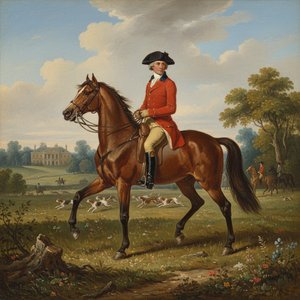
Hoynck’s brush moved between diverse subjects, ranging from religious scenes and still lifes to formal portraiture and animal painting. His versatility allowed him to navigate the specific demands of his English patrons, capturing both the likeness of the nobility and the specialized subjects of the sporting elite. One such likeness is the Portrait of Winifred Countess of Coventry, a work that reflects his engagement with the social circles of the era.
The artist’s focus on animals finds its most distinct expression in his depictions of champion hounds. His earliest securely dated work is a portrait of a champion greyhound, a dog that earned both the Earl of Shaftesbury’s and the Duke of Albemarle’s collars. This specific painting remains the only known portrait of a single, champion hound in his oeuvre. The canvas carries inscriptions detailing the victories that earned the animal its red and blue collars, marking the dog's success in the sporting contests favored by the Duke.
Other works attributed to his hand include The Spotted Dog (The Golden Horn at Constantinople). Whether through the formal structure of a portrait or the detailed rendering of a prize animal, Hoynck’s output reflects a painter capable of shifting his gaze from the human face to the specialized world of the racing kennel.
Q&A
Otto Hoynck의 작품을 사조별로 둘러볼 수 있나요?
모든 미술 사조 페이지에서는 Otto Hoynck의 작품을 예술 사조별로 모아 볼 수 있습니다.
Otto Hoynck의 출생지와 출생 연도는 어떻게 되나요?
Otto Hoynck은(는) 1630년 The Hague에서 태어났습니다.
특정 색상 팔레트의 Otto Hoynck 작품은 어디에서 찾아볼 수 있나요?
Otto Hoynck의 작품은 작가의 컬러 팔레트별로 보기 페이지에서 컬러 팔레트별로 만나보실 수 있습니다.
Otto Hoynck 작가의 작품 관련 통계 정보는 어디에서 확인할 수 있나요?
Otto Hoynck 작가의 작품 통계 정보는 방문 통계 페이지에서 확인하실 수 있습니다.