The Weight of the Brush
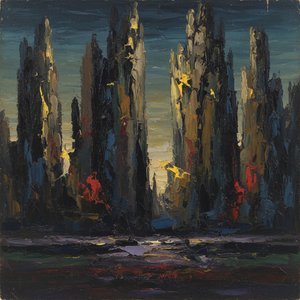
To look at the work of Norman Bluhm is to witness the residue of a life shaped by profound disruption. He was an abstract expressionist painter who did not merely paint; he processed the wreckage of the mid-twentieth century through heavy, gestural application. His presence in the canon is cemented by his inclusion in the permanent collections of the Museum of Modern Art and the Metropolitan Museum of Art. These are not mere accolades; they are evidence of a technical command that forced the art world to pay attention.
Bluhm’s trajectory was never linear. He began with the rigid, structural logic of architecture, attending the Illinois Institute of Technology at sixteen. There, he operated in the shadow of giants like Mies van de Rohe and Frank Lloyd Wright. This early exposure to architectural precision provided a skeletal framework that his later, more chaotic abstraction would eventually dismantle.
War and Rebirth
The trajectory of his life shifted violently during World War II. Drafted into the U.S. Air Force, Bluhm returned from service physically injured and emotionally scarred by the loss of his brother. This period of trauma effectively killed the architect and birthed the painter. He sought a life that was entirely his own, trading blueprints for brushes. This pursuit led him to the heart of European tradition.
His training was rigorous and geographically diverse:
- Academia de Belle Arte in Florence, Italy, where he grounded himself in fine art fundamentals.
- École des Beaux-Arts in Paris, France, a period that placed him in direct contact with the era's heavyweights, including Pablo Picasso and Alberto Giacometti.
A Concrete Legacy
Bluhm’s significance lies in his ability to bridge the gap between formal training and raw, expressive energy. His works, such as "Chandelle" (1966) and "Oz", demonstrate a refusal to settle for easy aesthetics. The Smithsonian American Art Museum holds pieces that reflect this uncompromising stance. He did not rely on decorative flourishes; he relied on the physical reality of paint. His career remains a study in how personal devastation can be converted into a disciplined, visual language.
Q&A
특정 색상 팔레트의 Norman Bluhm 작품은 어디에서 찾아볼 수 있나요?
컬러 팔레트별로 보기 페이지에서는 Norman Bluhm의 작품들을 색상 팔레트별로 모아볼 수 있습니다.
특정 매체로 분류된 Norman Bluhm의 모든 작품을 어떻게 찾을 수 있나요?
특정 매체로 제작된 Norman Bluhm의 모든 작품을 확인하시려면, 작가의 모든 매체별 페이지를 이용해 주세요.
Norman Bluhm의 다른 이름이나 별칭에는 무엇이 있나요?
Norman Bluhm은(는) ノーマン・ブルーム, Норман Блум라는 이름으로도 활동하고 있습니다.