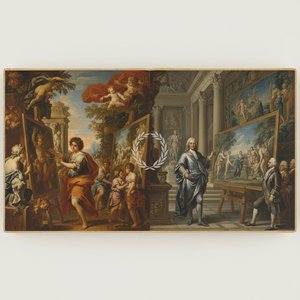
The Grace of Allegory: The Life and Art of Nicolas-Pierre Loir
In the vibrant tapestry of the seventeenth-century French art scene, few names evoke the refined elegance of the Baroque era quite like Nicolas-Pierre Loir. Born in Paris in 1624, Loir emerged from a lineage of craftsmanship, being the son of a goldsmith, a background that perhaps instilled in him a meticulous eye for detail and a profound respect for structured composition. His journey through the world of fine art was shaped by the prestigious studios of his era, where he studied under the masterful hands of Sébastien Bourdon and Simon Vouet. These mentors provided him with more than just technical skill; they introduced him to the grand language of religious and historical allegories, a genre that would become the cornerstone of his creative identity.
Loir’s artistic development was significantly enriched by his travels, most notably his sojourn to Italy between 1647 and 1649. This period of immersion in the sun-drenched landscapes and the weight of classical antiquity allowed him to absorb the profound intellectual clarity found in the works of masters like Nicolas Poussin. Upon his return to Paris in 1650, Loir began to weave these diverse influences into a singular, cohesive style. His work became a bridge between the lush, emotive textures of the early Baroque and a more disciplined, classical approach that favored line, logic, and moral gravity. He possessed a rare ability to transform a canvas into a stage where mythological figures and historical events were not merely depicted, but staged with a sense of eternal order.
A Legacy of Line and Legend
The essence of Loir’s artistry lies in his mastery of the draughtsman's art. As noted by the contemporary critic Roger de Piles, Loir was an exceptionally gifted draughtsman, a quality that allowed him to navigate the complexities of historical narrative with ease. His paintings often serve as visual treatises, where every gesture and shadow is placed with deliberate intention to convey deeper philosophical truths. Whether he was exploring the divine mysteries of religious scenes or the dramatic tension of classical myths, his compositions maintained a certain sacred geometry that invited viewers to contemplate the virtues and tragedies of the human condition.
- Mastery of Genre: His specialization in religious and historical allegories allowed him to contribute significantly to the French classical tradition.
- Pedagogical Influence: Loir’s impact extended through his students, such as François de Troy, ensuring that his stylistic nuances persisted in subsequent generations.
- Technical Versatility: Beyond the brush, his skills as an engraver allowed him to disseminate his visual narratives with precision and clarity.
Though his life ended in Paris in 1679, the historical significance of Nicolas-Pierre Loir remains etched in the annals of French art history. He was a painter who understood that art could be both a window into the past and a mirror for the soul. In an era often characterized by movement and drama, Loir offered a sanctuary of stability through his commitment to balance and classical reason. His works continue to resonate as testament to a period when art sought to harmonize the earthly struggle with the eternal beauty of the divine.
Q&A
Nicolas-Pierre Loir의 작품은 얼마나 인기가 있나요?
Nicolas-Pierre Loir의 방문 통계 페이지에서는 이 사이트에 등록된 작가의 작품들을 바탕으로 산출된 통계 정보를 제공합니다.
Nicolas-Pierre Loir의 작품을 팔레트별로 모아둔 곳은 어디인가요?
컬러 팔레트별로 보기 페이지에서는 Nicolas-Pierre Loir의 작품들을 색상 팔레트별로 모아볼 수 있습니다.
Nicolas-Pierre Loir 작품의 연도별 타임라인이 있나요?
Nicolas-Pierre Loir의 작품 연표를 확인해 보세요: 작품 연대기 페이지에서 작품들을 제작 날짜순으로 보실 수 있습니다.