


1

The Grand Canal near the Salute
The Grand Canal near the Salute is an oil on canvas painting created by Michele Marieschi in 1733. This artwork is currently housed at the Musée du Louvre in Paris, France.

11월 2026 업데이트 · 인기 점수 기준 순위 (각 작품의 검색, 방문 및 주문 수) · 46점의 미켈레 마리에스키 작품 (당사 카탈로그 기준)
요약하자면
The Grand Canal near the Salute (1733)은(는) 미켈레 마리에스키의 작품 중 가장 많은 시선을 사로잡는 회화이며, 원작은 파리에 위치한 루브르 박물관에 소장되어 있습니다. 그다음 시선은 Capriccio with Classical Arch and Goats (1741)와 The Grand Canal with the Ca' Rezzonico and the Campo San Samuele (1742)로 향합니다. 우리 카탈로그에 수록된 미켈레 마리에스키의 작품 46점 중, 가장 유명한 39점을 소개합니다. 각 작품은 제작 연도, 소장 박물관, 그리고 시대를 초월해 사랑받는 이유와 함께 독창적인 원작으로 제시됩니다.
The Grand Canal near the Salute is an oil on canvas painting created by Michele Marieschi in 1733. This artwork is currently housed at the Musée du Louvre in Paris, France.

The composition centers on the intersection of human architecture and the persistent force of the natural world. Crumbling stone arches and weathered columns, once symbols of structural precision, now lie partially reclaimed by thick foliage and creeping vines. In the foreground, a man, a boy, and a dog move through the ruins, providing a sense of scale against the heavy, decaying masonry. Beyond this immediate scene, a body of water…

The oil on canvas titled The Grand Canal with the Ca' Rezzonico and the Campo San Samuele captures a specific slice of Venetian life. Painted by Michele Marieschi, the work dates to about 1742. It presents a wide view of the waterways that define the city, focusing on the intersection of grand architecture and the constant movement of the canals.

Courtyard with a Staircase is an oil on canvas work by Michele Marieschi, executed in 1735. The composition functions as an architectural fantasy, presenting a structured arrangement of a staircase within a courtyard setting. This work belongs to the Venetian School, reflecting the topographical and imaginative traditions of 18th-century Italy.

In the heart of the eighteenth century, Venice was not merely a city but a stage, a shimmering spectacle of light and water where every canal served as a corridor for drama and commerce. Michele Marieschi, a master of the veduta, captures this ephemeral magic in his breathtaking work, The Grand Canal in Venice. This painting serves as a portal to a bygone era, inviting the viewer to step onto…

미켈레 마리예시의 리알토 다리에서 리바 드 베인 리알토 다리는 베네치아 시내의 상징적인 건축물로 예술가들에게 영감을 불어넣는 작품입니다. 이 그림은 리알토 다리가 흐르는 카날과 그 주변 풍경을 아름답게 담고 있으며 특히 리알토 다리의 지붕에 위치한 상점들이 활기찬 도시 분위기를 연출합니다. 마리예시의 리알토 다리는 바로코 시대 베네치아의 정취를 고스란히 표현하며 관람객에게 깊은 감동과 아름다움을 선사합니다. ### 작품 정보 및 배경 역사 마리예시는 1710년 베네치아에서 태어나 목공 기술자의 아들로 자랐습니다. 그의 예술적 감성은…

The oil on canvas depicts the Grand Canal in Venice, Italy, as it appeared in 1730. At the terminus of the waterway, the Santa Maria della Salute church occupies the central focus. The structure features a prominent dome and smaller domes situated on either side. The building's architecture is characterized by its position at the end of the canal, which directs the eye toward the church's facade. Numerous gondolas and…

An Architectural Capriccio with Figures beside a River is an 18th-century architectural capriccio executed in the Veduta style. The work is attributed to the Venetian artist Michele Marieschi. This composition presents a romanticized, imaginary landscape where crumbling classical ruins are integrated with rustic dwellings. The scene depicts a tranquil river and distant mountains, populated by several small figures engaged in various activities near the water's edge.

In this 1740 oil on canvas, we find ourselves observing a specific, quiet moment within the Venetian cityscape. The composition centers on the Rialto Bridge, its structural arches spanning the waterway with a sense of permanence amidst the constant movement of the Grand Canal. There is a particular attention paid to the boats floating below the stone spans and the figures gathered along the water's edge, suggesting a city that…

Fantastic Architecture of a Prison Courtyard is a work by Michele Marieschi, an artist born in Venice in 1710. Created about 1730, the piece belongs to the tradition of 18th-century architectural capriccios. Marieschi, the son of a woodcarver, brought a specific understanding of structure and texture to his depictions of built environments.
 Fantastic Architecture of a Palace Courtyard1730 · 바르샤바 국립 박물관
12
 Riva degli Schiavoni1730 · 바르샤바 국립 박물관
13
 Coastal Landscape1730 · 바르샤바 국립 박물관
14
 Fantastic Landscape with Ruins1730 · 바르샤바 국립 박물관
15
 Italian scenery with figures1727
16
 View of the Piazzetta dei Leoni1734 · 바이에른 주립 회화 컬렉션
17
 Saint Mark's Church and the Square in Venice1739
18
 View of the Grand Canal near Cà Pesaro1734 · 바이에른 주립 회화 컬렉션
19
 Landscape Capriccio1735 · 미니애폴리스 미술관
20
 The Church of Santa Maria della Salute, Venice1740 · 시카고 미술관
21
 Courtyard in a Renaissance House1742 · 국립 미술관
22
 Stairwell in a Renaissance Palace1742 · 국립 미술관
23
 Architectural fantasy featuring a palace courtyard1738 · 바르샤바 국립 박물관
24
 The Grand Canal with the Fishmarket (detail)1740
25
 The Grand Canal at San Geremia1740
26
 The Grand Canal with the Fishmarket1740
27
 View of the Rio di Cannareggio1740
28
 The Grand Canal at San Geremia (detail)1740
29
 The Grand Canal with the Palazzo Labia and Entry to the Cannareggio1742 · 슈타틸리체 무제엔
30
 Capriccio with Gothic Building and Obelisk1741 · 베네치아 아카데미아 미술관
31
 Piazza San Marco, Venice, with Saint Mark's Basilica, the Campanile and the Procuratie Nuove아일랜드 국립 미술관
32
 View of the Dogana and Santa Maria della Salute휴스턴 미술관
33
 View of Canale Grande in Venice with the Rialto BridgeStatens Museum For Kunst
34
 View of Canale Grande in VeniceStatens Museum For Kunst
35
 Landscape with ruins and a bridge바르샤바 국립 박물관
36
 Landscape with ruins바르샤바 국립 박물관
37
 Architectural fantasy featuring a prison courtyard바르샤바 국립 박물관
38
 Imaginative View with Obelisk
39
 View of Campo SS. Giovanni e Paolo, Venice
이 오리지널 작품들에서 가장 자주 등장하는 네 가지 주제와 그 정수를 보여주는 대표작들.
이 페이지에 있는 작품을 가장 많이 소장하고 있는 8개의 미술관
| 소장 미술관 | 도시 | 미켈레 마리에스키의 작품 | 이 목록의 작품들 |
|---|---|---|---|
 바르샤바 국립 박물관 |
바르샤바 | 10 | Ponte di Rialto, Fantastic Architecture of a Prison Courtyard, Fantastic Architecture of a Palace Courtyard |
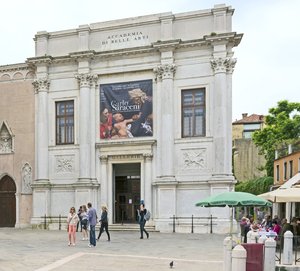 베네치아 아카데미아 미술관 |
베네치아 | 2 | Capriccio with Classical Arch and Goats, Capriccio with Gothic Building and Obelisk |
 슈타틸리체 무제엔 |
베를린 | 2 | The Grand Canal with the Ca' Rezzonico and the Campo San Samuele, The Grand Canal with the Palazzo Labia and Entry to the Cannareggio |
 에르미타주 박물관 |
상트페테르부르크 | 2 | Courtyard with a Staircase, 리알토 다리 리바 드 빈 |
 바이에른 주립 회화 컬렉션 |
뮌헨 | 2 | View of the Piazzetta dei Leoni, View of the Grand Canal near Cà Pesaro |
 국립 미술관 |
스톡홀름 | 2 | Courtyard in a Renaissance House, Stairwell in a Renaissance Palace |
 Statens Museum For Kunst |
코펜하겐 | 2 | View of Canale Grande in Venice with the Rialto Bridge, View of Canale Grande in Venice |
 루브르 박물관 |
파리 | 1 | The Grand Canal near the Salute |
그 시대를 정의하는 오리지널 작품을 만나보려면 연대를 선택하세요.

The artwork titled Italian scenery with figures is a work by the Venetian painter Michele Marieschi. Born in Venice, Italy, in 1710, the artist spent his life capturing the architectural essence of his home city. This specific piece, executed about 1727, offers a glimpse into the structured world of the eighteenth century through its focus on stone and human presence.
The Grand Canal near the Salute is an oil on canvas painting created by Michele Marieschi in 1733. This artwork is currently housed at the Musée du Louvre in Paris, France.
The composition centers on the intersection of human architecture and the persistent force of the natural world. Crumbling stone arches and weathered columns, once symbols of structural precision, now lie partially reclaimed by thick foliage and creeping vines. In the foreground, a man, a boy, and a dog move through the ruins, providing a sense of scale against the heavy, decaying masonry. Beyond this immediate scene, a body of water…
The Grand Canal near the Salute (1733), 루브르 박물관, 파리. 다음은 Capriccio with Classical Arch and Goats (1741)와 The Grand Canal with the Ca' Rezzonico and the Campo San Samuele (1742)입니다.
23세: The Grand Canal near the Salute은(는) 1733년 작품이며, 미켈레 마리에스키은(는) 1710년에 태어났습니다.
The Grand Canal near the Salute, Capriccio with Classical Arch and Goats, The Grand Canal with the Ca' Rezzonico and the Campo San Samuele, Courtyard with a Staircase, The Grand Canal in Venice, 리알토 다리 리바 드 빈, The Grand Canal with Santa Maria della Salute, An Architectural Capriccio with Figures beside a River, Ponte di Rialto 및 Fantastic Architecture of a Prison Courtyard. 위 순위는 각 작품의 제작 연도와 소장 박물관을 나타냅니다.
저희 카탈로그에는 1727년부터 1742년 사이의 미켈레 마리에스키 작가의 작품 46점이 수록되어 있습니다.
대부분 바르샤바 국립 박물관 (바르샤바), 베네치아 아카데미아 미술관 (베네치아) 및 슈타틸리체 무제엔 (베를린)에 소장되어 있습니다. 위의 박물관 목록에서 전체 목록을 확인하실 수 있습니다.
1730s 동안: 이 페이지의 총 39점의 작품 중 14점이 해당 시기에 제작되었으며, 그중 The Grand Canal near the Salute점입니다.
이 페이지에서 가장 오래된 작품은 Italian scenery with figures (1727)이며, 가장 최근 작품은 The Grand Canal with the Ca' Rezzonico and the Campo San Samuele (1742)입니다.
이 페이지의 39점의 작품에 걸쳐 있는 Architecture (18), Water (14) 및 Sky (12)
이 페이지의 총 39점의 작품 중 20점의 Oil On Canvas
이 페이지의 원작들을 기준으로 볼 때, Rococo
Ponte di Rialto, Fantastic Architecture of a Prison Courtyard 및 Fantastic Architecture of a Palace Courtyard: 바르샤바 국립 박물관, 바르샤바은(는) 이 페이지에 있는 작품 중 10점을 소장하고 있습니다.
베네치아 로코코의 황금기 속에서, 미켈레 마리에스키만큼 세레니시마(Serenissima)의 덧없는 마법을 생동감 있게 포착해낸 예술가는 드뭅니다. 1710년 베네치아에서 태어난 그는 목공의 아들로 태어나 장인 정신의 혈통을 이어받았습니다. 이러한 배경은 그가 묘사하는 대상의 구조와 질감, 그리고 물리적 본질에 대해 깊은 경외심을 갖게 하는 밑거름이 되었습니다. 1744년 초 세상을 떠나기까지 그의 삶은 비교적 짧았으나, 베두타(veduta) 전통에 남긴 그의 발자취는 결코 지워지지 않습니다. 그는 단순히 베네치아의 건축물을 기록하는 데 그치지 않았습니다. 그는 돌과 물에 생명력을 불어넣어, 정적인 도시 풍경을 빛과 움직임이 살아 숨 쉬는 찬란한 서사로 탈바꿈시켰습니다.
미켈레 마리에스키만의 독창적인 화풍은 18세기 이탈리아를 흐르던 예술적 조류에 깊이 뿌리를 두고 있습니다. 학자들은 종종 가스파레 디지아니와 전설적인 카날레토 같은 거장들의 영향을 언급하며, 그들의 작품이 도시 환경의 웅장함을 포착하는 청사진을 제공했다고 말합니다. 그러나 카날레토가 지형적인 정밀함과 절제된 고전적 명료함을 추구했다면, 미켈레 마리에스키는 더욱 대담하고 감성적인 접근 방식을 통해 자신만의 목소리를 찾아냈습니다. 그는 색채가 맥동하는 팔레트와 즉흥적이면서도 에너지가 넘치는 붓터치를 수용했습니다. 이러한 양식적 차별화는 그가 단순한 건축 기록을 넘어, 베네치아 삶의 박동을 암시하는 연극적 분위기와 공감각적인 정취를 풍경 속에 불어넣을 수 있게 했습니다.
매우 세밀하고 대규모의 지형적 회화를 의미하는 베두타 장르에서 미켈레 마리에스키의 기여는 원근법과 빛을 다루는 탁월한 통제력에서 극명하게 드러납니다. 그의 작품에는 대운하(Grand Canal), 살루테 성당, 그리고 여러 장엄한 궁전들과 같은 상징적인 랜드마크가 자주 등장하지만, 그것이 단순히 그 시대의 엽서 역할을 하는 것은 아닙니다. 대신 그는 세밀한 묘사와 상상력 풍부한 장식을 결합한 기법을 사용하여, 실재하면서도 꿈결 같은 장면을 창조해냈습니다. 그의 시선을 통해 운하의 물결은 변화하는 하늘을 비추는 거울이 되고, 오래된 성당이 드리운 그림자는 신비로움과 깊이를 담아내는 그릇이 됩니다.
그의 기술적 탁월함은 특정한 분위기를 자아내기 위해 빛을 조절하는 능력에서 가장 잘 나타납니다.
미켈레 마리에스키의 역사적 의의는 18세기 초의 엄격한 기록물과 그 이후에 등장할 더욱 표현적이고 감성적인 풍경화 사이의 간극을 메운 능력에 있습니다. 그는 베네치아의 관점을 단순한 관찰의 매체에서 깊은 정서적 울림을 전달할 수 있는 예술 형식으로 전환시킨 중추적인 인물이었습니다. 그의 작품은 18세기 후반의 격변이 베네치아의 사회적, 정치적 지형을 영원히 바꾸기 전, 사라진 세계를 들여다볼 수 있는 소중한 창 역할을 합니다.
오늘날에도 미켈레 마리에스키의 캔버스는 수집가와 역사학자 모두를 매료시키고 있습니다. 살루테 성당 근처의 대운하를 바라보는 숨 막히는 전망이든, 혹은 그의 보다 친밀한 건축 연구물이든, 그의 회화는 로코코 정신을 보여주는 걸작으로 남아 있습니다. 그는 예술계의 집단적 상상력을 끊임없이 자극하는 베네치아의 활기찬 에너지, 찬란한 빛, 그리고 영원한 우아함을 경험하고자 하는 이들에게 여전히 찬사받는 예술가입니다.


