The Emergence of a Symbolist Vision
Born in the coastal town of Hamina in 1870, Knut Magnus Enckell was destined to become a cornerstone of the Finnish Golden Age. His early journey was one of profound transition, moving from the quiet landscapes of his youth toward the vibrant, intellectual currents of Paris. After initial studies in Helsinki under the guidance of Gunnar Berndtson, Enckell sought the rigorous training of the Académie Julian, where the influence of masters like Jules-Joseph Lefebvre and Jean-Joseph Benjamin-Constant began to shape his artistic eye. While his early education was rooted in the prevailing Naturalism of the era, a deeper, more introspective impulse soon began to stir within his work, pulling him away from mere representation toward the enigmatic and evocative realms of Symbolism.A Transformation of Light and Color
The trajectory of Enckell’s career is marked by a remarkable aesthetic metamorphosis that mirrored the shifting tides of European modernism. In his formative years, his canvases were characterized by a subdued, almost somber palette that captured the melancholic depths of the human psyche. However, from 1902 onwards, a dramatic shift occurred; the shadows retreated to make way for an increasingly bright and luminous colorism. As a leading figure in the Septem group, Enckell embraced a new language of light, pushing the boundaries of Finnish art through bold, vibrant hues. This evolution was not merely technical but spiritual, as his use of radiant colors allowed him to explore themes that were previously shrouded in muted tones, bringing a newfound vitality to the Symbolist movement.The Tapestry of Myth and Psyche
Enckell’s oeuvre is a captivating exploration of the unseen, where mythology, theatre, and the human soul converge upon the canvas. His works often feel like fever dreams or whispered legends, capturing moments of profound psychological tension and ethereal beauty. He possessed a unique ability to blend the tangible world with the subconscious, creating scenes that resonate with both mystery and grace. Among his most evocative contributions are:- Fantasia (1895): A hauntingly beautiful watercolor that utilizes impressionistic brushwork to depict a mythological figure submerged in water, evoking themes of nature and deep melancholy.
- Midsummer Day Service in Lohja Church (1899): An atmospheric oil painting that captures the solemnity of Finnish religious ceremony through warm tones and intricate Gothic details.
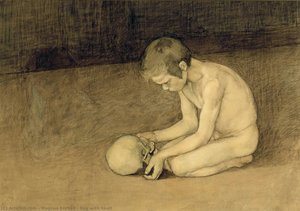
- Boy with Skull: A poignant exploration of mortality and the darker, more existential facets of his Symbolist explorations.
A Lasting Legacy in Finnish Art
Beyond his technical mastery, Magnus Enckell remains a figure of immense historical significance. He was more than just a painter; he was a cultural influencer who helped redefine the identity of Finnish art on an international stage. His ability to oscillate between being a traditionalist and a radical reformer allowed him to leave an indelible mark on the landscape of early 20th-century European art. Today, his legacy is preserved in the great institutions of Finland, standing as a testament to a life spent chasing the light through the shadows of the human spirit.질의응답
Magnus Enckell의 다른 이름이나 별칭에는 무엇이 있나요?
Magnus Enckell은(는) Knut Magnus Enckell라는 다른 이름으로도 알려져 있습니다.
Magnus Enckell 작가는 어떤 색상을 가장 자주 사용했나요?
Magnus Enckell의 팔레트 지놈는 작가의 작품 세계를 구성하는 컬러 프로필을 보여주는 페이지입니다.
Magnus Enckell의 작품 세계는 시간이 흐름에 따라 어떻게 변화했나요?
Magnus Enckell의 연대기는 작가의 활동 시기별로 분류된 작품들을 연대순으로 보여주는 스크롤 방식의 타임라인입니다.