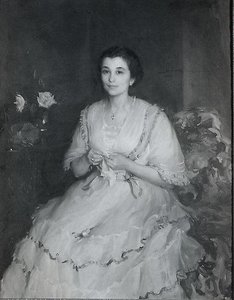
A Life Painted in Grace: The World of Lydia Field Emmet
Lydia Field Emmet, born in New Rochelle, New York, in 1866, emerged as a significant voice in American portraiture during an era defined by both societal transformation and artistic innovation. Descended from a family steeped in Irish history – her lineage tracing back to the nationalist lawyer Thomas Addis Emmet and his rebellious brother Robert – and American enterprise, she inherited a rich tapestry of intellectual and cultural influences. This heritage, combined with a nurturing upbringing that recognized and encouraged artistic talent, laid the foundation for a career dedicated to capturing the elegance and spirit of her time. Her father, William Jenkins Emmet, was a merchant, while her mother, Julia Colt Pierson, possessed an artistic sensibility as an illustrator; this blend of practicality and creativity shaped Lydia’s early world. The family's connections extended beyond politics and commerce – her maternal grandfather invented a nail-cutting machine, demonstrating the innovative spirit that permeated their lives. Crucially, she was part of a remarkable sisterhood of artists, alongside Rosina Emmet Sherwood and Jane Emmet de Glehn, fostering an environment of mutual support and artistic exploration.Formative Years and Artistic Pilgrimages
Lydia’s artistic journey began with lessons from her elder sister, Rosina, a testament to the strong bonds and shared passions within the family. This early guidance proved invaluable as she embarked on formal training at the Académie Julian in Paris during 1884-1885, accompanied by Rosina. While acknowledging shortcomings in the academy’s admission standards, Lydia found inspiration in the instruction of Tony Robert-Fleury, recognizing his ability to ignite a passion for artistic expression. This Parisian experience was pivotal, exposing her to classical techniques and establishing a foundation upon which she would build her unique style. Returning to New York, she continued her studies under the influential William Merritt Chase, whose emphasis on capturing light and atmosphere profoundly impacted her work. Further mentorship from artists like Harry Siddons Mowbray, Kenyon Cox, and Robert Reid broadened her artistic horizons. A second sojourn to Paris saw her refine her skills with masters such as William-Adolphe Bouguereau, Louis-Joseph-Raphaël Collin, and Frederick William MacMonnies, solidifying her technical prowess and deepening her understanding of the European art tradition.A Portraitist of Society: Style and Subject Matter
Lydia Field Emmet carved a niche for herself as a celebrated portraitist, specializing in depictions of society women and children. Her paintings are characterized by a refined realism, an exquisite attention to detail – particularly in the rendering of clothing and facial expressions – and a remarkable ability to capture the essence of her subjects with grace and poise. She wasn’t merely recording likenesses; she was revealing character, hinting at stories behind the carefully constructed facades of high society. Her medium of choice often leaned towards watercolor and oil painting, each lending itself to different nuances in texture and tone. Beyond individual portraits, Emmet's artistic talents extended to larger-scale projects, most notably her contributions to the Woman’s Building at the World’s Columbian Exposition in 1893. Her murals, including “Seal of the New York State Board” and “Art, Literature and Imagination,” showcased her versatility and commitment to celebrating female achievement. One notable early work was the illustrated book *Little Folk in Green* (1883), demonstrating a charming ability to capture childhood innocence.Legacy and Lasting Influence
Lydia Field Emmet’s success as a woman artist during a period of significant gender inequality is itself a testament to her talent and determination. She navigated a landscape where opportunities for women in the art world were limited, yet she persevered, earning recognition and establishing a thriving career. Her paintings graced the walls of the White House and found homes in prestigious museums, solidifying her place within the American artistic canon. The influence of William Merritt Chase is clearly visible in her work, particularly in her handling of light and color, but Emmet developed a distinctive style that was uniquely her own. She remained active as an artist throughout her life, continuing to paint portraits and landscapes until her death in 1952. Her family’s diverse contributions – spanning law, engineering, art, and politics – further enriched her world and provided a supportive network. Today, Lydia Field Emmet's legacy endures through the enduring beauty of her paintings, offering valuable insights into the social and cultural landscape of late 19th and early 20th century America, and inspiring future generations of artists to pursue their passions with unwavering dedication. Her work stands as a poignant reminder of an era defined by elegance, refinement, and the quiet strength of women who dared to create.Q&A
Lydia Field Emmet 작가는 어떤 사조의 작품 활동을 했나요?
모든 미술 사조 페이지에서는 Lydia Field Emmet의 작품을 예술 사조별로 모아 볼 수 있습니다.
Lydia Field Emmet은(는) 어느 시대의 작품을 남겼나요?
Lydia Field Emmet은(는) 19th Century 시대에 활동했습니다. 이 시기는 역사적 맥락 속에서 작가의 예술적 위치를 보여줍니다.
Lydia Field Emmet의 연도별 활동 기록이 있나요?
Lydia Field Emmet의 예술적 여정은 연대기 페이지에서 시기별로 펼쳐집니다. 이곳에서는 작가의 활동 시기를 장(chapter)으로 나누어 작품들을 연대순 타임라인 형태로 한눈에 확인할 수 있습니다.
Lydia Field Emmet의 작품은 얼마나 인기가 있나요?
Lydia Field Emmet 작가의 작품 통계 정보는 방문 통계 페이지에서 확인하실 수 있습니다.