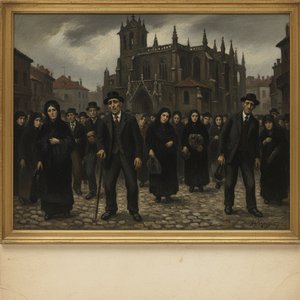
Jose Hernandez Quero: A Granada Legacy Illuminated
The story of Jose Hernandez Quero is one deeply intertwined with the soul of Andalusia, a narrative that begins in the historic streets of Granada. Born in 1930, his early years were shaped by the profound cultural echoes of Moorish Spain, an environment where history and art are inseparable. This heritage provided him with a unique visual vocabulary, characterized by a meticulous eye for detail and a palette that could shift from the sun-drenched warmth of Spanish landscapes to the deep, contemplative shadows of architectural studies. His formal artistic journey was anchored in the prestigious traditions of his homeland, beginning with foundational studies at the Art School of Granada and later refining his technical mastery at the Escuela de Bellas Artes de Sevilla. It was here that he developed the rigorous command of light and texture that would become a hallmark of his Spanish Realist style.
As his career progressed, Hernandez Quero sought to expand the boundaries of his Mediterranean roots by venturing into the heart of the European avant-garde. His transformative expedition to Paris during the late 1950s and early 1960s acted as a vital catalyst for his creative evolution. Immersed in the vibrant Parisian art scene, he encountered groundbreaking innovations in both painting and sculpture that challenged his classical training. This period of exploration allowed him to integrate a more experimental conceptual framework into his work, blending the structural integrity of Spanish tradition with a newfound curiosity for modern techniques. The result was an artistic output that felt both timeless and contemporary, bridging the gap between the historical weight of his subjects and the fluid energy of 20th-century modernism.
A Mastery of Medium and Symbolism
The versatility of Hernandez Quero’s talent is perhaps most evident in the diverse range of mediums he commanded. Whether working with the rich, tactile depth of oil paintings, the precise intimacy of etchings, or the layered complexity of lithographs, his hand remained unmistakably his own. His canvases often served as stages for still lifes brimming with symbolic detail, where every object was rendered with such precision that they seemed to pulse with an inner life. These compositions were rarely mere studies of objects; rather, they were carefully constructed meditations on permanence and decay, using light to imbue everyday items with a sense of emotional resonance and spiritual weight.
Beyond the still life, his depictions of human figures and landscapes showcased a profound sensitivity to the fleeting nature of existence. In his architectural drawings, such as the evocative 1968 work Facade of Casa de los Tiros, he utilized monochrome tones to strip away the distractions of color, forcing the viewer to confront the raw, structural elegance of Granada’s historic monuments. Through a masterful use of contrast, he captured the ruggedness of weathered stone and the delicate interplay of shadow, creating an immersive perspective that draws the observer into the very heart of the Andalusian streetscape. In these works, the presence of figures and even the flight of birds add layers of organic life, suggesting a harmonious, if transient, coexistence between the enduring monuments of Spanish history and the ephemeral beauty of nature.
Artistic Lineage and Lasting Significance
The artistic vision of Hernandez Quero was not formed in isolation but was part of a continuous dialogue with the masters who preceded him. He drew significant inspiration from the traditions of Spanish landscape painting and the dramatic intensity of the Surrealist movement. Most notably, the influence of El Greco can be felt in his ability to use form and pigment to convey deep-seated emotion and spiritual fervor. By emulating the capacity for expressive power found in the masters of the Spanish Golden Age, Quero was able to imbue his modern subjects with a sense of mythic grandeur.
Today, the legacy of Jose Hernandez Quero remains a vital part of the 20th-century art canon. His work stands as a testament to the enduring power of realism when wedded to profound emotional depth and technical brilliance. Through his dedication to capturing both the monumental and the minute, he ensured that the cultural essence of Granada and the broader Spanish identity would be preserved through his art. For collectors and historians alike, his oeuvre offers more than just visual beauty; it provides a window into a period of intense artistic transition, where the echoes of the past met the bold innovations of a new era.
질의응답
주제별로 분류된 Jose Hernandez Quero의 작품들은 어디에서 확인할 수 있나요?
Jose Hernandez Quero의 주제별 아틀라스는 작가의 작품들을 주제별로 분류하여 보여주는 페이지입니다.
Jose Hernandez Quero의 작품을 색상별로 모아둔 곳은 어디인가요?
색상별 인덱스 페이지에서는 Jose Hernandez Quero의 작품들을 색상별로 모아 보실 수 있습니다.
Jose Hernandez Quero의 작품 세계는 시간이 흐름에 따라 어떻게 변화했나요?
Jose Hernandez Quero의 예술적 여정은 연대기 페이지에서 시기별로 펼쳐집니다. 이곳에서는 작가의 활동 시기를 장(chapter)으로 나누어 작품들을 연대순 타임라인 형태로 한눈에 확인할 수 있습니다.
Jose Hernandez Quero의 출생지와 출생 연도는 언제인가요?
Jose Hernandez Quero은(는) 1930년 Granada에서 태어났습니다.
Jose Hernandez Quero의 작품 전체 목록을 볼 수 있는 곳이 있나요?
본 웹사이트에 등록된 Jose Hernandez Quero의 모든 작품은 작가의 모든 작품 보기 페이지에서 확인하실 수 있습니다.
Jose Hernandez Quero 작가의 출신 국가는 어디인가요?
Jose Hernandez Quero은(는) Spain에서 태어났습니다.
Jose Hernandez Quero의 출생 도시와 국가는 어디인가요?
Jose Hernandez Quero은(는) Spain의 Granada에서 태어났습니다.