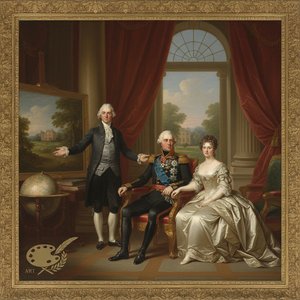
John Lewis Reilly: A Victorian Portraitist of Refined Elegance
John Lewis Reilly (1835-1922) stands as a significant, yet often understated, figure in 19th-century British art. More than simply a painter, he was a meticulous craftsman and a skilled interpreter of established masters, producing remarkably convincing copies alongside his own original portraits and historical scenes. His work reflects the prevailing aesthetic sensibilities of the Victorian era – a deep appreciation for classical forms, an interest in aristocratic subjects, and a commitment to capturing both outward appearance and inner character.
Born in London, Reilly’s artistic journey began with studies at the Royal Academy School. However, he quickly gravitated towards portraiture and historical painting, establishing himself as a respected artist within a relatively small circle of patrons and galleries. Unlike some of his contemporaries who sought fame through grand historical narratives, Reilly focused primarily on capturing the likenesses of prominent figures – from military officers and politicians to members of the aristocracy and even literary personalities like Charles Darwin. His approach was characterized by an almost obsessive attention to detail, evident in the meticulously rendered fabrics, jewelry, and expressions of his subjects.
The Influence of Masters and Copying Techniques
Reilly’s artistic development was profoundly shaped by the works of earlier masters, particularly those of the Dutch Golden Age and the Elizabethan era. He deeply admired Sir Anthony van Dyck, whose portraits he studied with intense scrutiny, seeking to emulate his elegant compositions and ability to convey a sense of dignified composure. This admiration is most strikingly evident in his numerous copies after Van Dyck, including a celebrated portrait of Charles I – a work that demonstrates not only technical proficiency but also a genuine understanding of the master’s artistic principles.
However, Reilly's practice extended beyond mere imitation. He was equally adept at working from other sources, notably Thomas Gainsborough and Dobson. His ability to faithfully reproduce these artists’ styles showcased his deep knowledge of technique and his commitment to preserving their legacies. This dedication to copying wasn’t viewed as a lesser pursuit; rather, it served as a rigorous training ground, allowing him to hone his skills and develop an unparalleled understanding of composition, color theory, and the nuances of portraiture.
Notable Works and Subject Matter
Reilly's oeuvre is characterized by a remarkable diversity of subjects. He produced numerous portraits of prominent figures from British society, including Major General Norman MacLeod, Admiral Sir Francis Leopold McClintock, and even Charles Darwin – a particularly intriguing commission that speaks to Reilly’s willingness to engage with the intellectual currents of his time. Beyond portraiture, he also created historical scenes, often depicting moments of military triumph or civic celebration. His painting “Homage to Jellett” is an example of this genre.
A significant portion of Reilly's work was dedicated to reproducing works by other masters. These copies were not simply mechanical reproductions; rather, they were carefully considered interpretations that sought to capture the essence of the original while adapting it to his own artistic sensibilities and the tastes of his clientele. The meticulous detail evident in these copies underscores Reilly’s commitment to preserving artistic traditions and ensuring their continued appreciation.
Legacy and Historical Significance
While John Lewis Reilly may not be as widely celebrated as some of his contemporaries, his contribution to 19th-century British art is undeniable. His meticulous technique, profound understanding of master artists, and ability to capture the essence of his subjects have earned him a place among the most skilled portraitists of his era. His work offers a valuable window into Victorian society – revealing the values, aspirations, and aesthetic preferences of a rapidly changing nation. Furthermore, Reilly’s dedication to copying highlights the importance of artistic lineage and the ongoing dialogue between generations of artists.
Reilly's legacy is further cemented by his continued presence in museum collections and private hands, ensuring that his art will be appreciated for years to come. His paintings serve as a testament to the enduring power of observation, skill, and a deep respect for artistic tradition.
Q&A
John Lewis Reilly 작가의 작품을 감상할 수 있는 가상 박물관에 방문할 수 있나요?
가상 방문이 가능합니다: John Lewis Reilly의 3D 갤러리 페이지에서 3D 갤러리를 통해 작가의 작품들을 만나보실 수 있습니다.
John Lewis Reilly의 작품을 기법별로 모아볼 수 있는 곳은 어디인가요?
모든 매체별 페이지에서는 John Lewis Reilly의 작품을 기법별로 모아볼 수 있습니다.
John Lewis Reilly의 예술 세계는 시간이 흐름에 따라 어떻게 진화했나요?
John Lewis Reilly의 연대기는 작가의 활동 시기별로 분류된 작품들을 연대순으로 보여주는 스크롤 방식의 타임라인입니다.