The Quiet Mastery of John Henry Norman
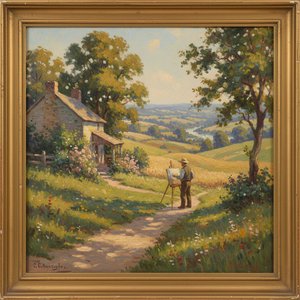
The work of John Henry Norman, a largely unsung figure of the early 20th-century American art scene, reveals a quiet mastery of capturing the essence of rural life and the subtle beauty of the natural world. Born in 1896 in what would later become part of Oklahoma, Norman’s artistic journey began amidst the vast landscapes of the American West, an environment that profoundly shaped his aesthetic sensibilities. While he never achieved widespread fame during his lifetime—a fact often obscured by the prominence of contemporaries like Rockwell—his paintings offer a poignant and enduring reflection on the changing face of America and its deep-rooted connection to the land.
Norman’s early life was marked by movement, reflecting the transient nature of frontier communities. He spent his formative years traveling with his family, absorbing diverse regional influences that would later inform his artistic style. This itinerant upbringing instilled in him a deep appreciation for the varied textures and colors of the American landscape, from the rolling hills of Oklahoma to the rugged mountains of Colorado. Largely self-taught, he developed a distinctive approach rooted in direct observation and an intimate engagement with his subjects. His early works demonstrate a clear debt to the traditions of tonal realism, reminiscent of masters like George Caleb Bingham, yet they quickly evolved into a style that was uniquely his own.
Atmospheric Depth and the Montana Influence
A pivotal moment in Norman’s artistic development occurred during his time in Montana in the 1920s. The stark beauty and dramatic light of the Big Sky Country ignited a passion for capturing winter scenes—snow-covered farms, frozen rivers, and solitary figures bundled against the cold. These paintings, characterized by their muted palette and atmospheric depth, became a hallmark of his oeuvre. He skillfully employed a limited range of colors—primarily blues, grays, whites, and browns—to evoke the biting chill and the profound stillness of a winter morning.
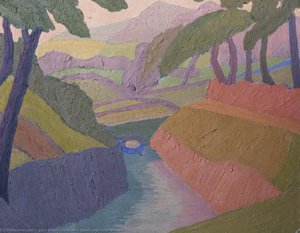
His technical prowess is perhaps most evident in works such as Landscape with Stream, created in 1930. In this piece, Norman utilizes soft brushstrokes and a delicate interplay of light and shadow to create a sense of tranquility. The composition, featuring a gentle stream winding through mountains and trees, draws the viewer into a peaceful, immersive experience. Through his ability to manipulate light, he transformed simple natural elements into profound studies of serenity and scale.
Legacy of an American Realist
Throughout his career, Norman remained dedicated to the depiction of the pastoral and the seasonal. His repertoire included diverse subjects that celebrated the quiet dignity of the American landscape:
- Winter Landscapes: Capturing the stark, frozen beauty of the northern plains and mountain ranges.
- Rural Life: Depicting the enduring presence of farms and small villages, such as his evocative Mount Nod Farm.
- Tonal Compositions: Exploring the relationship between light, shadow, and natural forms in works like No.1 Composition.
Though he passed away around 1980, Norman's historical significance lies in his ability to document a vanishing era of American life with sincerity and grace. His paintings serve as more than mere landscapes; they are emotional archives of a period defined by the intersection of rugged frontier spirit and the quietude of settled rural existence. For the modern observer, his work remains a window into a timeless, tranquil world, preserved through the careful application of oil and canvas.
Q&A
John Henry Norman 작가의 작품을 감상할 수 있는 3D 갤러리는 어디인가요?
가상 방문이 가능합니다: John Henry Norman의 3D 갤러리 페이지에서 3D 갤러리를 통해 작가의 작품들을 만나보실 수 있습니다.
John Henry Norman은(는) 어느 시대의 작품을 남겼나요?
John Henry Norman은(는) Modern 시대에 활동했습니다. 이 시기는 역사적 맥락 속에서 작가의 예술적 위치를 보여줍니다.
John Henry Norman의 다른 이름이나 별칭에는 무엇이 있나요?
John Henry Norman은(는) Henry Norman, Norman, John Henry라는 이름으로도 활동하고 있습니다.
John Henry Norman의 작품을 연도순으로 어디에서 볼 수 있나요?
John Henry Norman의 작품을 연도별로 정리하여 보여주는 작품 연대기 페이지입니다.