The Architect of Light and Shadow
Born in The Hague in 1822, Jan Weissenbruch entered a world where art was a family language. His father, Johannes, was a painter and collector whose private gallery provided the young Jan with an early education in the works of Andreas Schelfhout and Bartholomeus van Hove. This immersion in the Dutch tradition shaped his initial approach to the canvas. He began formal drawing lessons at sixteen under Johannes Low and later attended evening classes at the Hague Academy of Art. By 1843, he was already working in the studio of Van Hove, assisting with scenery for the Royal Theatre.
His early years were marked by a meticulous attention to detail, a style that mirrored the Romanticism of his predecessors. He looked toward the seventeenth-century master Jacob van Ruisdael, finding inspiration in the dramatic skies and heavy clouds seen at the Mauritshuis. These early landscapes were precise, almost rigid in their execution. However, as time passed, his brushwork began to loosen. The sharp edges of his youth gave way to a broader, more atmospheric application of paint. He moved away from the hyper-detailed traditions of the past toward something more fluid and tonal.
A Life Within the Hague School
Weissenbruch was a central figure in the development of the Hague School, an artist who helped define the movement's aesthetic through his focus on the Dutch landscape. He was a founding member of the Pulchri Studio, an important society for artists in The Hague. His work often centered on the quiet corners of the Netherlands—townscapes, city gates, and church interiors. He had a particular affinity for the architecture of vanishing towns, frequently painting bridges, canals, and gates like the Steigerpoort at Leerdam. He would sometimes alter architectural elements to better suit his vision of light and shadow.
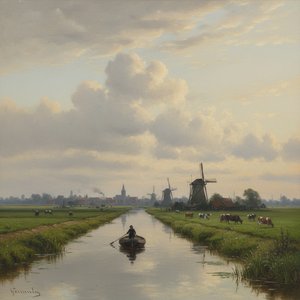
His technical range was broad, encompassing oil painting, watercolour, etching, and lithography. While he was a skilled draughtsman, it was his mastery of the grey light—the subtle shifts in silver, pearl, and slate tones—that characterized his mature period. He possessed an ability to capture the moisture in the air and the way sunlight filtered through heavy clouds. His subjects were often humble: a fisherman with a basket, a street corner, or the windswept polders near Nieuwkoop. Even as he moved toward a more impressionistic approach, he remained grounded in the reality of the Dutch landscape.
The Final Years and Quiet Legacy
The later years of Weissenbruch's life were marked by both personal struggle and continued artistic output. In his final decade, he suffered from agoraphobia, a condition that restricted his movement and forced him to find inspiration closer to home. This period saw him turning more toward the restoration of paintings, perhaps a way to remain connected to the art world while confined. Despite these limitations, he continued to produce work that reflected the atmospheric truth of the Low Countries.
He died in The Hague in 1880, leaving behind a body of work held in significant collections, including the Teylers Museum and the Royal Collection of HM King Charles III. His contribution to Dutch art lies in his transition from the structured Romanticism of the early nineteenth century to the more emotive, atmospheric realism that would define the Hague School. He remains a painter of the atmosphere, an artist who understood that the sky determines the soul of a painting.
Q&A
Jan Weissenbruch의 작품을 분위기별로 모아둔 곳은 어디인가요?
Jan Weissenbruch의 무드 룸에서는 작가의 작품들을 분위기별로 만나보실 수 있습니다.
Jan Weissenbruch 작품의 연도별 타임라인이 있나요?
Jan Weissenbruch의 작품을 연도별로 정리하여 보여주는 작품 연대기 페이지입니다.
Jan Weissenbruch의 연도별 활동 기록이 있나요?
Jan Weissenbruch의 예술적 여정은 연대기 페이지에서 시기별로 펼쳐집니다. 이곳에서는 작가의 활동 시기를 장(chapter)으로 나누어 작품들을 연대순 타임라인 형태로 한눈에 확인할 수 있습니다.
Jan Weissenbruch의 작품을 색상별로 찾아볼 수 있나요?
컬러 인덱스 페이지에서는 Jan Weissenbruch의 작품들을 색상별로 모아 보실 수 있습니다.