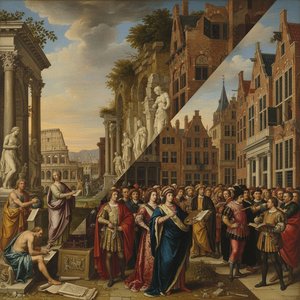
The Life and Origins of Jan van der Elburcht
Jan van der Elburcht was an early Dutch painter whose life began in the town of Elburg. Born in 1500, his very name carries the imprint of his birthplace, a common way for people of that era to signal where they belonged. He would eventually spend his final years in Antwerp, but his roots remained tied to the landscape of his youth.
In the circles of his time, he was often known by more personal nicknames. He was called cleen Hansken, which translates to little Hans. Others referred to him as der kleine Hans. These names suggest a sense of familiarity among his contemporaries, a way of identifying the man behind the brush through a more intimate, diminutive lens.
Professional Activity in Antwerp
By 1536, Jan van der Elburcht had established himself within the professional circles of Antwerp, becoming a member of the Guild of St. Luke. This membership marked his formal standing in a city that was a central hub for painters and craftsmen. He spent much of his working life within these urban walls, contributing to the local art scene through a variety of subjects. His hands were skilled in both the grand narratives of history painting and the quieter, more detailed observations of the natural world as a landscape artist.
His presence in Antwerp was a constant throughout his later years. He continued to practice his craft in the city for decades, navigating the demands of his profession until his death there in 1571. His work reflected the dual interests of his time, moving between the structured storytelling required for historical scenes and the atmospheric qualities found in his landscapes. This versatility allowed him to maintain a steady place in the guild's community for over thirty years.
Notable Religious Commissions and Artworks
While he was often recognized for his skill in capturing landscapes, much of his legacy is tied to the sacred spaces of Antwerp. One of his most significant contributions was an altarpiece created for the fisher's altar in the Onze-Lieve-Vrouwekathedraal. This work focused on the theme of the Miraculous catch of fish, a subject that allowed him to blend his interest in natural settings with religious storytelling. His painting titled De wonderbare visvangst, which dates to 1560, remains a key example of this period in his life.
His religious output also included detailed biblical scenes that required a careful hand. Between 1556 and 1563, he worked on The Baptism of the Eunuch. This piece was originally intended to serve as the left wing of a triptych, with the central panel depicting The Miraculous Draught of Fishes. Through these commissions, he brought the stories of the faith into the physical space of the cathedral, using the light and shadow of his landscapes to frame the spiritual moments of his subjects.
Q&A
Jan van der Elburcht의 예술 세계는 시간이 흐름에 따라 어떻게 진화했나요?
Jan van der Elburcht의 연대기는 작가의 활동 시기별로 분류된 작품들을 연대순으로 보여주는 스크롤 방식의 타임라인입니다.
미술 사조별로 분류된 Jan van der Elburcht의 작품은 어디에서 볼 수 있나요?
모든 미술 사조 페이지에서는 Jan van der Elburcht의 작품을 예술 사조별로 모아 볼 수 있습니다.
Jan van der Elburcht의 작품을 색상별로 정렬해서 볼 수 있나요?
Jan van der Elburcht의 작품은 작가의 컬러 인덱스 페이지에서 색상별로 감상하실 수 있습니다.