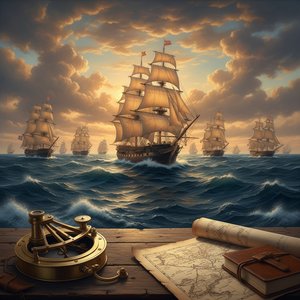
The Master of the Welsh Tides: The Life and Legacy of James Harris Senior
To gaze upon the canvases of James Harris Senior is to feel the salt spray of the Bristol Channel and hear the rhythmic, heavy pulse of the Atlantic. Born in the coastal enclave of Llanelly, Glamorn, around 1810, Harris was a true child of the sea. His early years were steeped in the industrious maritime atmosphere of Wales, where the sounds of shipbuilding—the rhythmic striking of hammers against hulls and the creaking of timber—served as his first introduction to the majesty of nautical life. With a father deeply embedded in the rugged industry of shipbuilding, Harris did not merely observe the ocean; he grew up within its very heartbeat, developing an intimate connection to the vessels and tides that would later define his illustrious career.
His artistic journey was one of profound self-discovery and meticulous observation. While lacking formal academic training in his earliest years, Harris possessed a visionary eye that allowed him to translate the raw power of the Welsh coastline into evocative oil paintings. Through dedicated self-study, he mastered the ability to capture the ephemeral qualities of light and atmosphere, a skill that would eventually place him among the notable marine artists of the Victorian era. His development was marked by an increasing command over chiaroscuro, as he drew deep inspiration from the masters of the past. The dramatic, sublime landscapes of Turner and Constable provided a blueprint for his approach to nature's fury, while the technical brilliance of Rembrandt and Rubens informed his understanding of light, shadow, and anatomical precision in the rendering of complex rigging and maritime structures.
A Symphony of Storm and Serenity
The breadth of Harris’s oeuvre is nothing short of remarkable, spanning several decades and encompassing over three hundred works that serve as a testament to his enduring passion. His paintings are rarely static; they are living, breathing chronicles of the sea's dual nature. On one hand, Harris was a master of the tempest. He possessed an uncanny ability to render the turbulent forces of nature, depicting ships caught in the throes of violent storms with such visceral detail that the viewer can almost sense the peril faced by the sailors of the nineteenth century. In works such as “Picking up the Pilot” (1869), he utilizes a Romantic and Luminist style to showcase the chaotic struggle between man-made vessels and the overwhelming power of the waves.
Yet, Harris was equally adept at capturing the ocean's moments of profound tranquility. He could pivot from the roar of a gale to the hushed, golden stillness of a coastal afternoon with seamless grace. His ability to manipulate color and brushwork allowed him to simulate textures ranging from the frothing white foam of a breaking wave to the glassy, reflective surface of a calm bay. This duality—the ability to find beauty within adversity and peace amidst the vastness—is what gives his work its enduring emotional resonance. Whether he was painting the dramatic “Oystermouth from the Sea” (1860) or the more structured “Man o' War and Sailing Ships” (1870), his focus remained on capturing the very soul of the maritime experience.
Historical Significance and Artistic Triumph
The historical importance of James Harris Senior lies in his role as a chronicler of a vanishing era. His paintings serve as vital visual records of the Victorian maritime world, documenting ship designs, coastal landscapes, and the atmospheric conditions of a period before the industrial revolution fundamentally altered the face of the seascapes he loved. His work is not merely decorative; it is an exploration of the human condition in relation to the infinite power of the natural world.
Throughout his life, Harris achieved considerable acclaim, leaving behind a legacy that continues to captivate collectors and historians alike. His contributions to the genre of marine art can be summarized through several key achievements:
- Mastery of Atmosphere: His unique ability to blend the influence of Romanticism with a realistic, meticulous attention to maritime detail.
- Cultural Documentation: Providing a profound visual history of the Welsh coastline and the shipbuilding traditions of Llanelly.
- Technical Versatility: The seamless transition between depicting high-drama maritime disasters and serene, light-drenched coastal vistas.
- Enduring Influence: Establishing himself as a definitive voice in Victorian marine painting, ensuring his works remain staples in prestigious collections such as the National Library of Wales.
Today, the works of James Harris Senior stand as more than just paintings; they are windows into a bygone age of sail and wind. He remains a visionary whose brush captured not merely the surface of the ocean, but its very essence, leaving an indelible mark on the annals of maritime art history.
Q&A
James Harris의 작품을 색상별로 정렬해서 볼 수 있나요?
James Harris의 작품은 작가의 컬러 인덱스 페이지에서 색상별로 감상하실 수 있습니다.
특정 주제별로 James Harris의 작품을 어떻게 찾아볼 수 있나요?
특정 주제의 James Harris 작품을 찾으려면 키워드별로 작품이 분류된 작가의 키워드별 탐색 페이지를 이용해 보세요.
James Harris의 작품을 기법별로 모아볼 수 있는 곳은 어디인가요?
모든 매체별 페이지에서는 James Harris의 작품을 기법별로 모아볼 수 있습니다.