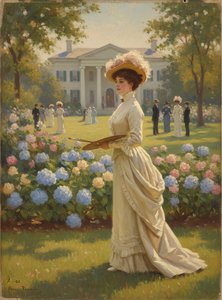
A Tapestry of Creativity: The Life and Legacy of Isobel Osbourne Strong Field
In the vibrant intersection of late nineteenth-century literature and visual design, few figures possess a life as richly textured as Isobel Osbourne Strong Field. Born in Indianapolis in 1858, her very existence was woven into a lineage of profound intellectual and artistic significance. As the daughter of the celebrated novelist Fanny Stevenson and the sister of Lloyd Osbourne, Isobel was raised within a domestic sphere where storytelling was not merely an occupation but a way of life. This upbringing, steeped in the meticulous observation required by her mother’s prose and the imaginative expansiveness shared with her brother, cultivated in Isobel a unique ability to blend aesthetic precision with deep symbolic meaning.
Her journey was one of constant movement and remarkable adaptation, traversing continents and cultures. Her marriage to the artist Joseph Dwight Strong in 1879 initiated a period of intense creative partnership, during which her artistic sensibilities were tested by the diverse landscapes she inhabited. From the burgeoning artistic circles of the American Midwest to the tropical majesty of Hawaii, Isobel’s eye was constantly being refined by the light and color of new worlds. It was during her time in Hawaii, between 1883 and 1889, that her talent reached a pinnacle of international recognition, proving that her vision could transcend the boundaries of traditional female roles in the arts.
The Radiance of the Royal Order
Perhaps the most enduring testament to Isobel’s design prowess is her commission for the Royal Order of the Star of Oceania. In 1886, King Kalākaua sought a symbol that would articulate his vision for an Oceanic confederation—a diplomatic beacon to assert Hawaiian sovereignty amidst growing Western pressures. Entrusted with this monumental task, Isobel demonstrated an extraordinary capacity for synthesizing complex political aspirations into a singular, breathtaking emblem. Her design was not merely decorative; it was a masterclass in symbolic communication.
The insignia featured a stylized beacon, representing the guiding light of Hawaii, surrounded by six stars that whispered of the unity sought among the Pacific archipelagos. To bring this vision to life, Isobel oversaw a process of immense technical difficulty, utilizing the enamel cloisonné technique. This painstaking method involved soldering delicate wires onto metal surfaces to create compartments for vibrant colored enamels. The resulting interplay of deep blues and lush greens captured the very essence of the Hawaiian landscape, creating an object that possessed both a celestial dignity and a terrestrial serenity. Such achievement placed her among a rare group of women recognized by royal authority during an era when the design of state honors was almost exclusively a male domain.
Literary Shadows and Later Years
Beyond the brilliance of her graphic designs, Isobel’s life was inextricably linked to the literary giants of her age. Following the death of her mother and her subsequent move to Vailima, Samoa, she stepped into a role of profound importance as the literary assistant to her stepfather, Robert Louis Stevenson. In the quiet, often difficult moments of his declining health, it was Isobel who transcribed his words, ensuring that his literary voice continued to resonate even when his physical strength faltered. This period of her life, documented alongside her brother in Memories of Vailima, highlights her role as a guardian of literary history.
Her later years were marked by a different kind of stability and prosperity following her marriage to the journalist Edward Salisbury Field. The establishment of an artists' studio at Zaca Lake in California transformed her home into a sanctuary for the creative spirit, a meeting place where writers and actors could gather under the warmth of shared passion. When we look back at the life of Isobel Osbourne Strong Field, we see more than just a designer or a memoirist; we see a woman who navigated the complexities of her era with grace, leaving behind a legacy of beauty that continues to illuminate the history of both art and literature.
Q&A
Isobel Osbourne Strong Field의 다른 이름이나 별칭에는 무엇이 있나요?
Isobel Osbourne Strong Field은(는) Isobel Strong라는 이름으로도 활동하고 있습니다.
Isobel Osbourne Strong Field의 활동 시기는 어떻게 구분되어 있나요?
Isobel Osbourne Strong Field의 연대기는 작가의 활동 시기별로 분류된 작품들을 연대순으로 보여주는 스크롤 방식의 타임라인입니다.
Isobel Osbourne Strong Field 작품의 연도별 타임라인이 있나요?
Isobel Osbourne Strong Field의 작품은 작품 연대기 페이지에서 연도순으로 확인하실 수 있습니다.